Caffeine
Best for
Sharpen focus
Likely strong benefit <1–3 weeks 2 meta-analyses, n=483 #2 of 31 studied
- 94 papers
- 9 of 89 outcomes
- 7 positive
- 8 severe, 10 major interactions
Caffeine delivers a likely strong benefit for sustained attention and may modestly improve resting pulse measures, especially during demanding or repetitive tasks in adults.
Median effective dose, most-studied outcomes
- Sustain more output for longer 4.5 mg/kg 1 wk
- Hold focus through repetitive work 300 mg <1–1 wk
- Make hard exercise feel easier 5 mg/kg 3 wk
Risk, worst reported severity
- myocardial infarction severe
- stroke severe
- antihypertensives major
- antidepressants major
What caffeine actually does
Exercise endurance helps you sustain effort before fatigue makes you slow down or stop. 21526071 · 25389379 · 31480553 +22
Feeling alert in the morning can make the day easier to start. 19241060 · 25527035 · 2794839 +4
Everyday energy helps you get through daily tasks without feeling worn down. 19241060 · 2794839 · 35684105 +1
Caffeine can leave some people feeling shaky, restless, anxious, or on edge. 41549915
| Outcome | Effect | Evidence | Dose | Time | Rank |
|---|---|---|---|---|---|
| Strong benefits 2 | |||||
| Lower resting heart rate Likely strong benefit At rest, the heart rate reflects how often the heart beats without physical activity. | | 3 meta-analyses 11 papers · n=1.6k | 4.7–474.78 mg/kg | 1–1 wk | #1 /27 |
| Sharpen focus Likely strong benefit Focus helps you stay with a task instead of being pulled away by distractions. | | 2 meta-analyses 16 papers · n=483 | — | 0–3 wk | #2 /31 |
| Clear benefits 1 | |||||
| Think faster Likely benefit Quick thinking helps information come together when time matters. | | 3 meta-analyses 10 papers · n=355 | — | 0–1 wk | #1 /33 |
| Modest benefits 3 | |||||
| Keep going longer during exercise Likely modest benefit Exercise endurance helps you sustain effort before fatigue makes you slow down or stop. | | 9 meta-analyses 25 papers · n=3.9k | 1.3–474.78 mg/kg | 1 wk | #5 /42 |
| Perform better in sport Proven modest benefit Overall sport performance reflects how well you perform across the demands of your sport. | | 5 meta-analyses 7 papers · n=3.2k | 1–10 mg/kg | — | #2 /8 |
| Make exercise feel easier Likely real but unnoticeable Perceived exertion is how hard exercise feels to you as you are doing it. | | 3 meta-analyses 14 papers · n=896 | 1.3–207 mg/kg | 3 wk | #2 /17 |
| Early research 3 | |||||
| Wake up more refreshed Studies contradict Feeling alert in the morning can make the day easier to start. | | 5 RCTs 7 papers · n=149 | — | 0–3 wk | — |
| Feel less tired every day Faint early signal Everyday energy helps you get through daily tasks without feeling worn down. | | 2 RCTs 4 papers · n=102 | 3–400 mg/kg | 3 wk | — |
| Ease caffeine-related jitters Not enough research Caffeine can leave some people feeling shaky, restless, anxious, or on edge. | | 1 meta-analysis 1 papers · n=— | 12.5–720 mg | — | — |
Effect tiers come from native-unit MCID where available, Cohen's d otherwise.
Dose, timing & forms
How much
For sustained focus, trials span a wide range, but around 300 mg sits near the middle of effective protocols for repetitive attention work.12 For endurance, studies commonly land near 4.5 mg per kg of body weight, with a small but real performance edge on average.2 Start lower than the doses used in a study if you rarely use caffeine, because tolerance and side effects vary sharply between people.3
When and how long
Caffeine works best as a planned tool, not a constant drip from morning to night. Use it before the mentally demanding block or training session you care about, then protect your bedtime window: caffeine taken even six hours before bed disrupted sleep in a controlled trial.4 Regular daily use can also blunt the noticeable lift, so an extra dose after a poor night often trades short term alertness for another rough night.24
Forms & standardisation
Choose a form that lets you know the caffeine amount. Tablets, gum, and clearly labeled drinks offer more predictable dosing than coffee, whose caffeine content changes with bean, brew, and serving size.3 Coffee and tea also bring flavor and other compounds, but the focus and exercise research centers on the caffeine dose itself.12
Studied range, by outcome
| Outcome | Studied range | Median effective | Duration | Evidence |
|---|---|---|---|---|
| Sustain more output for longer | 1.3–11 mg/kg | 4.5 mg/kg | 1 wk | 25 papers 24 sig. endpoints |
| Hold focus through repetitive work | 75–800 mg | 300 mg | <1–1 wk | 15 papers 29 sig. endpoints |
| Make hard exercise feel easier | 1.3–10 mg/kg | 5 mg/kg | 3 wk | 14 papers 3 sig. endpoints |
| Handle information faster | 75–800 mg | 166.1 mg | <1–1 wk | 10 papers 6 sig. endpoints |
| Feel alert through the day | 100–800 mg | 200 mg | <1–3 wk | 7 papers 4 sig. endpoints |
| Have less fatigue | 82.2–400 mg | 82.2 mg | 3 wk | 4 papers 3 sig. endpoints |
| Limit stress-related pulse spikes | 100–400 mg | — | 1 wk | 4 papers |
| Build all-around athletic ability | 1–6 mg/kg | 4.5 mg/kg | — | 3 papers 3 sig. endpoints |
| Feel calmer after caffeine | 12.5–720 mg | — | — | 1 paper |
Adverse events and drug interactions
Safety events
Drug interactions
Recommended Caffeine products
Real products that dose Caffeine where the research does, in a clean formulation, from brands we've audited. We only list ones we'd stand behind.
-

NutraBio
Caffeine 200 mg
Well dosed 600 mg/day A formulaBrand audit 90/100
-

NutraBio
100% Pure Caffeine 200 Milligrams
Well dosed 600 mg/day A formulaBrand audit 90/100
-

Nootropics Depot
DynaMine
Well dosed 100 mg/day A formulaBrand audit 87/100
-

Nootropics Depot
DynaMine Capsules 100 mg
Well dosed 200 mg/day A formulaBrand audit 87/100
-

Nutricost
Caffeine 200 mg
Well dosed 200 mg/day A formulaBrand audit 57/100
-

Nutricost
Caffeine 100 mg
Well dosed 100 mg/day A formulaBrand audit 57/100
Chosen for adequate Caffeine dosing vs. the studied range, a clean formulation (grade A–C), and independent brand-quality audits. Not sponsored.
What this is and how it works
- Focus outcomes span 16 studies (n=483), while resting-pulse outcomes span 11 studies (n=1,634). 1
- The evidence reviewed here covers 94 papers spanning 89 outcomes across cognitive, physical, cardiovascular, and sleep measures.
- Benefits are short-term, while late-day caffeine can disrupt sleep and higher doses can worsen anxiety or palpitations. 3
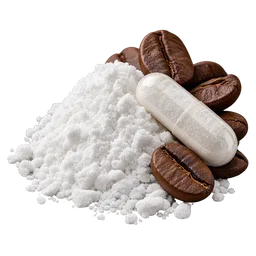
Caffeine is a natural stimulant found in coffee beans, tea leaves, cacao, kola nuts, and guarana. Coffee feels familiar, but caffeine itself is the same active molecule whether it comes from a drink, gum, gel, or tablet.3
Bottom line
Caffeine suits adults who want a reliable, short term boost for demanding focus or a modest edge in endurance work.12 Skip the casual high dose approach if caffeine makes you anxious, disrupts your sleep, triggers palpitations, or if you use medicines with important caffeine interactions. People with heart rhythm concerns, seizure history, or pregnancy questions should get individualized medical advice before using it regularly.3
Co-studied with
 Theanine20 shared
· d=0.60
Theanine20 shared
· d=0.60 Taurine13 shared
· d=0.99
Taurine13 shared
· d=0.99- Glucuronolactone13 shared · d=0.99
 Glucose13 shared
· d=0.99
Glucose13 shared
· d=0.99 Tyrosine11 shared
· d=0.50
Tyrosine11 shared
· d=0.50
Common questions
How much caffeine helps focus?
Is caffeine useful before endurance exercise?
How late is too late for caffeine?
Can caffeine make you feel calmer?
Sources
Sources
- 1. Caffeine as an attention enhancer (2010) ↑
- 2. Caffeine's effects on physical and cognitive performance: fatigue, task performance, alertness, and sleep deprivation (2012) ↑
- 3. The Safety of Ingested Caffeine: A Comprehensive Review (2017) ↑
- 4. Caffeine effects on sleep when taken 0, 3, or 6 hours before going to bed (2013) ↑
Generated August 27, 2026
Related
More evidence for Caffeine
Evidence guide
Caffeine
NewWide Awake, Wise to the Buzz: How a 500-Year Habit Became a Precision Tool
Evidence guide
Apr 20, 2026
Ranking
Staying asleep through the night
NewBest Supplements to Stay Asleep Through the Night
Evidence ranking
Apr 4, 2026
Evidence map
Focus & memory
NewFocus & memory: evidence map across 45 supplements
Evidence coverage map
Jul 30, 2026
Evidence map
Sleep
NewSleep: evidence map across 37 supplements
Evidence coverage map
Jul 30, 2026
Evidence map
Stress
NewStress: evidence map across 46 supplements
Evidence coverage map
Jul 30, 2026
Ingredient evidence
Ingredient evidence
NewBacopa
All scored outcomes
Aug 27, 2026