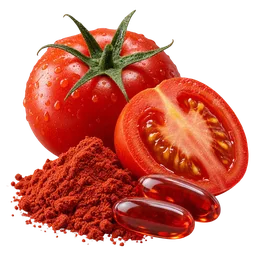
Lycopene
Best for
Lower prostate cancer risk
Barely detectable 5–30 mg/day 26–39 weeks 3 meta-analyses, n=259 #4 of 5 studied
- 37 papers
- 1 of 54 outcomes
- 1 positive
- 2 severe, 1 major interaction
Lycopene offers a barely detectable signal for lower prostate cancer risk, while evidence across its broader health outcomes remains too limited for strong prevention claims.
Median effective dose, most-studied outcomes
- Reduce prostate cancer risk 5 mg/kg/day 26–39 wk
- Keep prostate PSA levels steady 22.5 mg 26 wk
Risk, worst reported severity
- hepatitis E (acute viral hepatitis) severe
- pulmonary embolus severe
- ethanol (alcohol) major
- colistin moderate
What lycopene actually does
| Outcome | Effect | Evidence | Dose | Time | Rank |
|---|---|---|---|---|---|
| Early research 1 | |||||
| Lower prostate cancer risk Barely detectable Prostate cancer risk is the chance of developing cancer in the prostate. | | 3 meta-analyses 4 papers · n=259 | 5–30 mg | 26–39 wk | #4 /5 |
Effect tiers come from native-unit MCID where available, Cohen's d otherwise.
Dose, timing & forms
How much
The prostate-focused trials used oral lycopene protocols ranging from 15 to 30 mg per day, with one study using tomato sauce and another using a supplement. 1 2 Some research also used weight-based dosing around 5 mg per kg per day, but the small, early evidence base does not establish a dose for lowering prostate cancer risk or controlling prostate-specific antigen. 1 2
When and how long
Think daily consistency, not an occasional capsule. The prostate trials followed participants for about 26 to 39 weeks, so their designs do not support judging results after a short trial. 1 2 Take lycopene with a meal that contains some fat, since dietary fat increases absorption from tomato sauce. 3
Forms & standardisation
Both tomato-based foods and supplements have appeared in small prostate studies, so there is no proven winner between a capsule and food. 1 2 If you choose a supplement, look for a label that clearly states the amount of lycopene rather than relying on a vague "tomato complex" amount. Pairing either form with food containing fat makes practical sense because lycopene absorption rises with fat in the meal. 3
Studied range, by outcome
| Outcome | Studied range | Median effective | Duration | Evidence |
|---|---|---|---|---|
| Reduce prostate cancer risk | 5 mg/kg/day | 5 mg/kg/day | 26–39 wk | 3 papers 2 sig. endpoints |
| Keep prostate PSA levels steady | 15–30 mg | 22.5 mg | 26 wk | 2 papers 1 sig. endpoint |
Adverse events and drug interactions
Safety events
Drug interactions
Recommended Lycopene products
Real products that dose Lycopene where the research does, in a clean formulation, from brands we've audited. We only list ones we'd stand behind.
-

NOW
Lycopene 10 mg
Well dosed 30 mg/day A formulaBrand audit 87/100
-

Protocol For Life Balance
Lyc-O-Mato 20 mg
Well dosed 20 mg/day A formulaBrand audit 86/100
-

Doctor's Best
Lycopene With Lyc-O-Mato 10 mg
Well dosed 20 mg/day A formulaBrand audit 82/100
-

Pure Encapsulations
Lycopene 10 mg
Well dosed 30 mg/day A formulaBrand audit 78/100
-

Swanson
Lycopene 20 mg
Well dosed 20 mg/day A formulaBrand audit 69/100
-

Puritan's Pride
Lycopene 40 mg
Well dosed 40 mg/day A formulaBrand audit 68/100
Chosen for adequate Lycopene dosing vs. the studied range, a clean formulation (grade A–C), and independent brand-quality audits. Not sponsored.
What this is and how it works
- Across 4 studies (n=259), lycopene showed a positive direction for lower prostate cancer risk across 20 endpoints.1
- The reviewed evidence spans 37 papers and 54 outcomes, with prostate findings concentrated in small early studies.
- Localized prostate cancer populations and differing lycopene formulations limit confident conclusions about cancer prevention.1
Lycopene settles into fatty cell membranes, where it helps intercept unstable oxygen molecules before they trigger a chain reaction, like a firebreak stopping sparks from hopping across dry grass. 1 2 Its fat-soluble structure also explains why a meal with fat increases absorption from tomato foods. 3
Bottom line
Lycopene suits someone who wants a food-first carotenoid and understands that its prostate evidence is still early. It is not a proven strategy for preventing prostate cancer or managing a rising prostate-specific antigen result. 1 2 If you are in cancer treatment, have liver concerns, or use regular medicines, discuss supplements with your clinician before starting one.
Common questions
Does lycopene lower prostate cancer risk?
Is tomato sauce as good as a lycopene supplement?
How long does lycopene take to work?
Sources
Sources
Generated August 27, 2026