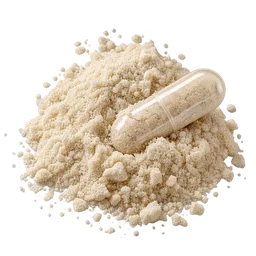
Bacillus Subtilis
What the trials found
Bacillus subtilis lacks sufficient human evidence for reliable benefits across everyday health outcomes, because one reviewed paper cannot establish a consistent or meaningful effect.
- 1 papers
- 0 of 12 outcomes
- 2 severe
Dose, timing & forms
How much
The reviewed evidence base contains only one paper, so it does not establish a trustworthy general dose for consumer goals. Do not treat a label's colony-forming-unit count as proof that a particular dose improves digestion, inflammation, blood sugar, or cardiovascular markers.
When and how long
There is not enough clinical evidence to recommend a best time of day, whether to take it with food, or whether doses need splitting. If you and a clinician decide to use a product, follow that specific product's label rather than assuming timing advice from other probiotic strains applies to Bacillus subtilis.
Forms & standardisation
Look for the full strain name, not just “Bacillus subtilis.” Probiotic effects often depend on the exact strain, and the spore form is the defining feature that gives this organism its unusual survival advantage.1 Current evidence does not identify a best-supported strain or standardization target for broad consumer use.
Adverse events and drug interactions
Safety events
What this is and how it works
- One reviewed paper provides no reliable quantitative effect estimate across the strongest outcomes 1.
- The review covers one paper spanning 12 outcomes, limiting conclusions about Bacillus subtilis supplements.
- People with impaired immune defenses should avoid self-directed use because probiotic infection risk deserves medical guidance.
Bacillus subtilis is a bacterium found in soil and fermented foods. In supplements, it appears as a spore, a compact dormant form that tolerates conditions that destroy many live bacteria.1
Its spore works like a seed in a sealed packet: it stays inactive through rough conditions, then can wake up when the environment becomes favorable in the digestive tract.1 That survival trait explains why manufacturers use it in shelf-stable probiotic products, but it does not by itself establish a specific health outcome in people.
Bottom line
Bacillus subtilis is interesting because its spores are built to survive the trip through the digestive system. Still, one reviewed paper is nowhere near enough to make strong promises about everyday health goals. Skip self-directed use if you have impaired immune defenses or other reasons to take infection risk seriously.
Common questions
What is Bacillus subtilis used for?
Is Bacillus subtilis a probiotic?
Should everyone take Bacillus subtilis?
Sources
Sources
- 1. Bacillus probiotics (2011) ↑
Generated August 27, 2026