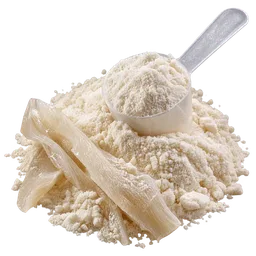
Collagen Peptides
Best for
Ease joint pain
Likely strong benefit 2–10.728 g/day 8–26 weeks 2 meta-analyses, n=2.1k #5 of 23 studied
- 46 papers
- 9 of 92 outcomes
- 7 positive
Collagen peptides show a likely strong benefit for activity-related joint pain, with additional support for skin moisture, while evidence spans many outcomes rather than one universal effect.
Risk, worst reported severity
- gastrointestinal discomfort (dyspepsia, flatulence, reflux esophagitis, appetite loss) mild
- skin irritation mild
What collagen peptides actually does
Skin texture and visible pores shape whether the surface looks even and refined. 26561784 · 29949889 · 33521019 +3
Facial wrinkles are lines and creases that become more visible as skin changes over time. 29949889 · 34443468 · 40935395
Skin radiance is the healthy-looking brightness that gives the complexion a natural glow. 34959923
| Outcome | Effect | Evidence | Dose | Time | Rank |
|---|---|---|---|---|---|
| Strong benefits 1 | |||||
| Ease joint pain Likely strong benefit Comfortable joints can make walking, stairs, and everyday movement easier. | | 2 meta-analyses 11 papers · n=2.1k | 2–10.728 g | 8–26 wk | #5 /23 |
| Clear benefits 1 | |||||
| More hydrated skin Proven benefit Hydrated skin holds water and can feel less dry, tight, or rough. | | 9 RCTs 9 papers · n=445 | 0.5–10 g | 8–13 wk | #1 /15 |
| Modest benefits 2 | |||||
| Firmer-looking skin Proven modest benefit Skin firmness shapes how taut and resilient the skin looks and feels. | | 10 RCTs 10 papers · n=428 | 0.5–10 g | 8–26 wk | #1 /7 |
| Feel less pain Likely real but unnoticeable Pain relief can make it easier to move, rest, focus, and get through the day. | | 1 meta-analysis 2 papers · n=327 | 10.728 g | 26 wk | — |
| Worth watching 1 | |||||
| Reduce visible sun damage Promising early signal Sun damage can leave skin with uneven tone, roughness, and other signs of photoaging. | | 2 RCTs 2 papers · n=152 | 1000 mg | 12 wk | #1 /3 |
| Early research 3 | |||||
| Smoother-looking skin Faint early signal Skin texture and visible pores shape whether the surface looks even and refined. | | 6 RCTs 6 papers · n=282 | 1–10 g | 8–26 wk | #1 /3 |
| Less noticeable facial wrinkles Faint early signal Facial wrinkles are lines and creases that become more visible as skin changes over time. | | 3 RCTs 3 papers · n=53 | 500–1650 mg | 8–13 wk | #2 /4 |
| More radiant-looking skin Not enough research Skin radiance is the healthy-looking brightness that gives the complexion a natural glow. | | 1 RCT 1 papers · n=44 | 1000 mg | 12 wk | — |
| Doesn't appear to help 1 | |||||
| Move with less stiffness Probably doesn't help Stiff joints can make everyday movements feel restricted or uncomfortable. | | 1 meta-analysis 5 papers · n=667 | 3–10 g | 5–26 wk | #8 /10 |
Effect tiers come from native-unit MCID where available, Cohen's d otherwise.
Dose, timing & forms
How much
For the best-supported goal, joint pain, studies use roughly 2 to 10.7 g daily of collagen peptides. A notable 24-week joint-pain trial used 10 g daily of collagen hydrolysate.1 Skin-moisture and elasticity studies span about 0.5 to 10 g daily, with benefits assessed after several weeks of steady use rather than after a single serving.23
When and how long
Trial protocols emphasize taking collagen every day, not saving it for hard workouts or painful days.12 There is no convincing evidence that morning versus evening changes the result, so attach it to a routine you actually keep. If it causes reflux, gas, or an unsettled stomach, taking it with food is a sensible practical adjustment.
Forms & standardisation
Choose hydrolyzed collagen peptides or collagen hydrolysate, the broken-down form used in the key skin and joint trials.12 Labels sometimes highlight bovine or marine origin, but no strong head-to-head evidence proves one source works best for everyone. Prioritize a product that states the peptide form and daily amount clearly, rather than one that leans on vague "collagen complex" marketing.3
Adverse events and drug interactions
Safety events
Recommended Collagen Peptides products
Real products that dose Collagen Peptides where the research does, in a clean formulation, from brands we've audited. We only list ones we'd stand behind.
-

Nature's Answer
Multi Collagen
Well dosed 1,500 mg/day A formulaBrand audit 75/100
-

Life Extension
Collagen Peptides for Skin & Joints
Well dosed 11.1 Gram(s)/day A formulaBrand audit 90/100
-

NOW
Collagen Peptides Powder
Well dosed 10 Gram(s)/day A formulaBrand audit 87/100
-

Allergy Research Group
Arthred Collagen Formula
Well dosed 10.5 Gram(s)/day A formulaBrand audit 83/100
-

Allergy Research Group
Arthred
Well dosed 10.5 Gram(s)/day A formulaBrand audit 83/100
-

Bluebonnet
Hydrolyzed Collagen Powder
Well dosed 12 Gram(s)/day A formulaBrand audit 82/100
Chosen for adequate Collagen Peptides dosing vs. the studied range, a clean formulation (grade A–C), and independent brand-quality audits. Not sponsored.
What this is and how it works
- Eleven studies (n=2,061) assessed reduced activity-related joint pain across 52 endpoints, with positive results.1
- Forty-six papers reviewed here span 92 outcomes, including joint comfort, skin moisture, and skin aging.
- Evidence varies by outcome, formulation, dose, and population, so joint-pain findings should not be generalized to every collagen claim.
Collagen peptides are small protein fragments made by breaking down collagen from animal connective tissues. Your body digests them into amino acids and short peptides, rather than sending an intact scoop of collagen straight to your skin or joints.5
After you swallow collagen peptides, short fragments enter the bloodstream and reach body tissues.5 Think of them as delivery slips at a repair shop: they provide raw protein building blocks and send signals that encourage collagen-making skin cells to maintain the skin's support network.24 That mechanism fits the observed improvements in skin moisture and elasticity, although it does not guarantee dramatic cosmetic change for every person.3
Bottom line
Collagen peptides make the most sense if joint pain limits activity or if skin moisture is your main goal. Expect a useful but gradual change, not a facelift in a tub, and do not count on it to meaningfully ease stiffness after rest.13 Skip it if animal-derived products do not fit your diet, and choose another option if it consistently causes digestive discomfort.
Common questions
Do collagen peptides actually help joint pain?
Do collagen peptides reduce wrinkles?
How long do collagen peptides take to work?
Is marine collagen better than bovine collagen?
Sources
Sources
- 1. 24-Week study on the use of collagen hydrolysate as a dietary supplement in athletes with activity-related joint pain (2008) ↑
- 2. Oral supplementation of specific collagen peptides has beneficial effects on human skin physiology: a double-blind, placebo-controlled study (2014) ↑
- 3. Effects of hydrolyzed collagen supplementation on skin aging: a systematic review and meta-analysis (2021) ↑
- 4. The effect of oral collagen peptide supplementation on skin moisture and the dermal collagen network: evidence from an ex vivo model and randomized, placebo-controlled clinical trials (2015) ↑
- 5. Identification of food-derived collagen peptides in human blood after oral ingestion of gelatin hydrolysates (2005) ↑
Generated August 27, 2026