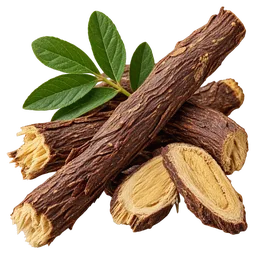
Licorice
Best for
Ease indigestion
Likely benefit 75–150 mg/day 4 weeks 1 meta-analysis, n=300 #1 of 10 studied
- 19 papers
- 1 of 54 outcomes
- 1 positive
- 2 life-threatening, 2 major interactions
Licorice likely benefits adults with post-meal indigestion, with the clearest evidence supporting short-term relief from functional dyspepsia and reflux-type upper-stomach discomfort.
Median effective dose, most-studied outcomes
- Reduce acid backflow and burning 150 mg 4 wk
- Settle upper-stomach discomfort 75 mg 4 wk
Risk, worst reported severity
- hypokalaemia life-threatening
- ventricular arrhythmia life-threatening
- warfarin major
- digoxin major
What licorice actually does
| Outcome | Effect | Evidence | Dose | Time | Rank |
|---|---|---|---|---|---|
| Clear benefits 1 | |||||
| Ease indigestion Likely benefit Indigestion can cause upper-belly discomfort, early fullness, or burning after meals. | | 1 meta-analysis 3 papers · n=300 | 75–150 mg | 4–4 wk | #1 /10 |
Effect tiers come from native-unit MCID where available, Cohen's d otherwise.
Dose, timing & forms
How much
For upper-stomach discomfort and reflux-type burning, the studied extract range is 75 to 150 mg daily over roughly four weeks. The strongest direct trial for functional indigestion used 75 mg twice daily of a flavonoid-rich licorice root extract for 30 days and found better symptom improvement than placebo.1 Treat these as extract-specific trial amounts, not a conversion for candy, tea, or unstandardized root powder.
When and how long
Use licorice as a daily trial rather than an occasional rescue after a rich meal. The functional-indigestion protocol split the extract into twice-daily doses for about a month, which keeps exposure steady and gives symptoms time to change.1 Take it exactly as the product label directs, and stop rather than increasing the dose if you notice swelling, weakness, palpitations, or muscle cramps because those can signal licorice-related electrolyte trouble.23
Forms & standardisation
The best direct coverage for indigestion comes from a defined, flavonoid-rich Glycyrrhiza glabra root extract, not from licorice candy or a generic tea.1 Look for the botanical name, extract amount, and a clear statement of whether the product is deglycyrrhizinated. DGL products remove much of glycyrrhizin, the component tied to the kidney and potassium effects of regular licorice.2
Studied range, by outcome
| Outcome | Studied range | Median effective | Duration | Evidence |
|---|---|---|---|---|
| Reduce acid backflow and burning | 75–150 mg | 150 mg | 4 wk | 2 papers 8 sig. endpoints |
| Settle upper-stomach discomfort | 75 mg | 75 mg | 4 wk | 2 papers 4 sig. endpoints |
Adverse events and drug interactions
Safety events
Drug interactions
Recommended Licorice products
Real products that dose Licorice where the research does, in a clean formulation, from brands we've audited. We only list ones we'd stand behind.
-

Nature's Way
DGL Ultra
Well dosed 150 mg/day B formulaBrand audit 72/100
-

NOW
Ginseng & Royal Jelly
Well dosed 200 mg/day B formulaBrand audit 87/100
-

Puritan's Pride
Ultimate Digestive Complex
Well dosed 150 mg/day A formulaBrand audit 68/100
-

Pure Encapsulations
ADR Formula
Well dosed 100 mg/day A formulaBrand audit 78/100
-

Pure Encapsulations
Heartburn Essentials
Well dosed 100 mg/day A formulaBrand audit 78/100
-

Seeking Health
Optimal Adrenal
Well dosed 100 mg/day A formulaBrand audit 85/100
Chosen for adequate Licorice dosing vs. the studied range, a clean formulation (grade A–C), and independent brand-quality audits. Not sponsored.
What this is and how it works
- Three studies (n=300) reported improved post-meal indigestion symptoms with standardized licorice extract.1
- Nineteen papers reviewed here span 54 outcomes, with strongest evidence concentrated in functional dyspepsia symptom relief.
- Evidence applies to specific standardized extracts; regular licorice carries blood-pressure, potassium, and heart-rhythm risks.23
Licorice comes from the root of Glycyrrhiza glabra, a plant used in teas, sweets, and traditional remedies. Supplement labels can describe whole-root powder, concentrated root extract, or deglycyrrhizinated licorice, often shortened to DGL. Those are not interchangeable products because their glycyrrhizin content differs sharply.2
The digestive trials show symptom relief, but they do not pin that relief on one proven molecule or pathway.1 Its best-established body effect involves glycyrrhizin: it blocks an enzyme that normally stops cortisol from switching on the kidney's salt-saving signal, like disabling the bouncer who keeps the wrong guest out of a locked room. That can drive sodium retention and potassium loss, which explains why regular licorice deserves more caution than its candy-like reputation suggests.2
Bottom line
A standardized licorice extract is a reasonable short-term option for adults whose main issue is post-meal upper-stomach discomfort or reflux-type burning, especially if they want an herbal option with direct trial data.1 Skip regular licorice extracts if you use digoxin, warfarin, or blood-thinning medicines, or if low potassium and heart-rhythm risks apply to you. This is one supplement where the form on the label matters as much as the name on the front.23
Common questions
Does licorice help indigestion?
Is deglycyrrhizinated licorice safer than regular licorice?
How long does licorice take to work for reflux symptoms?
Who should avoid licorice supplements?
Sources
Sources
Generated August 27, 2026