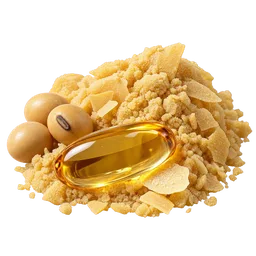
Phospholipid
What the trials found
Phospholipid products do not have a clear, consistent benefit across common health outcomes, because formulations, doses, and clinical evidence vary too widely to treat the ingredient label as one intervention.
- 3 papers
- 0 of 11 outcomes
- 1 major interaction
Risk, worst reported severity
- Suspected allergic reaction leading to study dropout
- nausea
- ceftolozane moderate
Dose, timing & forms
How much
There is no evidence-backed general dose range for an unspecified phospholipid supplement. The reviewed human papers cover too few products and too many different outcomes to turn their protocols into one practical recommendation.1 Use the dose on a product label only after confirming the exact phospholipid ingredient and discussing it with a qualified clinician or pharmacist, especially if you use medication.
When and how long
The available clinical evidence does not establish a best time of day, meal timing, or split-dose schedule for phospholipids as a broad category.1 Timing guidance needs to come from research on the exact ingredient, not from the word “phospholipid” alone. Until then, consistency with the product label matters more than chasing a supposedly optimal hour.
Forms & standardisation
The key label detail is the named phospholipid, not the front-label family term. Check whether the product identifies a specific compound, such as phosphatidylcholine or phosphatidylserine, its source, and the amount per serving.2 Do not assume that lecithin, a concentrated phospholipid extract, and a single purified phospholipid are interchangeable in either dose or expected effect.1
Adverse events and drug interactions
Safety events
Drug interactions
What this is and how it works
- Three papers reviewed here span 11 outcomes, but available information does not establish a consistent effect size or noticeable-change threshold.1
- Phospholipid is a family label, so findings for one formulation, dose, or population cannot automatically transfer.
- People with prior reactions or concurrent medicines should seek pharmacist or clinician guidance before trying a phospholipid product.
Phospholipids are fatty compounds that make up a large part of cell membranes. Think of them as the waterproof tiles in a cell’s outer wall: they help create a flexible barrier that keeps the cell’s inside separate from its surroundings.2 Supplements sold under this broad name can differ sharply in source, purity, and the specific phospholipids they contain.1
A phospholipid can become part of membrane structures or carry fat-soluble material through the body, but its effects depend on its exact chemical type and formulation.2 That is why findings from one phospholipid preparation do not automatically transfer to another product labeled simply “phospholipid.”1
Bottom line
Skip vague phospholipid products if you want a supplement with a clear, evidence-backed goal and dose. The limited, mixed clinical base does not support treating all phospholipid formulations as the same.1 People who have reacted to a similar product, or who take medicines, should get pharmacist or clinician guidance before trying one.
Common questions
What is an unspecified phospholipid supplement?
Do phospholipid supplements have proven benefits?
Is lecithin the same as a phospholipid supplement?
Sources
Sources
Generated August 27, 2026