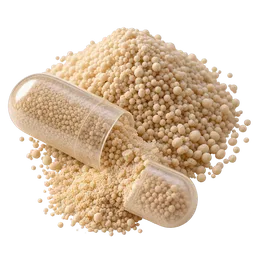
Saccharomyces boulardii
Best for
Reduce diarrhea
Likely strong benefit 1 weeks 1 meta-analysis, n=927 #3 of 16 studied
- 5 papers
- 2 of 5 outcomes
- 2 positive
Saccharomyces boulardii provides a likely strong benefit for shortening acute diarrhea episodes, while evidence for other digestive outcomes is less consistent.
Risk, worst reported severity
- nausea mild
- skin rash mild
- amoxicillin minor
- vonoprazan minor
What saccharomyces boulardii actually does
People taking antibiotics can develop diarrhea that interrupts treatment and daily life. 26955289
| Outcome | Effect | Evidence | Dose | Time | Rank |
|---|---|---|---|---|---|
| Strong benefits 1 | |||||
| Reduce diarrhea Likely strong benefit Diarrhea brings loose, watery stools that can disrupt daily life and cause dehydration. | | 1 meta-analysis 2 papers · n=927 | — | 1 wk | #3 /16 |
| Modest benefits 1 | |||||
| Prevent diarrhea from antibiotics Likely modest benefit People taking antibiotics can develop diarrhea that interrupts treatment and daily life. | | 1 meta-analysis 1 papers · n=8.0k | — | — | #2 /4 |
Effect tiers come from native-unit MCID where available, Cohen's d otherwise.
Dose, timing & forms
How much
For acute diarrhea, a commonly studied approach uses 250 mg twice daily for about 5 days, alongside oral rehydration rather than instead of it.1 Research on antibiotic-associated diarrhea also commonly uses divided daily doses throughout the antibiotic course, although the benefit is smaller than the effect seen for shortening an active diarrhea episode.2
When and how long
Take it every day during the short period when symptoms or antibiotic exposure create the problem. Splitting the daily amount into morning and evening doses matches common trial routines and keeps the yeast moving through the gut regularly.12 You can take it with or without food. If it unsettles your stomach, taking it with a meal is the practical choice.
Forms & standardisation
Look for a product that names the full strain, Saccharomyces boulardii, rather than a vague "probiotic blend." The clinical literature centers on live, dried S. boulardii preparations, often labeled in milligrams or colony-forming units.13 Avoid combining it with antifungal medication, since antifungals target yeast and can cancel out the supplement.
Adverse events and drug interactions
Safety events
Drug interactions
What this is and how it works
- Across 2 studies (n=927), Saccharomyces boulardii shortened acute diarrhea episodes, supporting a strong benefit. 1
- Five papers reviewed here spanned five outcomes, with strongest evidence focused on short-term diarrhea recovery.
- Evidence primarily supports short-term use alongside hydration, not every digestive complaint.
Saccharomyces boulardii is a strain of beneficial yeast, originally isolated from tropical fruit. Unlike many bacterial probiotics, it passes through your digestive tract temporarily rather than setting up permanent residence, so its value depends on taking it consistently during the window you need it.3
Think of it as a temporary cleanup crew in your gut: it can interfere with certain bacterial toxins and help reinforce the intestinal lining while it travels through.3 Those actions give the bowel less reason to dump water into the intestine, which fits the shorter diarrhea episodes seen in clinical trials.1
Bottom line
Saccharomyces boulardii is a sensible short-term option if you want to recover from uncomplicated acute diarrhea sooner, especially alongside proper hydration.1 It also offers a smaller layer of protection against diarrhea during antibiotics.2 Skip self-treatment and get medical advice if symptoms are severe, persistent, or you are in a high-risk medical group.3
Common questions
Does Saccharomyces boulardii stop diarrhea?
Should you take Saccharomyces boulardii with antibiotics?
Who should avoid Saccharomyces boulardii?
Sources
Sources
- 1. Role of a probiotic Saccharomyces boulardii in management and prevention of diarrhoea (2006) ↑
- 2. Systematic review and meta-analysis of Saccharomyces boulardii in adult patients (2010) ↑
- 3. Efficacy and safety of the probiotic Saccharomyces boulardii for the prevention and therapy of gastrointestinal disorders (2012) ↑
Generated August 27, 2026
Related
More evidence for Saccharomyces boulardii
Evidence guide
Saccharomyces boulardii
NewThe Yeast That Outsmarts Antibiotics: From Jungle Fruit Skins to Hospital Wards—and What Comes Next
Evidence guide
Apr 26, 2026
Ingredient evidence
Ingredient evidence
NewLactococcus acidophilus
All scored outcomes
Aug 27, 2026
Ingredient evidence
Ingredient evidence
NewLactobacillus rhamnosus
All scored outcomes
Aug 27, 2026