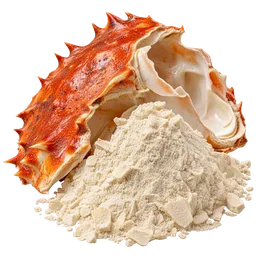
Chitosan
Best for
Lose weight
Proven modest benefit 0.34–3.4 g/day 8–52 weeks 3 meta-analyses, n=3.2k #3 of 72 studied
- 19 papers
- 3 of 44 outcomes
- 2 positive
- 2 major interactions
Chitosan provides a Proven modest benefit for weight reduction in adults with overweight or obesity, while cholesterol improvements are likely too small to notice.
Median effective dose, most-studied outcomes
- Weight relative to height 3,000 mg 8–52 wk
- Move toward a healthier weight 3,000 mg 8–52 wk
- Lower LDL cholesterol 3,000 mg 8–52 wk
Risk, worst reported severity
- Potential fat-soluble vitamin malabsorption (theoretical)
- Fecal impaction (fecalomas) requiring treatment withdrawal
- warfarin major
- acenocoumarol major
What chitosan actually does
| Outcome | Effect | Evidence | Dose | Time | Rank |
|---|---|---|---|---|---|
| Modest benefits 2 | |||||
| Lose weight Proven modest benefit Weight loss means carrying less total body weight over time. | | 3 meta-analyses 12 papers · n=3.2k | 0.34–3.4 g | 8–52 wk | #3 /72 |
| Lower cholesterol Proven but unnoticeable High LDL cholesterol can build up in artery walls and raise the risk of heart disease. | | 2 meta-analyses 10 papers · n=2.7k | 0.34–3.4 g | 8–52 wk | — |
| Early research 1 | |||||
| Lose body fat Not enough research Body fat loss changes the proportion of your body that is fat tissue. | | 3 RCTs 3 papers · n=159 | 2500–3000 mg | 12–13 wk | — |
Effect tiers come from native-unit MCID where available, Cohen's d otherwise.
Dose, timing & forms
How much
For the best-studied outcome, weight change, trials used roughly 800 to 3,200 mg daily, with 3,000 mg daily common in protocols that reported benefit. 1 Studies evaluating LDL and total cholesterol also commonly used doses around 1,500 to 3,200 mg daily, but the average cholesterol effect was trivial. 2 Body-fat findings are earlier and come from a much smaller set of trials, so they do not justify chasing a higher dose. 1
When and how long
The research tests chitosan as a daily routine over weeks, not as an occasional response to a rich meal. 12 Trial evidence does not establish a single best time of day or prove that taking it with a particular meal produces better results. Follow the product directions, and give extra attention to spacing if you take medicines or other supplements because chitosan can interfere with absorption.
Forms & standardisation
Look for a product that clearly identifies chitosan and provides the amount per daily serving. Clinical reviews combine products with different processing details, so evidence does not establish one molecular weight or degree of deacetylation as the clear winner. 12 A shellfish-derived product is common, while fungal-source chitosan offers an alternative for people avoiding crustacean origin. 1
Studied range, by outcome
| Outcome | Studied range | Median effective | Duration | Evidence |
|---|---|---|---|---|
| Weight relative to height | 800–3,200 mg | 3,000 mg | 8–52 wk | 11 papers 6 sig. endpoints |
| Move toward a healthier weight | 800–3,200 mg | 3,000 mg | 8–52 wk | 11 papers 8 sig. endpoints |
| Lower LDL cholesterol | 1,500–3,200 mg | 3,000 mg | 8–52 wk | 9 papers 2 sig. endpoints |
| Lower total cholesterol | 1,500–3,200 mg | 3,000 mg | 8–52 wk | 9 papers 3 sig. endpoints |
| Reduce total body fat | 2,500–3,000 mg | 2,500 mg | 12–13 wk | 3 papers 3 sig. endpoints |
Adverse events and drug interactions
Safety events
Drug interactions
What this is and how it works
- Across 12 studies (n=3,246), chitosan reduced body weight modestly in adults with overweight or obesity.1
- The reviewed evidence spans 19 papers and 44 outcomes, including 10 studies measuring cholesterol changes.12
- Chitosan’s cholesterol reduction was proven but unnoticeable, limiting its practical value for heart-risk improvement.2
Chitosan is a fiber-like substance made by processing chitin, the tough material in crustacean shells. When you swallow it, it largely stays inside your digestive tract rather than acting like a stimulant or an appetite drug. 1
Chitosan carries a positive electrical charge that can grab negatively charged bile acids and some dietary fats in the gut, like lint clinging to a charged sweater. Your body then uses cholesterol to replace some lost bile acids, but the measured cholesterol change remains trivial on average. 2
Bottom line
Chitosan fits someone who wants a modest, realistic extra tool for weight management and already plans to focus on food habits and activity. Skip the hype around fat blocking: average weight effects are small and cholesterol changes are trivial. 12 Avoid self-starting it if you use warfarin or other medicines with absorption or clotting concerns, and get clinician or pharmacist guidance first.
Common questions
Does chitosan actually help you lose weight?
Does chitosan lower cholesterol?
How long does chitosan take to work?
Is chitosan made from shellfish?
Sources
Sources
Generated August 27, 2026
Related
More evidence for Chitosan
Evidence map
Metabolic health
NewMetabolic health: evidence map across 82 supplements
Evidence coverage map
Jul 30, 2026
Ingredient evidence
Ingredient evidence
NewAsian Psyllium
All scored outcomes
Aug 27, 2026
Ingredient evidence
Ingredient evidence
NewBerberine
All scored outcomes
Aug 27, 2026
Ingredient evidence
Ingredient evidence
NewBrown Seaweed and Kelp
All scored outcomes
Aug 27, 2026
Ingredient evidence
Ingredient evidence
NewCapsaicin
All scored outcomes
Aug 27, 2026
Ingredient evidence
Ingredient evidence
NewChlorogenic Acid
All scored outcomes
Aug 27, 2026