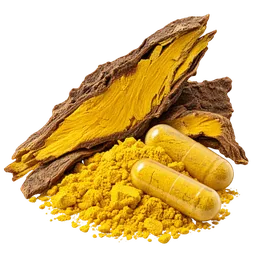
Berberine
Best for
Avoid sharp blood sugar rises after meals
Likely strong benefit 12–16 weeks 6 meta-analyses, n=9.3k #3 of 42 studied
- 40 papers
- 7 of 58 outcomes
- 7 positive
- 4 severe, 8 major interactions
Berberine delivers a likely strong benefit for flattening after-meal glucose rises, while evidence across cholesterol, weight, and other outcomes is less consistent.
Median effective dose, most-studied outcomes
- Lower total cholesterol 1,000 mg 4–54 wk
- Lower your triglyceride level 1,000 mg 4–54 wk
- Lower LDL cholesterol 1,000 mg 4–54 wk
Risk, worst reported severity
- acute cholecystitis (hospitalization, cholecystectomy) severe
- acute myocardial infarction severe
- cyclosporine major
- various CYP3A4 substrates (e.g., cyclosporine, indinavir) major
What berberine actually does
High LDL cholesterol can build up in artery walls and raise the risk of heart disease. 23118793 · 23512497 · 27446224 +17
High androgens in PCOS can contribute to acne, excess facial hair, and scalp hair thinning. 34444711
| Outcome | Effect | Evidence | Dose | Time | Rank |
|---|---|---|---|---|---|
| Strong benefits 1 | |||||
| Avoid sharp blood sugar rises after meals Likely strong benefit Blood sugar normally rises after eating, but a smaller rise can make levels easier to manage. | | 6 meta-analyses 12 papers · n=9.3k | — | 12–16 wk | #3 /42 |
| Clear benefits 2 | |||||
| Keep blood sugar steadier Proven benefit Steadier blood sugar can help avoid highs and lows that affect how you feel. | | 9 meta-analyses 18 papers · n=15k | — | 6–54 wk | #2 /86 |
| Improve insulin sensitivity Likely benefit Insulin sensitivity describes how well the body responds to insulin to move sugar out of the blood. | | 5 meta-analyses 9 papers · n=5.3k | 0.3–9 g | 8–54 wk | #2 /76 |
| Modest benefits 3 | |||||
| Lower cholesterol Likely modest benefit High LDL cholesterol can build up in artery walls and raise the risk of heart disease. | | 11 meta-analyses 20 papers · n=12k | 0.2–9 g | 4–54 wk | — |
| Lower triglycerides Likely modest benefit High triglycerides are blood fats linked with a higher risk of heart disease. | | 11 meta-analyses 18 papers · n=12k | 0.2–9 g | 4–54 wk | #6 /80 |
| Lose weight Proven but unnoticeable Weight loss means carrying less total body weight over time. | | 7 meta-analyses 14 papers · n=5.3k | — | 6–54 wk | #7 /72 |
| Early research 1 | |||||
| Lower high androgens in PCOS Barely detectable High androgens in PCOS can contribute to acne, excess facial hair, and scalp hair thinning. | | 2 RCTs 1 papers · n=80 | 1000 mg | 8–12 wk | #3 /9 |
Effect tiers come from native-unit MCID where available, Cohen's d otherwise.
Dose, timing & forms
How much
For steadier fasting and average glucose, the most useful signal clusters around 1,000 mg per day of oral berberine, although research doses span a much wider range. One influential three-month trial used 500 mg three times daily, while the reviewed glucose and cholesterol outcomes often center near 1,000 mg per day.14 Treat very high doses in the literature as study-specific protocols, not a reason to push your own dose upward.
When and how long
The key studies use berberine every day for weeks, not only after a heavy meal. A three-times-daily protocol spreads intake through the day, which fits berberine's strongest finding on after-meal glucose rather than relying on one large occasional dose.1 Most meaningful glucose and lipid results emerge over about 12 to 16 weeks of consistent use.14
Forms & standardisation
Look for a label that clearly states the amount of berberine hydrochloride, the form used in much of the clinical research. Skip products that hide the dose inside a proprietary blend, since you cannot match that product to trial dosing.14 Newer “enhanced absorption” versions do not automatically carry the same evidence as standard berberine hydrochloride.
Studied range, by outcome
| Outcome | Studied range | Median effective | Duration | Evidence |
|---|---|---|---|---|
| Lower total cholesterol | 200–9,000 mg | 1,000 mg | 4–54 wk | 18 papers 18 sig. endpoints |
| Lower your triglyceride level | 200–9,000 mg | 1,000 mg | 4–54 wk | 18 papers 17 sig. endpoints |
| Lower LDL cholesterol | 200–9,000 mg | 1,000 mg | 4–54 wk | 17 papers 15 sig. endpoints |
| Lower your fasting blood sugar | 300–9,000 mg | 1,000 mg | 6–54 wk | 15 papers 9 sig. endpoints |
| Limit after-meal glucose rises | 100–9,000 mg | 1,000 mg | 12–16 wk | 12 papers 12 sig. endpoints |
| Lower average blood sugar | 300–9,000 mg | 1,000 mg | 11–54 wk | 11 papers 9 sig. endpoints |
| Weight relative to height | 300–9,000 mg | 2,487.5 mg | 6–54 wk | 10 papers 4 sig. endpoints |
| Move toward a healthier weight | 500–6,250 mg | 1,250 mg | 6–54 wk | 10 papers 4 sig. endpoints |
| Help cells use insulin better | 300–9,000 mg | 2,487.5 mg | 8–54 wk | 7 papers 4 sig. endpoints |
| Use less insulin at rest | 300–9,000 mg | 1,000 mg | 12–54 wk | 5 papers 3 sig. endpoints |
| Make menstrual cycles more predictable | 360 mg | 360 mg | 13 wk | 1 paper 1 sig. endpoint |
| Support more regular ovulation with PCOS | 360 mg | 360 mg | 13 wk | 1 paper 1 sig. endpoint |
| Ease androgen excess in PCOS | 1,000 mg | — | 8–12 wk | 1 paper |
Adverse events and drug interactions
Safety events
Drug interactions
Recommended Berberine products
Real products that dose Berberine where the research does, in a clean formulation, from brands we've audited. We only list ones we'd stand behind.
-

Nootropics Depot
Berberine HCL Capsules 380 mg
Well dosed 1,520 mg/day A formulaBrand audit 87/100
-

Allergy Research Group
Berberine 500
Well dosed 1,500 mg/day B formulaBrand audit 83/100
-

SuperSmart
Berberine 1000 mg
Well dosed 1,000 mg/day A formulaBrand audit 63/100
-

XYMOGEN
ALAmax Protect
Well dosed 1,000 mg/day A formulaBrand audit 80/100
-

Thorne
Berberine
Well dosed 900 mg/day A formulaBrand audit 79/100
-

Double Wood Supplements
Berberine 500 mg
Well dosed 2,000 mg/day B formulaBrand audit 75/100
Chosen for adequate Berberine dosing vs. the studied range, a clean formulation (grade A–C), and independent brand-quality audits. Not sponsored.
What this is and how it works
- Across 12 studies (n=9,342), berberine reduced after-meal glucose rises; a validated MCID was not reported.1
- The review covered 40 papers and 58 outcomes, with strongest evidence centered on glucose control.4
- Berberine can inhibit human cytochrome P450 enzymes, creating prescription-drug interaction concerns.5
Berberine is a bright yellow plant compound found in several bitter herbs, including barberry and Coptis. Supplements isolate it into a measured capsule or tablet, rather than asking you to use the plants themselves.
Berberine switches on AMPK, a cell's fuel gauge. Think of AMPK as a phone entering low-power mode: it tells cells to pull more fuel from circulating glucose and spend it more carefully.2 It also increases the liver's LDL receptors, which work like extra loading docks that pull LDL particles out of the bloodstream.3
Bottom line
Berberine makes the most sense for someone focused on steadier glucose, especially after meals, who can use it consistently for several months.14 Keep expectations modest for cholesterol and do not buy it for weight loss. It is not a casual add-on if you take prescription medicines, because it can change how your body clears them.5
Co-studied with
- Drug:Amoxicillin14 shared · d=0.14
 Redyeastrice13 shared
· d=0.61
Redyeastrice13 shared
· d=0.61- Policosanol9 shared · d=0.59
- Drug:Rabeprazole7 shared · d=0.14
- Drug:Vonoprazan7 shared
- Silymarin4 shared · d=1.03
 Chitosan4 shared
· d=0.65
Chitosan4 shared
· d=0.65 Monacolin4 shared
· d=0.65
Monacolin4 shared
· d=0.65 Hydroxytyrosol4 shared
· d=0.65
Hydroxytyrosol4 shared
· d=0.65 Bifidobacteriumadolescentis4 shared
· d=0.46
Bifidobacteriumadolescentis4 shared
· d=0.46 Probiotics1 shared
· d=0.73
Probiotics1 shared
· d=0.73
Common questions
What does berberine do for blood sugar?
How long does berberine take to work?
Is berberine useful for weight loss?
Can berberine help with PCOS symptoms?
Does berberine interact with medications?
Sources
Sources
- 1. Efficacy of berberine in patients with type 2 diabetes mellitus (2008) ↑
- 2. Berberine, a natural plant product, activates AMP-activated protein kinase and has both lipid and glucose-lowering activities in 3T3-L1 adipocytes (2006) ↑
- 3. Berberine is a novel cholesterol-lowering drug working through a unique mechanism distinct from statins (2004) ↑
- 4. Berberine in the treatment of type 2 diabetes mellitus: a systematic review and meta-analysis (2012) ↑
- 5. Repeated administration of berberine inhibits cytochromes P450 in humans (2012) ↑
- 6. The effect of berberine on polycystic ovary syndrome patients with insulin resistance: A meta-analysis and systematic review (2019) ↑
Generated August 27, 2026
Related
More evidence for Berberine
Evidence guide
Berberine
NewFrom Monk's Yellow to Metabolic Clues: What Berberine Really Does (and Doesn't) Do
Evidence guide
May 1, 2026
Ranking
Fatty Liver Disease
NewBest Supplements for Fatty Liver Disease (NAFLD), Ranked by Evidence
Evidence ranking
Apr 4, 2026
Systematic review
Systematic review
NewBerberine for Metabolic Health: A Systematic Evidence Review
GRADE evidence review
May 25, 2026
Evidence brief
Berberine · Lower total cholesterol
NewBerberine for Total Cholesterol: What 23 Trials Show
Focused evidence brief
May 11, 2026
Evidence map
Metabolic health
NewMetabolic health: evidence map across 82 supplements
Evidence coverage map
Jul 30, 2026
Ingredient evidence
Ingredient evidence
NewBarberry (Berberis spp.)
All scored outcomes
Aug 27, 2026