New Fucoidan Published May 8, 2026
Fucoidan and the Seaweed Signal
A calmer, more resilient system rather than a dramatic felt effect
Evidence summary
Fucoidan does not yet show convincing symptom relief in humans, despite early microbiome and molecular-signaling changes in small placebo-controlled studies.
- Across 1 osteoarthritis trial, fucoidan did not beat placebo for symptom reduction.4
- Healthy-adult studies used a 4-week placebo design and a 1 g pilot dose, tracking microbiome and microRNA biomarkers.
- Fucoidan extracts vary by source and processing, so study results do not generalize cleanly across products.
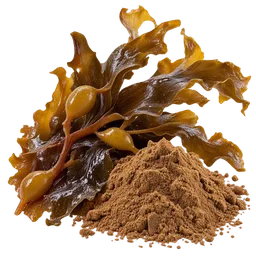
Fucoidan is one of those supplements that sounds almost mythic: a slippery sugar from brown seaweed, studied for immunity, inflammation, gut health, cancer support, and even exercise recovery. The catch is that the human story is still being sorted. Fucoidan looks less like a miracle and more like a message in a bottle from the ocean—interesting, biologically active, and frustratingly hard to decode.
The molecule that refuses to be just one molecule
If you're the kind of adult drawn to marine supplements, fucoidan has obvious appeal. It comes from edible brown seaweeds—wakame, kombu, mozuku, bladderwrack—the same shoreline organisms that have fed coastal cultures for generations.8 But the first thing researchers learned after Harald Kylin isolated and named it in 1913 is that fucoidan is not one neat, uniform substance.1 It is more like a family recipe copied by different islands: recognizably related, but altered by species, season, harvest conditions, extraction method, sulfate pattern, and molecular weight.12
That matters because fucoidan's reputation has raced far ahead of that complexity. A bottle may say fucoidan, but in the lab that label can hide very different materials.2 And when studies disagree, this is often the first suspect. Researchers are not always testing the same thing, even when they use the same name.2
Why scientists got interested in something slippery
The scientific intrigue is not just that fucoidan comes from seaweed. It is that its sulfate-rich surface seems able to interact with some of the body's "stickier" biology—proteins involved in cell signaling, immune traffic, clotting, and the way cells latch onto each other.6 A useful way to picture it is not as a key opening a lock, but as a strip of velcro moving through a crowded fabric shop. Depending on its exact texture, it may catch on different surfaces with different strength.26 That helps explain why fucoidan keeps showing up in conversations about inflammation, immunity, vascular biology, and the gut.6
But it also explains the central paradox of fucoidan research: the molecule is biologically busy, while the human evidence is still modest.36 In petri dishes and animals, fucoidan can look spectacular. In people, the results become quieter, smaller, and much less consistent.34
The first big reality check: sometimes nothing dramatic happens
One of the most useful human trials may be the least glamorous. In a randomized placebo-controlled osteoarthritis study, adults with mild-to-moderate hip or knee osteoarthritis took 300 mg a day of a Fucus vesiculosus extract standardized to 85% fucoidan for 12 weeks.4 Symptoms improved—but the placebo group improved too, and fucoidan did not outperform placebo.4
That null result is not a failure of the story. It is the story. It tells you fucoidan should not be treated like a broad-spectrum fix for aches just because it looks anti-inflammatory in theory.46 For supplement-curious adults, this is one of the most important pieces of evidence: the ocean chemistry may be real, but your knees do not read mechanistic papers.
Where the signal gets more interesting: the gut
The more intriguing human findings so far come from places where fucoidan behaves less like a painkiller and more like an ecological nudge. In a 2025 double-blind placebo-controlled trial, 91 healthy adults took a fucoidan-rich extract from Saccharina latissima for four weeks.5 The higher-dose group showed dose-dependent improvements in microbial diversity, with increases in bacteria often associated with gut resilience, such as Bifidobacterium and Faecalibacterium, and reductions in taxa linked with inflammatory states.5
That does not mean you feel a lightning-bolt effect after one capsule.5 Fucoidan may be better understood as a tide-table supplement than a stimulant: it does not shout; it shifts the shoreline a little at a time.56 For adults interested in gut health, recovery, or general system support, that is a more honest frame than expecting a dramatic same-day sensation.
There is a second twist here. Fucoidan may not work only by acting on your cells directly. It may also work by changing who gets fed in your intestinal neighborhood.58 In other words, part of the supplement may be less about you than about the microscopic dinner guests you carry around.
A strange clue: the body notices fucoidan faster than you do
One of the more surprising small studies gave healthy volunteers a single 1 g dose of Undaria pinnatifida fucoidan and looked at blood microRNA patterns 24 hours later.7 Researchers found changes in dozens of microRNAs tied to signaling pathways, including some not previously associated with fucoidan.7
That is not a consumer outcome. It does not tell you that you will sleep better, think faster, or live longer.7 But it does show something important: fucoidan may begin interacting with human biology quickly, even when the meaningful felt outcomes, if they exist, take weeks to emerge.57
This helps reconcile two facts that can seem contradictory. People may notice little right away, while lab measures still move.57 The orchestra may already be retuning even though the audience has not heard the new melody yet.
What about performance, cancer support, and the big promises?
This is where honesty matters most. In a small 2025 randomized trial combining fucoidan with resistance training, strength improved in both fucoidan and placebo groups, with no significant treatment effect on the main squat strength measure.9 There were some interesting secondary findings in peak power, lean mass, and body fat, but with only 20 participants, this is a clue, not a verdict.9
Cancer-support research is in a similar place. A 2022 systematic review focused on fucoidan as supplemental therapy in cancer patients found only four human studies total—one randomized trial and three quasi-experimental studies—with heterogeneous methods and outcomes.3 The review concluded that effects on survival, disease control, and adverse effects could not be confirmed.3 That's a long way from the marketing language sometimes wrapped around marine extracts.
Still, research has not stalled. As of February 24, 2026, Mayo Clinic is recruiting a placebo-controlled trial testing fucoidan for preventing chemotherapy-related fatigue in patients with gastrointestinal or gynecologic cancers.10 That is a useful signpost. The field is moving toward sharper, more practical questions: not "Does fucoidan do everything?" but "Does it help this one symptom in this one group?"10
The old tradition and the modern correction
There is a cultural backstory here, but it belongs to seaweeds more than to fucoidan capsules. Brown algae have been used in East Asian diets for centuries, and some species such as Sargassum have a long history in traditional Chinese medicine.8 Modern science partially validates the idea that these foods contain biologically active compounds.18
But the correction is crucial: eating seaweed in a cuisine is not the same as taking an extracted fucoidan supplement.28 Food traditions bring fiber, minerals, polyphenols, and a whole dietary context. A capsule isolates one thread from a much larger net.28
So what is fucoidan, really?
Right now, fucoidan looks most credible as an emerging supplement category for adults who are comfortable with uncertainty—especially those interested in gut ecology, adjunctive wellness strategies, or marine bioactives as a research frontier.3510 It looks much less credible as a miracle anti-inflammatory or universal recovery aid.34
Its most fascinating feature may be that the same property causing the confusion—its structural variability—is also what makes it scientifically interesting.12 Fucoidan is not a single trumpet note. It is a cluster of sea-born harmonics, and researchers are still figuring out which versions are music and which are just noise.210
Key takeaways
What to walk away with
- 01
Fucoidan was first isolated in 1913, but it is still hard to study because different seaweeds produce meaningfully different fucoidans.
- 02
Human evidence is mixed: some trials show microbiome or body-composition signals, while others show no advantage over placebo.
- 03
The strongest current consumer-facing story is not a dramatic felt effect, but gradual system-level changes, especially in the gut.
- 04
Product quality matters unusually much here; species, molecular weight, extraction method, and actual fucoidan content can change the outcome.
- 05
Fucoidan should be viewed as an emerging marine supplement, not a proven cure-all.
Effect timeline
When to expect what
- Immediate
- No clear same-day felt effects in human trials; one pilot study found blood microRNA changes within 24 hours after a single 1 g dose.
- Peak
- About 4 weeks for microbiome-related changes in healthy adults; 6-12 weeks in trials looking at exercise or osteoarthritis outcomes.
- Duration needed
- 4 weeks minimum for the clearest positive human signal so far; many studied outcomes used daily intake for 6-12 weeks.
- Wears off
- Unknown; human discontinuation data are sparse, so any benefits likely fade gradually rather than instantly.
Research trajectory
What the studies actually show
-
Fucoidan was first isolated and named in 1913, but more than a century later its structural variability remains one of the field's central problems. 1
Early chemistry identified a sulfated seaweed polysaccharide, yet later work showed that different brown algae produce distinct fucoidan architectures.
This helps explain why products and studies using the same word can behave differently.
-
A 12-week osteoarthritis RCT found fucoidan was safe but did not beat placebo for symptom reduction. 4
Researchers tested a standardized Fucus vesiculosus extract in adults with hip and knee osteoarthritis and saw a large placebo response.
Important null evidence that tempers broad anti-inflammatory marketing claims.
-
A 4-week placebo-controlled trial in healthy adults found dose-dependent microbiome changes with a Saccharina latissima fucoidan extract. 5
Higher-dose fucoidan increased diversity and taxa such as Bifidobacterium and Faecalibacterium while reducing inflammation-associated groups.
This is one of the best current human signals for a plausible consumer-facing benefit.
-
A single 1 g dose changed circulating microRNA patterns within 24 hours in a pilot human study. 7
Researchers used an exploratory blood-based approach rather than a symptom score and found pathway-level changes after fucoidan ingestion.
Suggests fucoidan can interact with human biology quickly, even when obvious felt effects are absent.
Human trials
What real trials found
-
Randomized placebo-controlled osteoarthritis trial in adults with mild-to-moderate hip or knee OA. 4
- Outcome
- Fucoidan was safe and well tolerated over 12 weeks, but symptom improvement was not significantly different from placebo.
- Why it matters
- A valuable real-world reminder that plausible anti-inflammatory mechanisms do not guarantee noticeable pain relief in humans.
- Source
- Myers et al., Biologics, 2016
-
Double-blind placebo-controlled trial in 91 healthy adults using a Saccharina latissima fucoidan-rich extract for 4 weeks. 5
- Outcome
- Higher-dose supplementation improved microbial diversity and increased several beneficial taxa while reducing inflammation-associated taxa.
- Why it matters
- This is one of the clearest human signals for fucoidan so far and supports a gut-focused interpretation of its potential.
- Source
- Gut Microbiome Modulation and Health Benefits of a Novel Fucoidan Extract from Saccharina latissima, 2025
-
Small randomized trial combining fucoidan supplementation with resistance training in healthy adults. 9
- Outcome
- No significant treatment effect on the main strength outcome, though some secondary measures like peak power and body composition changed favorably.
- Why it matters
- Illustrates the current state of the literature: interesting hints, but not enough to make a strong performance claim.
- Source
- Cousins et al., Scientific Reports, 2025
Expert insights
Voices in the field
Research into fucoidan has continued to gain pace over the last few years and point towards many exciting potential therapeutic or adjunct uses. 11
The high intra- and intermolecular diversity of fucoidan poses challenges in correlating specific structures with biological functions. 12
Practical guidance
Putting it to use
Who may benefit
Adults who are curious about marine-derived supplements, especially those interested in gut-health experiments or evidence-aware adjunctive wellness rather than a dramatic symptom fix.
Who should avoid
People using anticoagulant or antiplatelet medications, and those who need to tightly limit iodine if the product is a crude seaweed extract rather than a purified fucoidan extract.
Dosing
Human studies have used roughly 300 mg/day to 1 g/day of specific extracts, sometimes split into two doses. The more important detail is not just milligrams, but the exact species and extract used—Fucus vesiculosus, Undaria pinnatifida, and Saccharina latissima are not interchangeable in practice.
Timing
Don't expect a stimulant-like effect. The clearest human benefit signals were studied over 4 to 12 weeks, while one single-dose study found molecular changes without proving meaningful symptom changes.
Quality
Fucoidan is unusually sensitive to source and processing. Look for products that name the seaweed species, state actual fucoidan content, and ideally mention molecular weight or standardized extraction. 'Brown seaweed extract' alone is weak labeling for a category this variable.
Cautions
Fucoidan has heparin-like anticoagulant and antiplatelet potential in the broader literature, so caution makes sense for people taking blood thinners or preparing for surgery. With less-purified seaweed products, iodine content may also matter for people specifically trying to avoid excess iodine.
A closing thought
Fucoidan is a good reminder that nature does not hand us finished answers. Sometimes it hands us a fascinating material, a handful of weak and strong signals, and the discipline to separate possibility from proof.
Frequently asked
Common questions
Is fucoidan basically the same as just eating seaweed?
What is the most plausible reason someone might try fucoidan today?
How soon would fucoidan work if it works for me?
Why do fucoidan studies seem to point in different directions?
Sources
- 1. Fucoidan: Structure and Bioactivity (2008)
- 2. Important Determinants for Fucoidan Bioactivity: A Critical Review of Structure-Function Relations and Extraction Methods for Fucose-Containing Sulfated Polysaccharides from Brown Seaweeds (2011)
- 3. Effectiveness of Fucoidan on Supplemental Therapy in Cancer Patients: A Systematic Review (2022)
- 4. Effects of fucoidan from Fucus vesiculosus in reducing symptoms of osteoarthritis: a randomized placebo-controlled trial (2016)
- 5. Gut Microbiome Modulation and Health Benefits of a Novel Fucoidan Extract from Saccharina latissima: A Double-Blind, Placebo-Controlled Trial (2025)
- 6. Molecular Targets and Related Biologic Activities of Fucoidan: A Review (2020)
- 7. Micro RNA Expression after Ingestion of Fucoidan; A Clinical Study (2020)
- 8. Therapeutic Effects of Fucoidan: A Review on Recent Studies (2019)
- 9. Investigating fucoidan blend supplementation and resistance training in humans: a parallel randomized controlled trial design (2025)
- 10. ClinicalTrials.gov: Fucoidan for Preventing Chemotherapy-Related Fatigue in Patients With Gastrointestinal or Gynecological Cancer (2026)
- 11. Therapeutic Applications of a Potent Seaweed Extract
- 12. Developments in the analytical methodologies and structure-activity relationships of low molecular weight fucoidans: A review (2025)
1,061 words · 12 sources · Fucoidan