New Echinacea (Echinacea purpurea, E. angustifolia, E. pallida) Published May 6, 2026
Prairie Panacea, Airplane Colds, and a Hidden Microbiome: The Echinacea Plot Twist
Shorter, milder colds when started early, immune support during travel stress
Evidence summary
Echinacea for common colds shows a small preventive benefit in some standardized extracts, but evidence remains inconsistent and does not support reliable treatment of an active cold.
- Across 24 trials, echinacea products produced small preventive effects, but inconsistent results limited confidence in a broad cold claim.6
- Standardized E. purpurea trials in adults, travelers, and children drove the most favorable prevention signals.
- Rhinovirus-challenge treatment studies found no clear clinical benefit for E. angustifolia after exposure.
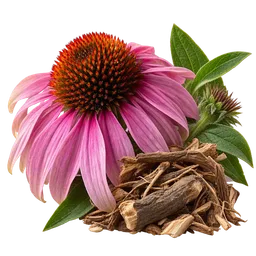
On a dusty Nebraska afternoon in the late 1800s, an exuberant folk doctor allegedly offered to prove his remedy by letting a rattlesnake bite him—and then dosing himself with echinacea. The tale was reprinted by Eclectic physicians and helped launch a prairie wildflower into medical fame. Whether or not the stunt happened exactly as told, it captures echinacea's enduring paradox: beloved in practice, debated in trials, and now—surprisingly—reshaped by the bacteria that live inside the plant itself. 23
From plains medicine to pharmacy counters
Long before supplement aisles, Plains tribes chewed roots, made poultices, and used echinacea for pain, throat troubles, and bites. Eclectic physicians in the late 19th and early 20th centuries then championed it in American clinics, and an Eclectic specimen of Echinacea angustifolia still sits in the Smithsonian's collection—a snapshot of a moment when a prairie plant was mainstream medicine. 13
The cold controversy
Fast-forward to modern trials and you meet contradiction. In 2005, a tightly controlled rhinovirus "challenge" study in the New England Journal of Medicine found no benefit from defined E. angustifolia root extracts. As lead author Ronald Turner later put it, "Our study found no evidence for an effect of echinacea on common cold illnesses." 45 A 2014 Cochrane review surveyed 24 controlled trials and concluded there might be a small preventive effect for some products, but results were inconsistent and treatment benefits were unconvincing. 6 And yet, other studies nudge the story. A 4-month, 755-person randomized trial of a standardized E. purpurea extract found fewer virologically confirmed colds—especially from enveloped viruses—among those who took echinacea, with safety similar to placebo. 7 In the peculiar theater of long-haul flights—dry air, close quarters—a placebo-controlled trial reported borderline lower respiratory symptom scores with echinacea started before and during travel. 8 In children, a 2021 randomized, blinded study found that preventive echinacea cut respiratory infections, complications like ear infections, and antibiotic use, while shortening fever days. 9 If you're feeling whiplash, you're not alone. The cast changes (species, plant parts, extraction), the setting changes (lab challenge vs. real life), and so do the outcomes measured. The plot doesn't resolve easily—but it deepens.
The twist: cannabinoid locks and hitchhiking bacteria
When you peek inside the plant, the story becomes more intelligible. Certain lipophilic compounds—alkylamides—look and behave a bit like our own endocannabinoids. In immune cells, they appear to fit CB2 receptors (think: a lock on the "inflammation patrol" doors), nudging them in ways that can both tone down an overzealous response and, in other contexts, rouse defenses. Early mechanistic work suggested these alkylamides tweak the signal cascades that decide how much inflammatory "alarm" gets broadcast. 10 Then researchers stumbled on a bigger twist: a notable share of echinacea's macrophage-stimulating punch comes not from plant cells at all but from the bacteria that live within the plant tissues. In other words, the plant's resident microbes can be the unseen co-authors of its immune effects. NCCIH-supported work shows that differences in the plant's bacterial passengers—and even the soil that shapes them—change how vigorously extracts wake up our innate defenders. In greenhouse and field samples, more organic-rich soils shifted the plant microbiome and increased immune-activating activity in vitro. 1112 As one investigator put it when their paper won an innovation award: "For over 30 years, scientists..thought that the active ingredients were plant-derived polysaccharides. This paper shows that it's the bacteria living inside the plants." 13
Why quality and identity matter
If activity varies with species, plant part, extraction, and even the plant's microbiome, then what's in the bottle matters. The American Botanical Council's Botanical Adulterants Prevention Program recently flagged labeling and identity issues in parts of the echinacea supply chain. "A native American medicinal plant, echinacea is one of the most popular herbs used therapeutically in North America," ABC's Mark Blumenthal noted, adding that the new bulletin is meant to help set proper identity specs and keep adulteration at bay. 14
A cautionary sidebar
Echinacea has a strong safety record in trials, but like all botanicals it isn't for everyone. Rare allergic reactions—including anaphylaxis—have been reported, particularly in people with atopy or sensitivity to the daisy family. Liver injury is uncommon; LiverTox notes overall good tolerance in studies, yet case reports exist, including a patient whose short course preceded autoimmune-like hepatitis. If you're immunosuppressed or managing liver disease, professional guidance is wise. 151617
How people make it work
What do the better trials have in common? Standardized E. purpurea preparations taken consistently through an exposure window. In adults, prevention was tested over about four months, sometimes with dose bumps during acute symptoms. In kids, a chewable E. purpurea formulation used for two two-month blocks reduced infections and antibiotics. Travelers started days before boarding. Choose products that state species and plant parts, are standardized to alkylamides, and come from brands with third-party quality testing—those details help line up with what was studied. 78914
The horizon: colds, coronaviruses, and standardization
In the lab, one E. purpurea preparation inactivated several coronaviruses—including SARS-CoV-2—on direct contact, and a small, open, randomized study during the pandemic suggested fewer viral detections and lower loads with preventive use, though confirmatory blinded trials are needed. More broadly, the field is inching toward standardization not just by plant chemistry but by the plant's microbial "signature," and toward clarifying when CB2-active alkylamides add meaningful benefit. That's the next chapter this prairie flower has earned. 1819101112
"Our study found no evidence for an effect of echinacea on common cold illnesses." — Ronald Turner, MD, NEJM trialist, reminding us that product, dose, and design matter. 5
"A native American medicinal plant..one of the most popular herbs..The new BAPP echinacea bulletin is a useful quality control resource.." — Mark Blumenthal, on why identity and integrity underpin outcomes. 14
Key takeaways
What to walk away with
- 01
Evidence is mixed: a 2005 rhinovirus–challenge RCT with defined E. angustifolia found no treatment benefit, while broader reviews suggest only small preventive effects for some products.
- 02
A 2014 Cochrane review of 24 trials reported possible modest prevention with certain echinacea preparations, but inconsistent results overall and little support for treatment once sick.
- 03
One 4-month RCT in 755 adults using standardized E. purpurea showed fewer virologically confirmed colds—especially from enveloped viruses—with good safety reporting.
- 04
Best use case is prevention during high-exposure periods (e.g., travel, school season) using a standardized E. purpurea extract over weeks, started before exposure and kept consistent.
- 05
Practical timing: begin days before flights or at the start of cold season; some trials increased doses briefly during acute symptoms.
- 06
Cautions: avoid if you're allergic to Asteraceae (ragweed, chrysanthemums, marigolds); rare severe allergies and rare liver injury have been reported; consult a clinician if on immunosuppressants or with liver disease.
Effect timeline
When to expect what
- Immediate
- No
- Peak
- 2–8 weeks for prevention; during first week for acute support in some studies
- Duration needed
- Use throughout exposure periods (e.g., 8–16 weeks); start before travel or cold season
- Wears off
- Likely within days to a few weeks after stopping
Research trajectory
What the studies actually show
-
A 2005 rhinovirus-challenge RCT with defined E. angustifolia extracts showed no clinical benefit. 4
Volunteers were inoculated with virus under controlled conditions; echinacea was used prophylactically or at challenge.
Highlights that not all species/preparations, doses, or models yield benefit; sets a high evidentiary bar.
-
A 2014 Cochrane review of 24 trials found possible small preventive effects for some echinacea products, but inconsistent results overall and little support for treatment effects. 6
Heterogeneous products and designs limited pooling; post-hoc analyses hinted at 10–20% lower risk of colds.
Supports cautious, product-specific expectations rather than blanket claims.
-
A 4-month, 755-adult RCT of standardized E. purpurea reported fewer virologically confirmed colds (especially enveloped viruses) and good safety. 7
Participants logged symptoms and provided nasal swabs during colds; adherence strengthened effects.
Suggests preventive value when using well-characterized E. purpurea throughout a risk season.
-
A blinded pediatric RCT found echinacea prevention reduced RTIs, antibiotic use, complications, and fever days. 9
Child-friendly E. purpurea tablets were used in two 2-month blocks with a short break.
Points to a potential role in pediatric RTI prevention and antibiotic stewardship, pending replication.
-
Mechanistic work indicates echinacea alkylamides interact with CB2 receptors in immune cells, and plant-resident bacteria (shaped by soil) drive much of the macrophage activation seen in vitro. 10
CB2-focused cell studies and NCCIH-supported plant-microbiome research linked soil organic matter and bacterial taxa to immune activity.
Explains variability across products and suggests new standardization routes beyond chemistry alone.
Human trials
What real trials found
-
Atopic woman developed anaphylaxis shortly after first dose of a commercial echinacea product; hypersensitivity confirmed on testing. 16
- Outcome
- Recovered; paper cautioned that atopic patients may face higher risk of severe reactions.
- Why it matters
- Illustrates rare but serious allergy risk in susceptible individuals.
- Source
- Medical Journal of Australia case report (1998)
-
58-year-old woman developed acute hepatitis after ~10 days of echinacea; liver biopsy consistent with drug-induced injury; later transitioned to autoimmune hepatitis pattern. 17
- Outcome
- Improved after stopping; required prednisone when autoimmune pattern emerged.
- Why it matters
- Shows rare hepatic adverse event and need for clinician oversight in liver disease.
- Source
- American College of Gastroenterology case (2015)
-
175 economy-class travelers randomized to echinacea or placebo around long-haul flights. 8
- Outcome
- Borderline lower respiratory symptom scores with echinacea during travel; signals for prevention when started before and continued through travel.
- Why it matters
- A real-world, high-exposure setting where preventive use may matter most.
- Source
- Randomized, double-blind trial in air travelers (2012)
Expert insights
Voices in the field
Our study found no evidence for an effect of echinacea on common cold illnesses. 5
For over 30 years, scientists...thought that the active ingredients were plant-derived polysaccharides. This paper shows that it's the bacteria living inside the plants. 13
A native American medicinal plant, echinacea is one of the most popular herbs used therapeutically in North America...The new BAPP echinacea bulletin is a useful quality control resource... 14
Practical guidance
Putting it to use
Who may benefit
People who face clustered exposures (teachers, parents of young kids, frequent flyers) and want an adjunct to hygiene, sleep, and vaccination—especially when using a standardized E. purpurea extract over several weeks.
Who should avoid
People with known Asteraceae allergies or severe atopy; those on immunosuppressants; individuals with active liver disease or prior herb-related liver injury.
Dosing
Trials showing preventive signals typically used standardized E. purpurea extracts daily across a season (~4 months in adults; two 2-month blocks in children), sometimes with short-term dose increases during acute symptoms.
Timing
Start before exposure windows—days before long flights or at the beginning of cold season—and stay consistent through the period of risk.
Quality
Look for labeled species/plant parts (E. purpurea is most studied), standardized alkylamide content, and third-party testing. Product identity matters, as mislabeling and species mixing have been documented.
Cautions
Allergy to the daisy family (ragweed, chrysanthemums, marigolds) increases risk of reactions; rare severe allergies and rare liver injury have been reported. If you use immunosuppressants or have liver disease, consult your clinician.
A closing thought
Echinacea's journey—from rattlesnake lore to blinded trials, from plant chemistry to plant microbiomes—suggests a humbler kind of certainty: not that one herb "works" or "doesn't," but that living medicines are ecosystems. When we match a well-made product to the right moment and measure honestly, the prairie flower has something to teach modern immunity—and something more to teach about how we standardize nature without flattening it.
Frequently asked
Common questions
Does echinacea work better for preventing colds or treating them once they start?
Which echinacea product has the best evidence in this narrative?
When should I start taking it if I'm about to travel or heading into cold season?
Who is most likely to benefit from echinacea according to this article?
Who should avoid echinacea or talk to a clinician first?
What side effects or risks should I watch for?
Related
More on this supplement
Pulled from across the site — rankings, comparisons, combinations, and reviews where this supplement shows up.
Sources
- 1. Echinacea: Usefulness and Safety | NCCIH (2024)
- 2. Echinacea.—Echinacea. | King's American Dispensatory (historical reprint)
- 3. Echinacea angustifolia—Eclectic materia medica specimen (1924)
- 4. An Evaluation of Echinacea angustifolia in Experimental Rhinovirus Infections (NEJM, 2005) (2005)
- 5. Does Echinacea Really Work Against Colds? (TIME) — Turner quote (2018)
- 6. Cochrane Review: Echinacea for preventing and treating the common cold (2014) (2014)
- 7. Safety and Efficacy of Echinacea purpurea to Prevent Common Cold Episodes (RCT, 2012) (2012)
- 8. Echinacea in air travelers (RCT, 2012) (2012)
- 9. Echinacea reduces antibiotic usage in children (RCT, 2021) (2021)
- 10. Echinacea alkylamides and CB2 receptor interactions (FEBS Lett., 2004) (2004)
- 11. NCCIH research result: Bacteria inside echinacea influence effects (2016) (2016)
- 12. Plant microbiome–dependent immune action of Echinacea enhanced by soil organic matter (Sci Rep, 2019) (2019)
- 13. UM News: Quote from David S. Pasco on bacteria driving activity (2016) (2016)
- 14. NutraIngredients-USA: BAPP echinacea adulteration bulletin with quote (2025) (2025)
- 15. LiverTox: Echinacea (2019)
- 16. Echinacea-associated anaphylaxis (1998 case report) (1998)
- 17. Echinacea-induced acute hepatitis transitioning to autoimmune hepatitis (2015 case) (2015)
- 18. In vitro virucidal activity of Echinacea extract against coronaviruses incl. SARS-CoV-2 (2020) (2020)
- 19. Open, randomized exploratory study during COVID-19 (2022) (2022)
1,098 words · 19 sources · Echinacea (Echinacea purpurea, E. angustifolia, E. pallida)