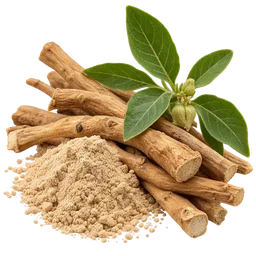
Ashwagandha
Best for
Feel less stressed day to day
Likely strong benefit 4–13 weeks 2 meta-analyses, n=2.2k #2 of 28 studied
- 53 papers
- 18 of 145 outcomes
- 16 positive
- 8 severe, 6 major interactions
Ashwagandha delivers a likely strong benefit for daily stress, with additional gains in stamina and sleep, especially when taken consistently for several weeks rather than used as an instant calming aid.
Median effective dose, most-studied outcomes
- Handle daily demands with less stress 300 mg 4–13 wk
- Support healthier cortisol patterns 312.5 mg 6–13 wk
- Ease anxiety symptoms 425 mg 8–12 wk
Risk, worst reported severity
- hepatotoxicity severe
- acute-on-chronic liver failure severe
- hypnotics and sedatives major
- anxiolytics major
What ashwagandha actually does
Daily stress is the sense that life's demands are stretching beyond what you can handle. 23439798 · 27055824 · 32021735 +15
Everyday energy helps you get through daily tasks without feeling worn down. 30854916 · 33600918 · 35873404 +3
Sleep quality reflects whether the night leaves you feeling well rested. 31728244 · 32021735 · 32226684 +8
Anxiety can bring persistent worry, unease, and physical tension into ordinary moments. 23439798 · 24330893 · 31517876 +9
Testosterone levels in men are tied to sex drive, erections, muscle mass, and energy. 19501822 · 24371462 · 26609282 +9
Feeling alert in the morning can make the day easier to start. 31728244 · 32226684 · 34559859
Recovery helps your body feel ready for the next training session after hard exercise. 30463324 · 33670194 · 38931168 +3
Psychological distress includes difficult emotions that can make daily life feel overwhelming. 31517876
Fight-or-flight is the surge that readies your body when it senses pressure or danger. 40875185 · 38732539 · 41599843
More muscle can support strength, movement, and the physical changes you train for. 26609282 · 38988644 · 39381480 +1
Anxiety during menopause can bring worry, tension, and difficulty feeling at ease. 41561822
| Outcome | Effect | Evidence | Dose | Time | Rank |
|---|---|---|---|---|---|
| Strong benefits 4 | |||||
| Feel less stressed day to day Likely strong benefit Daily stress is the sense that life's demands are stretching beyond what you can handle. | | 2 meta-analyses 18 papers · n=2.2k | — | 4–13 wk | #2 /28 |
| Feel less tired every day Likely strong benefit Everyday energy helps you get through daily tasks without feeling worn down. | | 6 RCTs 6 papers · n=390 | 125–700 mg | 8–12 wk | #4 /31 |
| Stay asleep through the night Likely strong benefit Uninterrupted sleep helps the night feel more settled and restorative. | | 1 meta-analysis 2 papers · n=339 | 120–600 mg | 10 wk | #1 /15 |
| Fall asleep sooner Likely strong benefit A shorter wait for sleep can make bedtime feel less frustrating. | | 1 meta-analysis 2 papers · n=339 | 120–600 mg | 10 wk | #3 /20 |
| Modest benefits 5 | |||||
| Sleep that feels more restorative Proven modest benefit Sleep quality reflects whether the night leaves you feeling well rested. | | 2 meta-analyses 11 papers · n=1.4k | — | 4–13 wk | #3 /34 |
| Feel less anxious Likely modest benefit Anxiety can bring persistent worry, unease, and physical tension into ordinary moments. | | 2 meta-analyses 12 papers · n=1.3k | — | 8–12 wk | #2 /30 |
| Raise testosterone levels in men Likely modest benefit Testosterone levels in men are tied to sex drive, erections, muscle mass, and energy. | | 1 meta-analysis 12 papers · n=944 | — | 8–26 wk | #2 /12 |
| Get more sleep each night Likely modest benefit More time asleep can help you meet the amount of sleep you need. | | 1 meta-analysis 2 papers · n=339 | 120–600 mg | 10 wk | #4 /9 |
| Get stronger Likely modest benefit Strength helps your muscles produce more force for lifting, carrying, and daily movement. | | 1 meta-analysis 7 papers · n=242 | 240–600 mg | 4–12 wk | #4 /41 |
| Worth watching 2 | |||||
| Feel more sexual desire Large effect, needs confirmation Sexual desire and arousal can make intimacy feel more wanted and engaging. | | 3 RCTs 4 papers · n=291 | 300–600 mg | 8 wk | #5 /9 |
| Support male fertility hormones Promising early signal Male reproductive hormones help regulate sperm production and sexual development. | | 2 RCTs 4 papers · n=202 | 400–5000 mg | 8–12 wk | #1 /3 |
| Early research 7 | |||||
| Wake up more refreshed Faint early signal Feeling alert in the morning can make the day easier to start. | | 1 meta-analysis 3 papers · n=267 | 600 mg | 10–12 wk | #4 /16 |
| Recover better after exercise Faint early signal Recovery helps your body feel ready for the next training session after hard exercise. | | 1 meta-analysis 6 papers · n=168 | 120–1000 mg | 4–12 wk | — |
| Ease psychological distress Not enough research Psychological distress includes difficult emotions that can make daily life feel overwhelming. | | 1 RCT 1 papers · n=60 | 240 mg | 9 wk | — |
| Calm the fight-or-flight response Faint early signal Fight-or-flight is the surge that readies your body when it senses pressure or danger. | | 3 RCTs 3 papers · n=28 | 125–600 mg | 6–12 wk | #4 /9 |
| Build more muscle Barely detectable More muscle can support strength, movement, and the physical changes you train for. | | 4 RCTs 4 papers · n=212 | 500–600 mg | 8–9 wk | — |
| Ease anxiety during menopause Not enough research Anxiety during menopause can bring worry, tension, and difficulty feeling at ease. | | 1 study 1 papers · n=— | 300 mg | 8 wk | — |
| Lift your overall mood Not enough research Mood shapes how positive, calm, and engaged a person feels from day to day. | | 2 RCTs 2 papers · n=— | 125–600 mg | 9–12 wk | — |
Effect tiers come from native-unit MCID where available, Cohen's d otherwise.
Dose, timing & forms
How much
For daily stress, the clearest protocol used 300 mg twice daily of a concentrated root extract for 60 days, with improvements in perceived stress and cortisol measures.1 Across the stronger stress, sleep, and fatigue outcomes, effective daily intakes often cluster around 300 to 600 mg of a standardized extract, but the much wider published range means milligrams only make sense alongside the extract type on the label.12 For resistance training, a trial used 300 mg twice daily alongside an exercise program and found a modest strength advantage.3
When and how long
Think of ashwagandha as a daily routine, not a rescue tool for a chaotic afternoon. Stress research commonly split the daily amount into morning and evening doses, while sleep studies used consistent daily dosing over several weeks.12 If your goal is sleep, an evening dose fits the studied use pattern, but avoid stacking it with sedatives or anxiety medicines without a clinician's advice because the calming effects can add up.25
Forms & standardisation
Root extract has the best direct trial coverage. Look for a label that states whether it uses root only or root plus leaf, gives the extract amount, and names its withanolide standardization rather than relying on a proprietary blend.12 Do not assume two products with the same milligram number are interchangeable, because concentrated extracts and plain root powder deliver very different amounts of plant compounds.1
Studied range, by outcome
| Outcome | Studied range | Median effective | Duration | Evidence |
|---|---|---|---|---|
| Handle daily demands with less stress | — | 300 mg | 4–13 wk | 14 papers 16 sig. endpoints |
| Support healthier cortisol patterns | — | 312.5 mg | 6–13 wk | 13 papers 18 sig. endpoints |
| Ease anxiety symptoms | — | 425 mg | 8–12 wk | 12 papers 15 sig. endpoints |
| Support healthy testosterone in men | — | 600 mg | 8–26 wk | 12 papers 14 sig. endpoints |
| Sleep more soundly | — | 392.5 mg | 4–13 wk | 11 papers 16 sig. endpoints |
| Increase everyday strength | 240–600 mg | 500 mg | 4–12 wk | 7 papers 5 sig. endpoints |
| Have less fatigue | 125–700 mg | 312.5 mg | 8–12 wk | 6 papers 5 sig. endpoints |
| Restore strength after exercise | 120–1,000 mg | 600 mg | 4–12 wk | 5 papers 5 sig. endpoints |
| Support coordinated fertility hormones | 400–5,000 mg | 5,000 mg | 8–12 wk | 4 papers 10 sig. endpoints |
| Build muscle size | 500–600 mg | 600 mg | 8–9 wk | 4 papers 4 sig. endpoints |
| Feel more sexual desire | 300–600 mg | 600 mg | 8 wk | 4 papers 5 sig. endpoints |
| Feel alert through the day | 600 mg | 600 mg | 10–12 wk | 3 papers 2 sig. endpoints |
| Stay asleep through the night | 120–600 mg | 360 mg | 10 wk | 2 papers 3 sig. endpoints |
| Fall asleep sooner | 120–600 mg | 480 mg | 10 wk | 2 papers 2 sig. endpoints |
| Spend more time asleep | 120–600 mg | 360 mg | 10 wk | 2 papers 1 sig. endpoint |
| Feel more emotionally steady | 125–600 mg | 362.5 mg | 9–12 wk | 2 papers 2 sig. endpoints |
| Allow more time for sleep | 120–600 mg | — | 10 wk | 2 papers |
| Align energy with day and night | 500 mg | — | 9 wk | 1 paper |
| Ease anxiety during menopause | 300 mg | 300 mg | 8 wk | 1 paper 1 sig. endpoint |
| Stay calmer under physical stress | 125 mg | 125 mg | 12 wk | 1 paper 1 sig. endpoint |
| Cope with emotional distress | 240 mg | — | 9 wk | 1 paper |
Adverse events and drug interactions
Safety events
Drug interactions
Recommended Ashwagandha products
Real products that dose Ashwagandha where the research does, in a clean formulation, from brands we've audited. We only list ones we'd stand behind.
-

Nootropics Depot
Ashwagandha Extract 250 mg
Well dosed 500 mg/day A formulaBrand audit 87/100
-

Nootropics Depot
Ashwagandha Capsules 500 mg
Well dosed 500 mg/day A formulaBrand audit 87/100
-

Seeking Health
Ashwagandha Extract
Well dosed 420 mg/day A formulaBrand audit 85/100
-

Pure Encapsulations
Ashwagandha
Well dosed 500 mg/day A formulaBrand audit 78/100
-

Double Wood Supplements
Ashwagandha 500 mg
Well dosed 500 mg/day A formulaBrand audit 75/100
-

Dr. Mercola
Organic Ashwagandha
Well dosed 800 mg/day A formulaBrand audit 63/100
Chosen for adequate Ashwagandha dosing vs. the studied range, a clean formulation (grade A–C), and independent brand-quality audits. Not sponsored.
What this is and how it works
- Across 18 studies (n=2,220), ashwagandha improved daily-stress outcomes; a standardized effect size and MCID comparison were unavailable.1
- Evidence spans 53 reviewed papers and 145 outcomes, with strongest signals for stress, stamina, and sleep.
- Findings primarily involve daily use of ashwagandha extracts over weeks, not immediate effects from single doses.
Ashwagandha is a small shrub used for centuries in Indian herbal practice. Supplements usually contain an extract from its root, although some products also use leaf material. The name appears on wildly different products, so the extract and its standardization matter as much as the word "ashwagandha" on the front label.12
Your stress system works like a smoke alarm: useful when there is real danger, exhausting when it stays too sensitive. In a controlled trial, a concentrated root extract lowered cortisol, a hormone that rises when that alarm stays switched on, alongside lower reported stress.1 Sleep findings suggest that dialing down this stress signaling also gives the brain a better runway into sleep, though the studies do not prove one single pathway explains every benefit.2
Bottom line
Ashwagandha makes the most sense if daily stress, fatigue, or trouble falling and staying asleep are your main goals and you are willing to use it consistently for weeks.12 Expect a meaningful but not miraculous shift in stress and sleep, and treat the testosterone, libido, and muscle claims as secondary. Skip self-treatment and speak with a clinician first if you have liver problems or take medicines with sedating, seizure, immune, or cancer-treatment effects.45


Common questions
How long does ashwagandha take to work for stress?
Does ashwagandha help you sleep?
Does ashwagandha raise testosterone?
Who should avoid ashwagandha?
Sources
Sources
- 1. A prospective, randomized double-blind, placebo-controlled study of safety and efficacy of a high-concentration full-spectrum extract of Ashwagandha root in reducing stress and anxiety in adults (2012) ↑
- 2. Efficacy and Safety of Ashwagandha Root Extract in Insomnia and Anxiety: A Double-blind, Randomized, Placebo-controlled Study (2019) ↑
- 3. Examining the effect of Withania somnifera supplementation on muscle strength and recovery: A randomized controlled trial (2015) ↑
- 4. Ashwagandha (2024)
- 5. Ashwagandha (2024)
Generated August 27, 2026
Related
More evidence for Ashwagandha
Evidence guide
Ashwagandha (Withania somnifera)
NewSmell of a Horse, Calm in a Storm: Ashwagandha's ancient promise meets modern stress
Evidence guide
Mar 10, 2026
Ranking
Deep, Restful Sleep
NewBest Supplements for Deep, Restful Sleep (2026)
Evidence ranking
Mar 29, 2026
Ranking
Low Testosterone
NewBest Supplements for Testosterone, Ranked by Evidence
Evidence ranking
Apr 4, 2026
Ranking
Trouble Falling Asleep
NewBest Supplements to Fall Asleep Faster, Ranked by Clinical Evidence
Evidence ranking
May 27, 2026
Ranking
Daily Stress
NewBest Supplements for Daily Stress Relief, Ranked by Clinical Evidence
Evidence ranking
Apr 4, 2026
Ranking
Hair Growth
NewBest Supplements to Speed Up Hair Growth (2026)
Evidence ranking
May 16, 2026