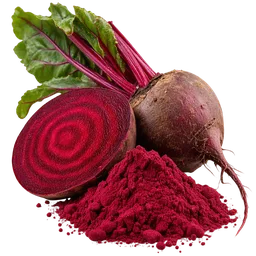
Beet nitrate
Best for
Lower blood pressure
Probably helps a lot <1–26 weeks 24 trials · at least 658 people · 2 reviews #2 of 71 studied
- 48 papers
- 3 of 61 outcomes
- 3 positive
Beet nitrate likely benefits blood-pressure control and exercise tolerance, with the clearest evidence for modest vascular support and small endurance gains.
Median effective dose, most-studied outcomes
- Lower your systolic pressure 150 mL 1–26 wk
- Lower your diastolic pressure 140 mL 4–26 wk
- Promote easier vessel relaxation 400 mg 1–12 wk
Risk, worst reported severity
- spironolactone moderate
What beet nitrate actually does
| Outcome | Effect | Evidence | Dose | Time | Rank |
|---|---|---|---|---|---|
| Strong benefits 1 | |||||
| Lower blood pressure Probably helps a lot Blood pressure is the force of blood against artery walls; persistently high pressure strains the heart and blood vessels. | | 24 trials · at least 658 people · 2 reviews | — | 0–26 wk | #2 /71 |
| Clear benefits 1 | |||||
| Better blood flow Probably helps Blood flow carries oxygen to the whole body, and flexible blood vessels help it keep moving. | | 26 trials · 561 people | 0.11–816 mL | 0–12 wk | #4 /42 |
| Modest benefits 1 | |||||
| Better endurance performance Probably helps a little Endurance performance matters when an effort lasts long enough that keeping a steady pace becomes the challenge. | | 32 trials · at least 754 people · 2 reviews | 5.5–2100 other | 0–9 wk | #7 /32 |
Effect tiers come from native-unit MCID where available, Cohen's d otherwise.
Dose, timing & forms
How much
For blood pressure, the best-supported juice protocols cluster around 140 to 150 mL daily for several weeks, while studies of vessel relaxation also test 400 to 800 mg of nitrate from oral products.12 For endurance, trials often use up to 400 mL of nitrate-rich beetroot juice across multiweek training periods.34 Expect a modest edge, not a transformation: the blood pressure and endurance effects are real but small on average.23
When and how long
Consistency matters more than a perfect clock time. Blood pressure trials used a daily routine over weeks, and endurance protocols kept supplementation going across training blocks rather than treating it as an occasional rescue drink.24 If you use beet nitrate for training, take it on a repeatable schedule that fits your workouts and follow the specific product instructions.
Forms & standardisation
Look for beetroot juice concentrates or extracts that list the actual nitrate amount per serving. The evidence does not support treating every beet powder as interchangeable, because nitrate content changes dramatically by product and growing conditions.13 Skip antibacterial mouthwash near your dose when you can, since it disrupts the mouth-bacteria step that starts nitrate conversion.5
Studied range, by outcome
| Outcome | Studied range | Median effective | Duration | Evidence |
|---|---|---|---|---|
| Lower your systolic pressure | 24–250 mL | 150 mL | 1–26 wk | 19 papers 4 sig. endpoints |
| Lower your diastolic pressure | 24–250 mL | 140 mL | 4–26 wk | 17 papers 2 sig. endpoints |
| Promote easier vessel relaxation | 380–800 mg | 400 mg | 1–12 wk | 13 papers 7 sig. endpoints |
| Sustain more output for longer | 70–400 mL | 400 mL | 2–9 wk | 11 papers 1 sig. endpoint |
| Build aerobic capacity | 50–140 mL | 140 mL | 1–9 wk | 9 papers 1 sig. endpoint |
| Help your vessels widen with blood flow | 400–800 mg | 800 mg | 1–8 wk | 7 papers 4 sig. endpoints |
| Make hard exercise feel easier | 70 mL | 70 mL | 2 wk | 6 papers 1 sig. endpoint |
| Build all-around athletic ability | 808 mg | 808 mg | — | 1 paper 1 sig. endpoint |
Adverse events and drug interactions
Drug interactions
What this is and how it works
- Across 13 studies (n=2,116), 41 nitric-oxide-related endpoints showed positive changes supporting vascular and exercise benefits 1.
- The review covered 48 papers and 61 outcomes across blood pressure, vascular function, and exercise performance.
- Antibacterial mouthwash can markedly reduce nitrate-to-nitrite conversion, potentially weakening beet nitrate’s effects 5.
After you swallow nitrate, helpful bacteria in your mouth start converting it into nitrite. Your body then uses nitrite to produce nitric oxide, a signal that tells blood vessel muscle to relax.15 Think of it as opening extra lanes on a busy road, so blood moves with less resistance and working muscles receive oxygen more efficiently.34
Bottom line
Beet nitrate is a sensible option if you want modest blood pressure support or a small endurance boost and you value evidence over hype. It makes the most sense as a consistent routine, not a last-minute performance shortcut. If you take prescription medicines, especially medicines that affect blood pressure or fluid balance, check with a clinician before using it.
Common questions
Does beet nitrate lower blood pressure?
Does beet nitrate improve endurance?
Should you avoid mouthwash when taking beet nitrate?
Is beetroot powder the same as beet nitrate?
Sources
Sources
- 1. Acute blood pressure lowering, vasoprotective, and antiplatelet properties of dietary nitrate via bioconversion to nitrite (2008) ↑
- 2. Dietary nitrate provides sustained blood pressure lowering in hypertensive patients: a randomized, phase 2, double-blind, placebo-controlled study (2015) ↑
- 3. Dietary nitrate supplementation reduces the O2 cost of low-intensity exercise and enhances tolerance to high-intensity exercise in humans (2009) ↑
- 4. Acute and chronic effects of dietary nitrate supplementation on blood pressure and the physiological responses to moderate-intensity and incremental exercise (2010) ↑
- 5. The increase in plasma nitrite after a dietary nitrate load is markedly attenuated by an antibacterial mouthwash (2008) ↑
Generated August 27, 2026
Related
More evidence for Beet nitrate
Ingredient evidence
Ingredient evidence
NewAlanine
All scored outcomes
Aug 27, 2026
Ingredient evidence
Ingredient evidence
NewArginine
All scored outcomes
Aug 27, 2026
Ingredient evidence
Ingredient evidence
NewBeet
All scored outcomes
Aug 27, 2026
Ingredient evidence
Ingredient evidence
NewBeta-Alanine
All scored outcomes
Aug 27, 2026
Ingredient evidence
Ingredient evidence
NewCaffeine
All scored outcomes
Aug 27, 2026
Ingredient evidence
Ingredient evidence
NewCarnitine
All scored outcomes
Aug 27, 2026