New Head to head Published May 8, 2026
Creatine Monohydrate vs Creatine Anhydrous for Strength, Training Performance, and Lean Mass
The choice matters because both forms deliver creatine, but one has the strongest evidence for strength, repeated hard sets, and lean-mass gains while the other mainly offers a more concentrated ingredient for tighter formulas. What is at stake is whether you pay for the form with the best proof and simplest dosing, or for a form that may fit better into a capsule or pre-workout blend.
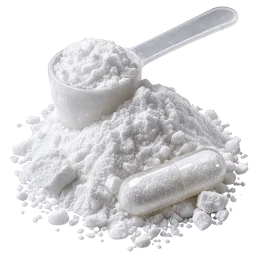
Evidence summary
For strength, repeated hard sets, and lean-mass gains, creatine monohydrate is the best-proven default; for a smaller capsule or pre-workout blend, creatine anhydrous wins on convenience.
- Across dozens of resistance-training trials, creatine monohydrate raises lean mass by about 1–2 kg, a noticeable change.2
- Creatine anhydrous contains more creatine per gram, so smaller capsule or tablet servings are easier to formulate.
- Anhydrous has much thinner direct evidence for strength and lean-mass gains than monohydrate.
The contenders
Two ways to approach the same goal
Option A
Creatine monohydrate
Standardization
Creatine plus one water molecule. PubChem lists molecular weight at 149.15 g/mol, so pure creatine monohydrate is about 87.9 percent creatine by weight and about 12.1 percent water by weight. It is also the form specifically named by the International Society of Sports Nutrition as the most effective creatine supplement for increasing high-intensity exercise capacity and lean body mass during training.
Forms
Powder, micronized powder, capsules, tablets, ready-to-mix sticks, and some gummies or chews. Powder is the most common study-aligned form.
Typical dosage
Common evidence-based dosing is either a loading phase of about 0.3 g/kg/day for 5 to 7 days, often simplified as 20 g/day split into 4 doses, followed by 3 to 5 g/day, or simply 3 to 5 g/day without loading. Loading saturates muscle faster, while daily maintenance without loading reaches saturation more gradually.
Strengths
- Best-supported form for lifters, with a large body of trials and position-stand support for high-intensity performance and lean body mass during training.
- Meta-analyses of creatine plus resistance training show added lean-mass gains versus training alone. A 2024 systematic review in adults under 50 found creatine added to resistance training increased lean body mass compared with placebo.
- Strong practical value because 3 to 5 g/day is enough for maintenance for most athletes, and monohydrate is widely available as low-cost powder.
Trade-offs
- The scale may rise early because creatine increases total body water along with muscle creatine storage. This is not the same as fat gain, but it can matter for weight-class athletes.
- Some people report stomach discomfort, especially with large single doses. Splitting doses or skipping the loading phase often improves tolerability.
- It contains less creatine per gram than anhydrous on paper, so a 5 g serving of monohydrate provides about 4.4 g of creatine before accounting for normal manufacturing variation.
Safety
In healthy people, recommended creatine monohydrate dosing has not been shown to harm kidney function in controlled research, and the International Society of Sports Nutrition reports no compelling evidence of detrimental effects with short or long-term use in otherwise healthy individuals.1 People with kidney disease, those using kidney-stressing medicines, pregnant or breastfeeding people, and minors should use medical supervision.7
Option B
Creatine anhydrous
Standardization
Creatine without the water molecule. Pure anhydrous creatine has molecular weight about 131.14 g/mol, which means it is theoretically 100 percent creatine by weight. In plain terms, it is a more concentrated dry form, not a different active ingredient once it is in the body.
Forms
Usually appears inside multi-ingredient pre-workouts, capsules, dry blends, tablets, or specialty powders. It is less commonly sold as a standalone bulk powder than creatine monohydrate.
Typical dosage
Dose by creatine-equivalent content. Since anhydrous is theoretically about 12 percent more concentrated than monohydrate, about 2.6 to 4.4 g anhydrous approximates the creatine content of 3 to 5 g monohydrate. Direct athlete outcome trials using anhydrous as the test form are limited, so dosing is usually extrapolated from monohydrate research.
Strengths
- More creatine per gram on paper, which can help formulators fit a creatine dose into capsules, tablets, or crowded pre-workout formulas.
- May be useful when label space, scoop size, or dry-blend weight matters more than lowest cost per effective dose.
- Should deliver the same active molecule, creatine, if the product is accurately dosed and stable, but this is an indirect inference from chemistry rather than a direct head-to-head strength trial.
Trade-offs
- No high-impact head-to-head resistance-training trials show creatine anhydrous improves strength, power, or lean mass more than creatine monohydrate.
- Less real-world research, less guideline support, and less standalone availability than monohydrate.
- The theoretical concentration advantage only matters if the product is accurately assayed and priced fairly per gram of actual creatine, which buyers often cannot verify from a front label alone.
Safety
Because anhydrous creatine delivers the same active molecule, creatine, the same practical cautions apply: avoid unsupervised use with kidney disease, discuss use with a clinician if taking kidney-stressing medicines, and watch stomach tolerance when using larger doses. However, the long-term safety evidence is much stronger for creatine monohydrate specifically than for anhydrous as a distinct supplement form.167
Head-to-head
How they compare, criterion by criterion
Strength and training-performance evidence
Winner: A · Creatine monohydrateImportance: high
Monohydrate wins because the International Society of Sports Nutrition specifically identifies creatine monohydrate as the most effective supplement for increasing high-intensity exercise capacity and lean body mass during training, based on decades of trials.1 Anhydrous lacks comparable head-to-head resistance-training outcome trials showing superior strength or power.
Lean-mass gains with resistance training
Winner: A · Creatine monohydrateImportance: high
A 2024 systematic review and meta-analysis in adults under 50 found creatine added to resistance training increased lean body mass compared with resistance training plus placebo.2 That evidence base is overwhelmingly built around monohydrate or creatine protocols treated as monohydrate-standard dosing, not anhydrous-specific trials.
Dose clarity and clinical transferability
Winner: A · Creatine monohydrateImportance: high
Monohydrate dosing is simple and study-aligned: load at about 20 g/day for 5 to 7 days if faster saturation is desired, then maintain at 3 to 5 g/day, or take 3 to 5 g/day from the start.1 Anhydrous dosing must be converted to creatine-equivalent grams, which adds label-reading friction and creates more room for underdosing.
Creatine per gram
Winner: B · Creatine anhydrousImportance: medium
Anhydrous wins this narrow chemistry criterion. Creatine monohydrate has molecular weight 149.15 g/mol because it includes water, while anhydrous creatine is about 131.14 g/mol, so anhydrous is more concentrated by weight.45 For a buyer, this means a smaller anhydrous dose can theoretically match the creatine content of a larger monohydrate dose.
Safety evidence and tolerability confidence
Winner: A · Creatine monohydrateImportance: high
Monohydrate has the stronger safety file. The International Society of Sports Nutrition reports no compelling evidence that short or long-term creatine monohydrate use harms otherwise healthy people, and a 2025 kidney-function systematic review found no significant change in glomerular filtration rate, a kidney filtering measure, across included creatine studies.13 Anhydrous likely shares many creatine-related cautions, but it has less form-specific long-term evidence.
Quality control and standardization confidence
Winner: A · Creatine monohydrateImportance: medium
Monohydrate wins because its identity, dosing, and safety status are better defined in sports-nutrition guidance and regulatory discussions. A review of novel creatine forms concluded that creatine monohydrate has clearly defined safety, efficacy, and regulatory status in many markets, while other forms have less clear evidence and status.6
Cost and value per effective dose
Winner: A · Creatine monohydrateImportance: high
Monohydrate wins for most buyers because the effective daily dose is small, widely available, and directly backed by outcome studies.1 Anhydrous may contain more creatine per gram, but unless it is priced similarly per creatine-equivalent gram and independently tested, the concentration advantage does not reliably beat monohydrate on value.
Formulation fit
Winner: B · Creatine anhydrousImportance: low
Anhydrous wins when the product goal is compact formulation rather than evidence certainty. Removing water makes each gram more concentrated, which can help in capsules, tablets, or dense pre-workout blends where every gram of powder matters.45 This does not mean better gym outcomes, only better space efficiency.
Real-world adoption and availability
Winner: A · Creatine monohydrateImportance: medium
Which should you choose
By goal and use case
You want the safest default for strength, repeated hard sets, and lean-mass gains
You dislike loading phases or get stomach upset from large doses
Pick monohydrate and skip the load. Taking 3 to 5 g/day reaches muscle saturation more gradually and avoids the 20 g/day loading approach that is more likely to bother the stomach when taken in large single doses.1
You are buying a pre-workout that already contains creatine anhydrous
You need the smallest possible capsule or tablet serving
You are a weight-class athlete worried about scale weight
Neither form clearly avoids creatine-related water-weight gain because both deliver creatine. If scale weight is critical, avoid loading, use 3 g/day, monitor morning body weight, and time changes away from weigh-in periods.1
You want the lowest cost per proven serving
The bottom line
Creatine monohydrate is the clear winner for lifters and athletes. It is the form named in the International Society of Sports Nutrition position stand, it anchors most of the strength and lean-mass evidence, and it is easy to dose at 3 to 5 g/day without paying for a concentration advantage that rarely changes outcomes.12 Creatine anhydrous is not a bad ingredient if it is accurately dosed, but its case is mostly chemical and formulation-based: it removes the water molecule, which makes it more concentrated per gram, yet it has not demonstrated better strength, training performance, lean-mass, or safety outcomes than monohydrate in the evidence that matters to buyers.456
Safety considerations
For healthy adult lifters, creatine monohydrate at recommended doses is generally well tolerated, with weight gain from increased water and muscle creatine storage being the most consistent effect reported in the literature.1 Kidney safety is often misunderstood: creatine can raise blood creatinine, a breakdown marker, without necessarily meaning kidney damage, and a recent systematic review found no significant change in glomerular filtration rate, which is a more direct estimate of kidney filtering function.3 Still, people with kidney disease, reduced kidney function, diabetes with kidney involvement, or regular use of kidney-stressing medicines such as some anti-inflammatory pain relievers, certain antibiotics, chemotherapy agents, or transplant medicines should talk with a clinician before using either form.7 Pregnant or breastfeeding people and adolescents should also use medical supervision because the adult sports-performance evidence does not automatically transfer to those groups.17
Frequently asked
Common questions
Do I need to cycle off creatine monohydrate or anhydrous?
Is creatine anhydrous better for cutting because it has less water in the molecule?
Can I take creatine with caffeine?
Is micronized creatine a third option?
What should I look for on a creatine label?
Sources
- 1. International Society of Sports Nutrition position stand: safety and efficacy of creatine supplementation in exercise, sport, and medicine (2017) position stand and review ↑
- 2. The Effect of Creatine Supplementation on Resistance Training-Based Changes to Body Composition: A Systematic Review and Meta-analysis (2024) systematic review and meta-analysis ↑
- 3. Effect of creatine supplementation on kidney function: a systematic review and meta-analysis (2025) systematic review and meta-analysis ↑
- 4. Creatine Monohydrate, PubChem Compound Summary (2025) chemical database ↑
- 5. Creatine, anhydrous, product specification and molecular weight (2025) chemical supplier datasheet ↑
- 6. Analysis of the efficacy, safety, and regulatory status of novel forms of creatine (2011) review ↑
- 7. Creatine: Uses, Side Effects and Warnings (2023) clinical drug information reference ↑
- 8. Creatine, Mayo Clinic Drugs and Supplements (2026) clinical consumer reference ↑