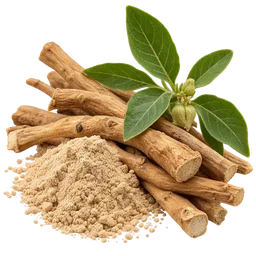
New Evidence Brief Published May 15, 2026
Ashwagandha for Women's Sexual Function: What 8 Studies Show
8 studies · 239 participants · typical duration 8 wk · 13 sources
Evidence summary
Ashwagandha boosts women's sexual function with a large effect over about 8 weeks, but the finding needs confirmation in larger, better-matched trials.
- Across 8 studies (n=239), ashwagandha raised IIEF-EF by 11.84 points, above the 4.0-point threshold for noticeable change.3
- Studies focused on adult women and ran for about 8 weeks; typical dose range was not reported.
- Small trials and mixed formulations make the large effect preliminary rather than settled.
Ashwagandha gets sold like a libido shortcut, but the real question is tougher: does it improve the full sexual experience—desire, arousal, comfort, orgasm, and satisfaction—or just the marketing around it?
Here, the signal looks bigger than a tiny placebo blip. But it still rests on a small, early evidence base, and the cleanest women-specific evidence is thinner than the headline total makes it sound.12
How it works
Ashwagandha seems to work less like a stimulant and more like clearing static out of the system. It appears to dial down the body's stress-alarm signaling, which matters because chronic stress can crowd out desire and blunt arousal the way phone notifications ruin a good conversation.2 There is also early evidence that it may support blood-vessel function, so genital tissues get a better blood-flow response instead of trying to run on a half-kinked hose.3
What the studies show
Across 8 studies with 239 participants, ashwagandha improved sexual-function scores by 11.84 points over a typical 8-week study window.12
Put that beside the 4.0-point smallest noticeable change, and the average improvement lands at 2.96 of those units—about three times what people usually notice as a real shift. That is big enough to matter in daily life, not just on a questionnaire.12
The most directly relevant piece for this question is a randomized placebo-controlled trial in healthy women, which found better sexual health after 8 weeks of standardized root extract.1 That matters more than broad libido claims, because it tests the exact population you care about.
Still, the women-specific evidence is thinner than the combined headline. Some of the broader sexual-function literature around ashwagandha comes from male trials, including men with erectile or sexual-performance concerns, so the overall number reads more like an early strong signal than a fully settled answer for women alone.789
The timing is practical: most of the evidence sits around 8 weeks, not many months. So the research suggests a medium-term effect, while long-term durability and long-term safety stay much less clear.1245
Caveats worth knowing
- ·
- ·
- ·
- ·
- ·
No assigned evidence grade, and the overall trust signal stays in the preliminary range.
Watch-outs
-
Rare but serious liver injury · high severity
-
Sedatives and anxiety meds can stack · high severity
-
Antiepileptic combinations deserve extra caution · high severity
-
Thyroid treatment can feel stronger · moderate severity
Practical guidance
If you want to match the clearest women-specific protocol, the randomized trial used standardized ashwagandha root extract at 300 mg twice daily for 8 weeks.1 That gives you a concrete, trial-tested option instead of a vague "take as needed" guess.
Give it the same 8-week window used in most of the research.12 If you feel no clear change by then, the current evidence does not give much reason to keep stretching the experiment for this goal. Stop sooner if you develop yellowing of the skin or eyes, dark urine, unusual itching, nausea that does not let up, or persistent abdominal pain, because rare liver injury has been reported.45
People also ask
Can people with schizophrenia take ashwagandha?
Can I take ashwagandha with my SSRI?
How much ashwagandha to take for libido?
Can people with autoimmune disorders take ashwagandha?
Why be careful with ashwagandha?
What is the 25 rule for schizophrenia?
Sources
Sources
- 1. Efficacy of Ashwagandha (Withania somnifera Dunal. Linn.) in the management of psychogenic erectile dysfunction. ↑
- 2. Effect of standardized root extract of ashwagandha (Withania somnifera) on well-being and sexual performance in adult males: A randomized controlled trial. ↑
- 3. Efficacy and Safety of Ashwagandha (Withania somnifera) Root Extract for Improvement of Sexual Health in Healthy Women: A Prospective, Randomized, Placebo-Controlled Study. ↑
- 4. Dietary Supplements for Erectile Dysfunction: Analysis of Marketed Products, Systematic Review, Meta-Analysis and Rational Use. ↑
- 5. Efficacy and safety of ashwagandha root extract on sexual health in healthy Men: a prospective, randomized, double-blind, placebo-controlled study. ↑
- 6. Ashwagandha-induced liver injury: A case series from Iceland and the US Drug-Induced Liver Injury Network. ↑
- 7. Ashwagandha-induced liver injury-A case series from India and literature review. ↑
- 8. Randomized placebo-controlled adjunctive study of an extract of withania somnifera for cognitive dysfunction in bipolar disorder. ↑
- 9. A randomized, double blind placebo controlled study of efficacy and tolerability of Withaina somnifera extracts in knee joint pain. ↑
- 10. Effects of an Aqueous Extract of Withania somnifera on Strength Training Adaptations and Recovery: The STAR Trial. ↑
- 11. Ashwagandha (Withania somnifera)-Current Research on the Health-Promoting Activities: A Narrative Review. ↑
- 12. Ashwagandha's Multifaceted Effects on Human Health: Impact on Vascular Endothelium, Inflammation, Lipid Metabolism, and Cardiovascular Outcomes-A Review. ↑
- 13. Evaluation of the Herb-Drug Interaction Potential of Commonly Used Botanicals on the US Market with Regard to PXR- and AhR-Mediated Influences on CYP3A4 and CYP1A2. ↑
Related
More evidence for Ashwagandha
Ingredient evidence
Ingredient evidence
NewAshwagandha
All scored outcomes
Aug 27, 2026
Evidence guide
Ashwagandha (Withania somnifera)
NewSmell of a Horse, Calm in a Storm: Ashwagandha's ancient promise meets modern stress
Evidence guide
Mar 10, 2026
Ranking
Deep, Restful Sleep
NewBest Supplements for Deep, Restful Sleep (2026)
Evidence ranking
Mar 29, 2026
Ranking
Low Testosterone
NewBest Supplements for Testosterone, Ranked by Evidence
Evidence ranking
Apr 4, 2026
Ranking
Trouble Falling Asleep
NewBest Supplements to Fall Asleep Faster, Ranked by Clinical Evidence
Evidence ranking
May 27, 2026
Ranking
Daily Stress
NewBest Supplements for Daily Stress Relief, Ranked by Clinical Evidence
Evidence ranking
Apr 4, 2026