5-HTP
7 studies read · 6 answers · 3 sources
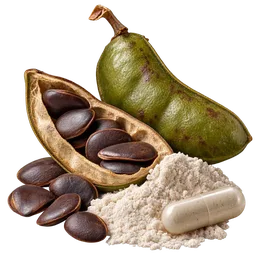
5-HTP does not have enough research to establish meaningful benefits for depression symptoms, anxiety, or sleep, so routine self-treatment is not supported.
What it does
Early findings (6)
-
Better sleep quality · May help
1 trial · 48 people · noticed in 4 weeks
-
A brighter everyday mood · Unclear if it helps
1 trial · 46 people
-
Less depression · Unclear if it helps
4 trials · at least 75 people · noticed in 4–12 weeks
-
Fewer anxiety symptoms · Unclear if it helps
3 trials · at least 62 people · noticed in 4–12 weeks
-
Staying asleep through the night · Unclear if it helps
1 trial · 16 people · noticed in 4 weeks
-
More hours of sleep · Unclear if it helps
1 trial · 16 people · noticed in 4 weeks
How to take it
5-HTP is a reasonable topic to discuss with a clinician if you are curious about sleep, but one small positive sleep trial does not make it a proven sleep supplement.2 Skip self-treatment for depression or anxiety, where the evidence remains too limited to guide use.1 Anyone taking an antidepressant or another serotonin-active medicine should not use it without direct medical supervision.3
How much
The clearest, though still early, sleep signal came from 100 mg daily for about four weeks in one trial.2 Anxiety studies also used 100 mg daily for roughly four to 12 weeks, but only one of two studies reported a significant result. Depression research used weight-based dosing for five to 12 weeks and did not show a significant improvement, so there is no evidence-grounded standard dose for depression.1
When
The available trials test daily use over weeks, not an occasional dose on a stressful day or a sleepless night.1 They do not establish whether morning versus evening use, split doses, or taking it with food produces better results. Since nausea, vomiting, and diarrhea can occur, stop self-experimenting and seek medical advice if significant stomach symptoms appear.3
Which form
Look for a label that states the actual amount of 5-HTP per serving. The human literature centers on 5-HTP itself, rather than a specific branded extract or a plant-extract ratio, so a high-sounding Griffonia percentage does not show that a product matches a studied protocol.2 Product form does not remove the major interaction risk with medicines that affect serotonin.3
The dose that worked, by measure (2)
- Ease anxiety symptoms
- 100 mg4–12 weeks
- Sleep more soundly
- 100 mg4 weeks
Who should be careful
Medicines it can clash with
- antidepressants major
- nialamide major
- moclobemide major
- clomipramine major
- carbidopa moderate
- amitriptyline moderate
Reported side effects
- seizures severe
- hypoglycaemia severe
- hyperthermia severe
- vomiting moderate
- Diarrhea (6 6-8 loose stools daily) with fecal incontinence moderate
- Markedly increased urinary 5-hydroxyindole acetic acid (5-HIAA) excretion (393 µmol/24 h) moderate
- elevated 24-h urine 5-hydroxyindoleacetic acid (5-HIAA) excretion moderate
- hypomania moderate
Bottles worth buying
Dosed where the research is, in a clean formula, from audited brands. Not sponsored.
-

5-HTP 100 mg
NOW · 100 mg a day · brand audit 87
-

5-HTP 100 mg
Protocol For Life Balance · 300 mg a day · brand audit 86
-

5-HTP 100 mg
Pure Encapsulations · 300 mg a day · brand audit 78
-

5-HTP (5-Hydroxytryptophan) 50 mg
Pure Encapsulations · 200 mg a day · brand audit 78
-

5-HTP 200 mg
NutraBio · 400 mg a day · brand audit 90
-

5-HTP 100 mg Extra Strength
Swanson · 100 mg a day · brand audit 69
How it works
5-HTP sounds like a direct route to better sleep and mood. The catch is that its human evidence is still far thinner than the marketing makes it sound.1
5-HTP, short for 5-hydroxytryptophan, is a compound your body makes from the amino acid tryptophan. Supplements usually use material from the seeds of Griffonia simplicifolia, a West African plant, or a manufactured form of the same compound.2
5-HTP crosses into the brain and supplies raw material for serotonin, a chemical messenger involved in mood, appetite, and the sleep-wake cycle.2 Think of it as delivering flour to a bakery, not a finished loaf: more ingredient does not guarantee that the brain produces the right amount of serotonin in the right place.2