Saffron
Best for
Lift your overall mood
Large effect, needs confirmation 28–60 mg/day 6–8 weeks 3 studies, n=189 #3 of 18 studied
- 58 papers
- 15 of 133 outcomes
- 14 positive
- 3 severe
Saffron provides a proven benefit for premenstrual syndrome symptoms and likely improves sleep continuity, while effects across weight, appetite, anxiety, and sexual desire remain smaller or less certain.
Median effective dose, most-studied outcomes
- Reduce overall depressive symptom severity 30 mg 4–48 wk
- Weight relative to height 200 mg 6–13 wk
- Move toward a healthier weight 200 mg 6–12 wk
Risk, worst reported severity
- angina severe
- COVID-19 severe
- valproate moderate
- isoniazid moderate
What saffron actually does
Weight loss means carrying less total body weight over time. 29391933 · 29417083 · 29531568 +6
Sexual desire and arousal can make intimacy feel more wanted and engaging. 19427775 · 22552758 · 23280545 +2
Depression can bring persistent low mood and loss of interest in daily life. 22552758 · 23280545 · 24299602 +10
Mood shapes how positive, calm, and engaged a person feels from day to day. 33598475 · 35813851 · 41477128
A shorter wait for sleep can make bedtime feel less frustrating. 33925432 · 36141931 · 36235697 +1
Daily stress is the sense that life's demands are stretching beyond what you can handle. 33598475 · 40698027 · 37447245
Appetite control can help eating feel more manageable when hunger or cravings get in the way. 29391933 · 35548173 · 35990354
Anxiety can bring persistent worry, unease, and physical tension into ordinary moments. 34745923 · 36141931 · 37288021 +1
Clear vision helps a person read detail, recognize faces, and navigate everyday tasks. 31618812
| Outcome | Effect | Evidence | Dose | Time | Rank |
|---|---|---|---|---|---|
| Clear benefits 2 | |||||
| Fewer PMS symptoms Proven benefit PMS can bring physical and emotional symptoms in the days before a period. | | 1 meta-analysis 2 papers · n=692 | 28–90 mg | 4–10 wk | #1 /10 |
| Stay asleep through the night Likely benefit Uninterrupted sleep helps the night feel more settled and restorative. | | 1 meta-analysis 4 papers · n=405 | — | 4–6 wk | #2 /15 |
| Modest benefits 5 | |||||
| Lose weight Proven modest benefit Weight loss means carrying less total body weight over time. | | 1 meta-analysis 9 papers · n=554 | — | 6–13 wk | #4 /72 |
| Feel more sexual desire Likely modest benefit Sexual desire and arousal can make intimacy feel more wanted and engaging. | | 1 meta-analysis 5 papers · n=345 | 15–400 mg | 1–6 wk | #6 /9 |
| Ease depression symptoms Likely real but unnoticeable Depression can bring persistent low mood and loss of interest in daily life. | | 6 meta-analyses 13 papers · n=18k | — | 4–48 wk | #4 /36 |
| Sleep that feels more restorative Likely real but unnoticeable Sleep quality reflects whether the night leaves you feeling well rested. | | 1 meta-analysis 5 papers · n=519 | — | 4–6 wk | — |
| Reduce insomnia symptoms Likely real but unnoticeable Less severe insomnia can mean fewer nights spent struggling with sleep. | | 1 meta-analysis 3 papers · n=340 | — | 4–5 wk | #3 /13 |
| Worth watching 3 | |||||
| Lift your overall mood Large effect, needs confirmation Mood shapes how positive, calm, and engaged a person feels from day to day. | | 3 RCTs 3 papers · n=189 | 28–60 mg | 6–8 wk | #3 /18 |
| Lose body fat Large effect, needs confirmation Body fat loss changes the proportion of your body that is fat tissue. | | 2 RCTs 3 papers · n=38 | 30–400 mg | 8–12 wk | #2 /41 |
| Get more sleep each night Promising early signal More time asleep can help you meet the amount of sleep you need. | | 3 RCTs 4 papers · n=120 | 15.5–30 mg | 4–12 wk | #7 /9 |
| Early research 5 | |||||
| Fall asleep sooner Faint early signal A shorter wait for sleep can make bedtime feel less frustrating. | | 1 meta-analysis 4 papers · n=291 | — | 4–12 wk | #7 /20 |
| Feel less stressed day to day Faint early signal Daily stress is the sense that life's demands are stretching beyond what you can handle. | | 3 RCTs 3 papers · n=122 | — | 4–8 wk | #10 /28 |
| Feel fuller and curb cravings Barely detectable Appetite control can help eating feel more manageable when hunger or cravings get in the way. | | 1 meta-analysis 3 papers · n=529 | 10–100 mg | 6–8 wk | #9 /44 |
| Feel less anxious Barely detectable Anxiety can bring persistent worry, unease, and physical tension into ordinary moments. | | 1 meta-analysis 4 papers · n=278 | — | 1–6 wk | — |
| See more clearly Not enough research Clear vision helps a person read detail, recognize faces, and navigate everyday tasks. | | 1 RCT 1 papers · n=— | 20 mg | 26 wk | — |
Effect tiers come from native-unit MCID where available, Cohen's d otherwise.
Dose, timing & forms
How much
For PMS, the strongest evidence centers on 28 to 30 mg daily of saffron extract for about two menstrual cycles.1 Sleep and mood studies also often land near 30 mg daily, while weight-focused trials span much wider doses and produce only small average changes, so higher doses do not equal better results.23 Treat saffron as a daily, several-week trial, not a supplement you take only on a stressful day.
When and how long
Use the schedule printed for the specific extract, because trials have used both divided daily doses and single daily doses.123 For sleep, make the dose part of a consistent evening routine rather than judging it after one night. For PMS, start early enough to assess a full cycle or two, since the clinical trials tracked symptoms over weeks, not hours.12
Forms & standardisation
Look for a supplement that clearly identifies Crocus sativus stigma extract and gives the amount per daily serving. The named extracts in sleep and mood research are not interchangeable with culinary saffron threads, and products vary in their crocin and safranal content.24 A transparent label with extract standardization and third-party quality testing gives you a better shot at matching the studied material.
Studied range, by outcome
| Outcome | Studied range | Median effective | Duration | Evidence |
|---|---|---|---|---|
| Reduce overall depressive symptom severity | 15–125 mg | 30 mg | 4–48 wk | 12 papers 9 sig. endpoints |
| Weight relative to height | 15–400 mg | 200 mg | 6–13 wk | 8 papers 3 sig. endpoints |
| Move toward a healthier weight | — | 200 mg | 6–12 wk | 7 papers 3 sig. endpoints |
| Feel more sexual desire | 15–400 mg | 165 mg | 1–6 wk | 5 papers 2 sig. endpoints |
| Sleep more soundly | — | 29 mg | 4–6 wk | 5 papers 8 sig. endpoints |
| Support overall antioxidant capacity | 6–400 mg | 30 mg | 10–12 wk | 5 papers 3 sig. endpoints |
| Ease anxiety symptoms | — | 40 mg | 1–6 wk | 4 papers 5 sig. endpoints |
| Stay asleep through the night | — | 30 mg | 4–6 wk | 4 papers 4 sig. endpoints |
| Fall asleep sooner | — | 30 mg | 4–12 wk | 4 papers 2 sig. endpoints |
| Spend more time asleep | 15.5–30 mg | — | 4–12 wk | 4 papers |
| Feel more emotionally steady | 28–60 mg | 60 mg | 6–8 wk | 3 papers 1 sig. endpoint |
| Sleep more easily through the night | — | 26.5 mg | 4–5 wk | 3 papers 2 sig. endpoints |
| Lower body fat percentage | 30–400 mg | 300 mg | 8–12 wk | 3 papers 2 sig. endpoints |
| Stay fuller between meals | 30–100 mg | 30 mg | 6–8 wk | 2 papers 4 sig. endpoints |
| Handle daily demands with less stress | 20–30 mg | 25 mg | 4–8 wk | 2 papers 2 sig. endpoints |
| Ease the overall PMS burden | 28–90 mg | 44.5 mg | 4–10 wk | 2 papers 2 sig. endpoints |
| Reduce calorie intake | 10–100 mg | 30 mg | 8 wk | 2 papers 3 sig. endpoints |
| Reduce food cravings | 100 mg | — | 6 wk | 1 paper |
| Read fine detail more easily | 20 mg | — | 26 wk | 1 paper |
Adverse events and drug interactions
Safety events
Drug interactions
Recommended Saffron products
Real products that dose Saffron where the research does, in a clean formulation, from brands we've audited. We only list ones we'd stand behind.
-

Swanson
Saffron Extract
Well dosed 60 mg/day A formulaBrand audit 69/100
-

Seeking Health
Serotonin Nutrients
Well dosed 30 mg/day A formulaBrand audit 85/100
-

Country Life
PMS Rescue
Well dosed 30 mg/day C formulaBrand audit 74/100
-

Paradise
Saffr-Tone
Well dosed 30 mg/day A formula -

Core Nutritionals
BURN Blazin' Blue Raz
Well dosed 30 mg/day C formulaBrand audit 60/100
-

Core Nutritionals
BURN Orange Mango
Well dosed 30 mg/day C formulaBrand audit 60/100
Chosen for adequate Saffron dosing vs. the studied range, a clean formulation (grade A–C), and independent brand-quality audits. Not sponsored.
What this is and how it works
- Across 2 studies (n=692), saffron improved premenstrual syndrome symptoms in women with PMS.1
- The review spans 58 papers and 133 outcomes, including four sleep studies involving 405 adults with poor sleep.
- Evidence is strongest for PMS and sleep, with benefits depending on extract, dose, and consistent use.
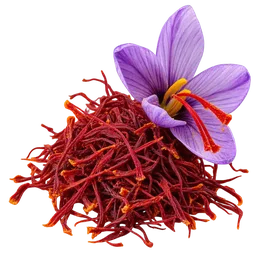
Saffron is the deep red stigma, or thread-like tip, of the Crocus sativus flower. Each flower produces only three threads, which explains why real saffron costs far more than most kitchen spices. Supplements use powdered stigma or concentrated extracts that capture saffron compounds such as crocin and safranal.4
Saffron's compounds appear to influence serotonin signaling, one of the brain's message systems for mood, appetite, and sleep, while also acting on oxidative stress pathways.4 Think of serotonin signaling as a group chat with a volume control: saffron seems to adjust how strongly some messages get heard, rather than forcing the brain into one setting.4 Human trials connect that biology with changes in PMS symptoms, sleep continuity, and depressive symptom scores, although results differ sharply by outcome.123
Bottom line
Saffron makes the most sense if PMS symptoms or broken sleep are your main target and you are willing to use it consistently for several weeks.12 Weight, appetite, anxiety, and sexual-desire results are smaller or less certain, so do not buy it expecting a major transformation. Skip self-treatment and speak with a clinician first if you use prescription medicines or have a history of hypomania.
Co-studied with
 Vitamine40 shared
· d=0.73
Vitamine40 shared
· d=0.73 Probiotics12 shared
· d=0.23
Probiotics12 shared
· d=0.23 Magnesium12 shared
· d=0.23
Magnesium12 shared
· d=0.23- Drug:Metformin9 shared · d=0.38
 Baicalin5 shared
· d=0.54
Baicalin5 shared
· d=0.54
Common questions
Does saffron help with PMS?
Can saffron improve sleep?
How long does saffron take to work?
Is saffron useful for depression?
Sources
Sources
- 1. Crocus sativus L. saffron in the treatment of premenstrual syndrome: a double-blind, randomised and placebo-controlled trial (2008) ↑
- 2. The effect of saffron extract on sleep quality in healthy adults with self-reported poor sleep: a randomized, double-blind, placebo-controlled trial (2021) ↑
- 3. Saffron for depression: a systematic review of clinical trials and meta-analysis (2019) ↑
- 4. Saffron and its active ingredients: from traditional medicine to modern medicine (2015) ↑
Generated August 27, 2026
Related
More evidence for Saffron
Evidence guide
Saffron
NewThreads of Light: How a Royal Dye Became a Research-Backed Aid for Mood, Sleep, and Sight
Evidence guide
Apr 7, 2026
Ranking
Deep, Restful Sleep
NewBest Supplements for Deep, Restful Sleep (2026)
Evidence ranking
Mar 29, 2026
Ranking
Peripheral Neuropathy
NewBest Supplements to Ease Neuropathy Pain and Numbness (2026)
Evidence ranking
Apr 4, 2026
Ranking
Sleep Quality
NewBest Supplements to Increase Deep, Restorative Sleep (2026)
Evidence ranking
May 16, 2026
Ranking
High Blood Pressure
NewBest Supplements for Blood Pressure, Ranked by Clinical Evidence
Evidence ranking
Apr 4, 2026
Ranking
Daily Stress
NewBest Supplements for Daily Stress Relief, Ranked by Clinical Evidence
Evidence ranking
Apr 4, 2026