New 5-HTP (5-hydroxytryptophan) Published Apr 3, 2026
Seeds, Sleep, and Serotonin: How a West African vine met modern science
Better sleep quality for poor sleepers, gentle appetite control, and calm mood support
Evidence summary
5-HTP from Griffonia simplicifolia is a serotonin precursor with its clearest human signal in sleep support, plus smaller migraine and fibromyalgia trial findings, but it can confound carcinoid testing.
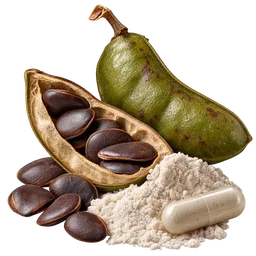
In coastal West Africa, the dry pods of a climbing vine snap open with a sound like tiny firecrackers. Traders gather the glossy black seeds—Griffonia simplicifolia—once chewed as sticks for clean teeth, now exported for a different promise: a molecule that feeds the brain's calm—5-HTP.
From forest markets to lab benches
Walk a Ghanaian roadside market and you'll see bundles of Griffonia stems sold as traditional chewing sticks, part of a long local toolkit for everyday health. Today, the same plant sustains a global trade because its seeds are unusually rich—often 6–20% by weight—in 5-HTP, the direct building block the body uses to make serotonin. Ethnobotanists call Griffonia a wild-harvested resource whose pods have been traded for decades, enough that sustainability and fair supply now matter as much as potency. One review even notes it's been dubbed a herbal "Prozac."12
The unlikely rise of serotonin
Serotonin itself wasn't born in a wellness aisle. Mid-century researchers trying to tame hypertension kept stumbling over a mysterious "tonic" in blood serum. As historian-scientist Patricia Whitaker-Azmitia put it, serotonin began as "an annoying artifact" that became "one of the most important discoveries in neuroscience."3 That pivot—artifact to essential messenger—frames why 5-HTP, serotonin's immediate precursor, draws such attention.
What 5-HTP actually does
Think of serotonin synthesis as a two-step assembly line. The slow step is adding an oxygen to tryptophan; the next step snaps the part into serotonin. 5-HTP is that halfway-built part. When you swallow 5-HTP, the body can fast-track it into serotonin. Not all of that action is in your head: the gut holds the vast majority of the body's serotonin, which helps explain why newcomers sometimes feel queasy—the intestine is the first stop on this conveyor belt.45
Where the evidence is strongest—and where it's not
Depression was the earliest target. A Cochrane review concluded the small, older trials were suggestive—"better than placebo at alleviating depression"—but too few and too fragile to be definitive. Their bottom line: more and better studies are needed.6
Sleep has become the modern frontier. In 2024, a 12-week randomized controlled trial in older adults found that 100 mg daily improved specific sleep components in those who slept poorly at baseline; it also nudged the gut ecosystem toward greater diversity and more short-chain-fatty-acid-producing bacteria—an eyebrow-raising gut–sleep link. The authors wrote that 5-HTP "can improve certain sleep quality components..more prominently..in poor sleepers."7
Parkinson's and dream enactment: In a crossover study of patients with REM sleep behavior disorder, 50 mg of 5-HTP increased time in REM without worsening the acting-out behaviors, and patients reported small benefits in daily motor experience. Early, small, but intriguing.8
Migraine prevention isn't new: Back in a 124-patient randomized trial, 5-HTP performed comparably to methysergide, with improvements most notable in attack intensity and duration, not frequency.9
Chronic pain: A placebo-controlled trial in primary fibromyalgia reported broad symptom improvements over weeks on 5-HTP, though confirmatory modern replications are still wanted.10
Appetite and weight: A double-blind study using 900 mg/day documented reduced carbohydrate intake and meaningful weight loss, consistent with serotonin's role in satiety.11
Together, this paints a nuanced picture: promising signals for sleep quality and appetite control, legacy studies in pain and migraine, and a cautious "maybe" for mood pending robust modern trials.
Two surprises on the trail
The gut keeps showing up. In the 2024 sleep trial, improved sleep in poor sleepers came with a shift toward more diverse microbiota and more bacteria that make short-chain fatty acids—fuel for gut cells that may, in , steady sleep architecture. The brain–gut handshake is rarely a one-way street.7
A lab test trap. Because the body breaks serotonin into 5-HIAA, taking 5-HTP can spike urine 5-HIAA and mimic a biochemical signature of carcinoid syndrome. Case reports and a controlled study show markedly elevated 24-hour 5-HIAA during 5-HTP use, while other tumor markers stay normal. If your clinician is chasing a carcinoid tumor, 5-HTP can throw them off the scent.12
Quality and safety: the lessons of contamination
The 1989 eosinophilia–myalgia epidemic traced to contaminated L-tryptophan taught an enduring lesson: purity matters. Investigators linked the outbreak to a single manufacturer's impurities, including the notorious "Peak E," later shown to activate fibroblasts and collagen production in ways that fit patients' tissue findings.131415 5-HTP itself was not the culprit then, but later analyses did find families of contaminants (nicknamed "Peak X") in some commercial 5-HTP lots, and modern profiling of Griffonia extracts has occasionally detected signatures suggesting non-plant fermentation sources or adulteration. The practical takeaway is simple: choose third-party-tested products and suppliers with transparent sourcing.1617 Separately, stacking serotonergic agents can rarely push the body into serotonin syndrome—a hazardous "too much signal" state. The risk rises with combinations (SSRIs/SNRIs, MAOIs, certain migraine drugs, some antibiotics like linezolid), so co-use should be physician-supervised. Nausea and GI upset are the most common everyday side effects and usually ease with time or slower titration.518
How thoughtful users weave it in
Health-conscious readers typically try 50–100 mg in the evening for sleep quality, or build toward 150–300 mg/day in divided doses when exploring daytime mood or appetite effects, while watching for interactions and pausing before any 5-HIAA testing. Consumer guidance reflects the wide dosing range reported in studies (often 150–800 mg/day), so "start low and go slow" is wise. Enteric-coated forms or taking with a small snack may soften GI complaints.1116125
"Available evidence suggests [5-HTP and tryptophan] were better than placebo at alleviating depression," Cochrane concluded, "however, the evidence was of insufficient quality to be conclusive."6
"5-HTP supplementation can improve certain sleep quality components..more prominently..in poor sleepers," reported the 2024 randomized trial that also saw a friendlier microbiome shift.7
The quiet philosophy of a seed
A Griffonia pod doesn't know about clinical endpoints. It knows when the sun dries its seams, it snaps—dispersing the next generation. Our science is still catching up to that humble efficiency. Between a serotonin story that began as an "annoying artifact," cautious modern trials, and a supply chain that runs from forest to pharmacy, 5-HTP invites a middle path: curiosity with care, potential with proof.
Key takeaways
What to walk away with
- 01
5-HTP comes from Griffonia simplicifolia seeds (often 6–20% 5-HTP) and is the direct precursor to serotonin, linking a traditional plant to modern neuroscience.
- 02
Clinical signals: 12 weeks of 5-HTP (100 mg/day) improved select sleep measures in poor sleepers and shifted gut bacteria toward SCFA producers.
- 03
Older trials suggest 5-HTP matched methysergide for migraine prevention and eased broad fibromyalgia symptoms versus placebo, warranting modern replication.
- 04
Practical dosing: 50–100 mg at night for sleep; 150–300 mg/day in divided doses for daytime goals; higher studied doses raise side-effect risk—titrate slowly.
- 05
Timing & tolerance: Evening dosing may align with melatonin rhythms; enteric coating or a small snack can reduce early nausea.
- 06
Safety first: Avoid unsupervised combinations with SSRIs/SNRIs, MAOIs, certain migraine meds, and linezolid; stop before 24-h 5-HIAA tests to prevent false positives.
Effect timeline
When to expect what
- Immediate
- Within days (satiety, some sleep measures)
- Peak
- 4–12 weeks
- Duration needed
- 8–12 weeks minimum for sustained benefits in trials
- Wears off
- Likely within 1–2 weeks after stopping
Research trajectory
What the studies actually show
-
12-week 5-HTP (100 mg/day) improved select sleep measures in poor sleepers and increased SCFA-producing gut bacteria. 7
Singapore RCT tracked subjective and actigraphy sleep plus microbiome shifts.
Connects 5-HTP to both sleep and gut ecology in humans.
-
5-HTP matched methysergide for migraine prophylaxis in a 124-patient RCT, with fewer side effects. 9
1987 head-to-head trial emphasized intensity/duration over frequency improvements.
Suggests a non-ergot, non-triptan preventive pathway worth revisiting.
-
Placebo-controlled fibromyalgia trial found broad symptom improvements over weeks on 5-HTP. 10
Early double-blind study with clinically meaningful endpoints.
Signals cross-domain effects (pain, sleep, mood) needing modern replication.
-
5-HTP can cause false-positive 24-h urine 5-HIAA tests used for carcinoid diagnosis. 12
Controlled crossover and case reports documented marked 5-HIAA rises during 5-HTP use.
High clinical relevance: pause 5-HTP before workups.
Human trials
What real trials found
-
Older adults (mean ~66 years) took 100 mg/day for 12 weeks; poor sleepers improved specific sleep components and showed increased microbiome diversity. 7
- Outcome
- Subjective sleep improved in poor sleepers; serum serotonin rose; SCFA-producing bacteria increased.
- Why it matters
- Links 5-HTP to sleep quality and gut changes in humans.
- Source
- Clin Nutr 2024 randomized controlled trial
-
Parkinson's patients with REM sleep behavior disorder took 50 mg/day in a crossover design. 8
- Outcome
- REM percentage increased without more RBD episodes; small improvements in daily motor experience.
- Why it matters
- Explores sleep stability in a sensitive population.
- Source
- Sleep and Breathing 2021 RCT (with open-access PMC)
-
Migraine prophylaxis vs methysergide in 124 patients. 9
- Outcome
- 71% improved on 5-HTP; benefits prominent in intensity and duration; fewer side effects than methysergide.
- Why it matters
- Headache prevention signal from older but sizable RCT.
- Source
- Randomized clinical trial, 1987
-
Obese adults given 900 mg/day 5-HTP for two 6-week periods. 11
- Outcome
- Weight loss with reduced carbohydrate intake and early satiety.
- Why it matters
- Appetite/weight evidence aligned with serotonin biology.
- Source
- Double-blind trial, 1992
-
Primary fibromyalgia patients in a double-blind, placebo-controlled trial. 10
- Outcome
- Significant improvements across pain, sleep, and tender points; mild, transient side effects.
- Why it matters
- Pain and sleep symptoms in a chronic condition.
- Source
- J Int Med Res 1990
Expert insights
Voices in the field
Serotonin was "an annoying artifact" that became "one of the most important discoveries in neuroscience." 3
Available evidence suggests [5-HTP and tryptophan] were better than placebo at alleviating depression... however, the evidence was of insufficient quality. 6
5-HTP supplementation can improve certain sleep quality components... more prominently... in poor sleepers. 7
Practical guidance
Putting it to use
Who may benefit
People with poor sleep quality looking for gentle, nightly support; those exploring appetite control within a structured diet; individuals with recurrent migraine or fibromyalgia open to older evidence while awaiting modern trials.
Dosing
Common trial ranges span 50–100 mg at night for sleep, and 150–300 mg/day in divided doses for daytime goals; higher doses (up to ~800 mg/day) have been studied but increase side-effect risk—titrate slowly.
Timing
Evening dosing can dovetail with melatonin production; enteric-coated capsules or a small snack may ease early nausea.
Quality
Prefer third-party-tested Griffonia extracts from transparent supply chains; ask about contaminant screening (e.g., Peak E/X) and identity testing—issues flagged by both historical outbreaks (in tryptophan) and modern profiling of Griffonia extracts.
Cautions
Avoid unsupervised combinations with SSRIs/SNRIs, MAOIs, certain migraine meds, and linezolid due to serotonin syndrome risk; stop 5-HTP before 24-h 5-HIAA testing to prevent false positives.
A closing thought
The Griffonia seed doesn't promise certainty; it offers potential. If you choose to work with 5-HTP, pair curiosity with accountability—measure sleep, track mood, involve your clinician, and respect the chemistry that links gut to brain. Progress, like a pod opening in the sun, comes with timing and care.
Frequently asked
Common questions
Which medications should I avoid combining with 5-HTP?
Is 5-HTP safe during pregnancy or breastfeeding?
How does 5-HTP compare with melatonin for sleep?
How should I store 5-HTP and choose a quality product?
Is 5-HTP over-the-counter in the U.S., and what about cost?
Related
More on this supplement
Pulled from across the site — rankings, comparisons, combinations, and reviews where this supplement shows up.
Sources
- 1. From forest to pharmacy: Griffonia trade, uses, and sustainability (2021)
- 2. Griffonia Baill. | Plants of the World Online (Kew) – traditional uses (2025)
- 3. The Discovery of Serotonin and its Role in Neuroscience (1999)
- 4. Enterochromaffin cells: ~95% of body serotonin in GI tract (2022)
- 5. MSKCC Integrative Medicine monograph: 5-HTP (2025)
- 6. Cochrane Review: Tryptophan and 5-HTP for depression (2002)
- 7. The impact of 5-HTP on sleep and gut microbiota in older adults (RCT) (2024)
- 8. 5-HTP in Parkinson's RBD (randomized crossover) – open access (2021)
- 9. 5-HTP vs methysergide in migraine prophylaxis (RCT) (1987)
- 10. 5-HTP in primary fibromyalgia – double-blind, placebo-controlled (1990)
- 11. 5-HTP and weight loss in obesity – double-blind trial (1992)
- 12. 5-HTP elevates urinary 5-HIAA (false-positive carcinoid workup) (2009)
- 13. NEJM investigation of 1989 eosinophilia–myalgia syndrome (1990)
- 14. JCI: Peak E stimulates fibroblast collagen synthesis (1995)
- 15. Case-implicated contaminants ("Peak X") in commercial 5-HTP (2000)
- 16. Chemical characterization/DNA fingerprinting of Griffonia; adulteration markers (2019)
- 17. MedlinePlus: Serotonin syndrome overview and combinations (2024)
- 18. WebMD monograph: dosing ranges and cautions (2024)
1,115 words · 18 sources · 5-HTP (5-hydroxytryptophan)