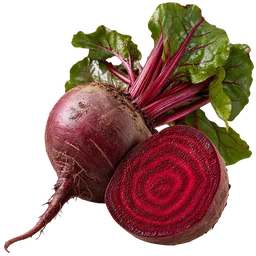
Beet
Best for
Raise your aerobic capacity
Faint early signal 100–280 mL/day 3 studies, n=78
- 13 papers
- 5 of 28 outcomes
- 4 positive
- 1 major interaction
Beet delivers likely real but unnoticeable improvements in nitric-oxide-related blood flow and blood pressure, without a meaningful, reliable exercise-performance boost.
Median effective dose, most-studied outcomes
- Build aerobic capacity 140 mL —
- Sustain more output for longer 140 mL 1 wk
- Promote easier vessel relaxation 280 mL 1 wk
Risk, worst reported severity
- Urine discolouration mild
- cadmium exposure
- warfarin major
What beet actually does
Nitric oxide helps blood vessels relax and maintain healthy circulation. 26873098 · 30653856 · 40128734
Blood pressure is the force of blood against artery walls, and high levels strain the heart. 40128734
Aerobic fitness helps you sustain hard exercise before fatigue makes you slow down. 30653856 · 38953606 · 39994008
Exercise endurance helps you sustain effort before fatigue makes you slow down or stop. 30653856 · 38953606 · 40369047
Overall sport performance reflects how well you perform across the demands of your sport. 38953606
| Outcome | Effect | Evidence | Dose | Time | Rank |
|---|---|---|---|---|---|
| Modest benefits 2 | |||||
| Improve nitric oxide balance Likely real but unnoticeable Nitric oxide helps blood vessels relax and maintain healthy circulation. | | 1 meta-analysis 3 papers · n=1.9k | 70–300 mL | 1 wk | #4 /21 |
| Lower blood pressure Likely real but unnoticeable Blood pressure is the force of blood against artery walls, and high levels strain the heart. | | 1 meta-analysis 1 papers · n=1.8k | 70 other | — | — |
| Early research 3 | |||||
| Raise your aerobic capacity Faint early signal Aerobic fitness helps you sustain hard exercise before fatigue makes you slow down. | | 3 RCTs 3 papers · n=78 | 100–280 mL | — | — |
| Keep going longer during exercise Barely detectable Exercise endurance helps you sustain effort before fatigue makes you slow down or stop. | | 3 RCTs 3 papers · n=70 | 140–280 mL | 1 wk | — |
| Perform better in sport Not enough research Overall sport performance reflects how well you perform across the demands of your sport. | | 1 RCT 1 papers · n=20 | 140 mL | — | — |
Effect tiers come from native-unit MCID where available, Cohen's d otherwise.
Dose, timing & forms
How much
The better-studied protocols use beetroot juice or concentrated juice in the neighborhood of 140 to 280 mL daily for aerobic capacity and sustained exercise output. 12 Vessel-relaxation studies cluster nearer 250 to 280 mL daily, but the blood-pressure changes in the reviewed evidence are small enough that most people will not feel them. 23
When and how long
Use beet consistently through the study period rather than treating it as an occasional pre-workout shortcut. The salient exercise and vessel studies ran for roughly 8 days, so any effect reflects repeated intake, not a single serving. 2 If you are testing it for training, keep the product and routine stable so you can judge whether the small possible effect matters for your own sessions. 12
Forms & standardisation
The clinical work centers on beetroot juice and concentrated juice products, not generic beet powder. 12 Look for a product that states its dietary nitrate content or provides transparent batch testing, because the nitrate is the compound tied to the blood-flow and exercise mechanism. 23 A bright red color alone does not tell you how much nitrate the product provides.
Studied range, by outcome
| Outcome | Studied range | Median effective | Duration | Evidence |
|---|---|---|---|---|
| Build aerobic capacity | 140–280 mL | 140 mL | — | 3 papers 2 sig. endpoints |
| Sustain more output for longer | 140–280 mL | 140 mL | 1 wk | 3 papers 1 sig. endpoint |
| Promote easier vessel relaxation | 250–280 mL | 280 mL | 1 wk | 3 papers 5 sig. endpoints |
| Build all-around athletic ability | 140 mL | — | — | 1 paper |
Adverse events and drug interactions
Safety events
Drug interactions
What this is and how it works
- Across 3 studies (n=1,867), nitric-oxide endpoints improved; one study (n=1,823) reported lower blood pressure, with no MCID supplied. 2
- Thirteen reviewed papers spanning 28 outcomes included blood-flow, blood-pressure, exercise, and oxygen-use measures.
- Findings primarily involve dietary nitrate, with exercise benefits remaining early and inconsistent. 1
After you consume beet nitrate, bacteria in your mouth and enzymes in your body convert it into nitric oxide, a signal that tells blood vessels when to relax. Think of it as opening extra lanes on a road when traffic builds, so blood can move with less resistance. 23 During exercise, nitrate also appears to lower the oxygen needed for a set workload, although that physiological change does not guarantee a meaningful improvement in race or gym performance. 12
Bottom line
Beetroot is reasonable for someone curious about a small edge in aerobic training or blood-flow support, especially if they enjoy juice-based supplements. Keep expectations grounded: the reviewed findings show subtle vessel effects and early, inconsistent exercise results rather than a dramatic endurance upgrade. 123 Skip self-experimentation without clinical advice if you take warfarin.
Co-studied with
Common questions
Does beetroot juice improve endurance?
Does beetroot lower blood pressure?
Why does beetroot juice affect exercise?
Is beetroot juice safe to take every day?
Sources
Sources
- 1. Dietary nitrate supplementation reduces the O2 cost of low-intensity exercise and enhances tolerance to high-intensity exercise in humans (2009) ↑
- 2. Acute and chronic effects of dietary nitrate supplementation on blood pressure and the physiological responses to moderate-intensity and incremental exercise (2010) ↑
- 3. Inorganic nitrate supplementation lowers blood pressure in humans: role for nitrite-derived NO (2015) ↑
Generated August 27, 2026
Related
More evidence for Beet
Ingredient evidence
Ingredient evidence
NewBeet nitrate
All scored outcomes
Aug 27, 2026
Ingredient evidence
Ingredient evidence
NewRhodiola
All scored outcomes
Aug 27, 2026
Ingredient evidence
Ingredient evidence
NewAlanine
All scored outcomes
Aug 27, 2026
Ingredient evidence
Ingredient evidence
NewArginine
All scored outcomes
Aug 27, 2026
Ingredient evidence
Ingredient evidence
NewBeta-Alanine
All scored outcomes
Aug 27, 2026
Ingredient evidence
Ingredient evidence
NewCaffeine
All scored outcomes
Aug 27, 2026