Rhodiola
22 studies read · 6 answers · 7 sources
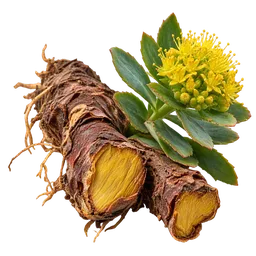
Rhodiola provides a proven modest benefit for exercise endurance, helping active adults work longer before fatigue and modestly raising aerobic capacity, while benefits for stress and persistent daily fatigue remain less certain.
What it does
Clear benefits
-
Better endurance performance · Probably helps
Endurance performance matters when an effort lasts long enough that keeping a steady pace becomes the challenge.
6 trials · at least 359 people · 1 review · noticed in <1–5 weeks
Early findings (5)
-
Sharper focus · May help
5 trials · 148 people · noticed in 1–4 weeks
-
More sprint speed and power · May help
2 trials · 72 people · noticed in 1–4 weeks
-
Fewer anxiety symptoms · May help
1 trial · 80 people · noticed in 2 weeks
-
Feel less daily stress · May help
1 trial · 80 people · noticed in 2 weeks
-
More everyday energy, less fatigue · Unclear if it helps
1 trial · 40 people · noticed in 1–6 weeks
How to take it
Rhodiola makes the most sense for an active person who wants a modest, evidence-based endurance edge and accepts that the payoff is likely subtle. Skip it as a primary answer for persistent daily fatigue or stress, since those findings remain mixed or early. If you use prescription medicines or tend toward insomnia, get pharmacist or clinician guidance before trying it.
How much
For the best-supported use, short-term exercise studies span a wide 60 to 2,400 mg/day range, with many effective protocols clustering around roughly 600 to 1,000 mg/day of oral extract.2,3,4 Aerobic-capacity studies generally ran for several weeks, while some endurance experiments tested a single pre-exercise serving.2,3 Do not interpret higher doses as better. The observed endurance and aerobic gains are small, and evidence for everyday fatigue remains inconsistent.4,6
When
Match timing to your goal rather than taking Rhodiola randomly. Exercise research has tested it shortly before a workout for acute performance, while aerobic and stress-related protocols used daily dosing for weeks.2,3,6 Take it earlier in the day at first, especially if you are prone to light sleep or difficulty falling asleep. Consistent daily use matters more for multiweek outcomes than occasional use.1,6
Which form
Look for a root extract that names both rosavins and salidroside on the label. Much of the older fatigue research used the standardized SHR-5 root extract, so a product that discloses its standardization gives you a closer match to the human evidence than an unspecified raw-root powder.1,6 Different extracts are not automatically interchangeable, which helps explain why labels with the same milligram amount can perform differently.4,5
The dose that worked, by measure (7)
- Sustain more output for longer
- 1,025 mg<1–5 weeks
- Hold focus through repetitive work
- 576 mg1–4 weeks
- Have less fatigue
- 576 mg1–6 weeks
- Build aerobic capacity
- 645 mg2–5 weeks
- Make hard exercise feel easier
- 3 mg/kg1–4 weeks
- Support healthier cortisol patterns
- 576 mg4 weeks
- Soften the fight-or-flight surge
- 1,750 mg<1 weeks
Who should be careful
Medicines it can clash with
- paroxetine major
- losartan moderate
- doxorubicin moderate
- apatinib moderate
- chloroquine moderate
- tilmicosin moderate
- ceftriaxone minor
Reported side effects
- headache mild
- Difficulty in falling asleep mild
- Light sleep mild
- Dizziness mild
- Drowsiness mild
- Pruritus mild
- Dry hand mild
- Abdominal distension mild
Bottles worth buying
Dosed where the research is, in a clean formula, from audited brands. Not sponsored.
-

Rhodiola Rosea 3% Rosavins
Nootropics Depot · 500 mg a day · brand audit 87
-

Rhodiola Rosea Capsules 500 mg
Nootropics Depot · 500 mg a day · brand audit 87
-

Rhodiola Rosea
Pure Encapsulations · 200 mg a day · brand audit 78
-

Rhodiola Rosea
Nature's Answer · 420 mg a day · brand audit 75
-

Ultra Rhodiola Extract 500 mg
The Vitamin Shoppe · 500 mg a day · brand audit 69
-

Rhodiola Rosea Root 400 mg
Swanson · 400 mg a day · brand audit 69
How it works
Rhodiola appears to influence stress-signaling systems, including the brain chemicals and hormone signals that decide how strongly you react when pressure hits.5 Think of it as adjusting a smoke alarm's sensitivity, not removing the fire: the goal is a less jumpy alarm response while the real demand still exists.5 Human trials show small exercise effects, but they do not yet pin those effects on one proven biological pathway.2,3
Studied alongside
Common questions
What is Rhodiola best supported for?
Does Rhodiola give you energy like caffeine?
Can you take Rhodiola before a workout?
Does Rhodiola reduce stress?
Sources
- 1. Clinical trial of Rhodiola rosea L. extract SHR-5 in the treatment of stress-related fatigue (2000)
- 2. Acute Rhodiola rosea intake can improve endurance exercise performance (2004)
- 3. The effects of acute Rhodiola rosea supplementation on exercise performance and cognitive function (2013)
- 4. Rhodiola rosea for physical and mental fatigue: a systematic review (2012)
- 5. Effects of adaptogens on the central nervous system and the molecular mechanisms associated with their stress-protective activity (2010)
- 6. A randomised, double-blind, placebo-controlled, parallel-group study of the standardised extract SHR-5 of the roots of Rhodiola rosea in the treatment of subjects with stress-related fatigue (2009)
- 7. Rhodiola rosea L. in generalized anxiety disorder: a double-blind, randomized, placebo-controlled study (2008)