New Rhodiola rosea Published May 1, 2026
A Root for Harsh Places: How Rhodiola Turns Stress into Stamina—Sometimes in an Hour, Sometimes in a Month
Better stress resilience, sustained energy without crashes, and improved endurance during tough days
Evidence summary
Rhodiola supports short-term stamina and stress-fatigue relief, with the strongest evidence coming from acute endurance tests and four-week fatigue trials.
- Acute Rhodiola intake improved endurance and lowered perceived exertion within about an hour 6.
- Standardized extract studies in stress-related fatigue improved attention and blunted the morning cortisol surge 3.
- Depression trials found fewer adverse events than sertraline, but smaller antidepressant effects 5.
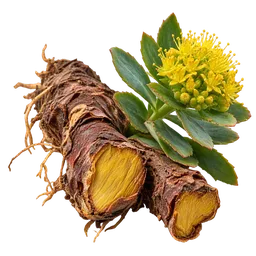
High on wind-scraped coasts and mountain ledges, a rose-scented root clings to stone. People from Siberia to Scandinavia carried it for "hard days." Centuries later, scientists asked a deceptively simple question: can a plant built for harsh places help humans endure ours?
The plant that learned to say "not today" to stress
Rhodiola rosea grows where life is inconvenient—Arctic slopes, sea cliffs, thin soils. In old medical texts and northern folklore, its root was prized when work was long and weather unforgiving. The modern European regulator echoes that tradition cautiously: arctic root (R. rosea) "can be used for the temporary relief of symptoms of stress, such as fatigue and sensation of weakness," a recognition based on long-standing use—not definitive trials. 1 Across the Atlantic, the U.S. National Center for Complementary and Integrative Health keeps us honest: "There isn't enough evidence from studies in people to allow conclusions to be reached about whether rhodiola is helpful for any health-related use." 2 So what do we actually know when we leave legend and step into labs?
When the mind sags under load
In a Swedish phase III trial of people with stress-related fatigue, a month of standardized rhodiola extract improved concentration (fewer missed targets on a continuous attention test) and nudged the body's morning stress signal toward normal—a smaller cortisol surge on waking—compared with placebo. Participants didn't report serious side effects. Think of it as turning down a blaring alarm so you can focus on the task at hand. 3 Clinicians treating burnout—a modern word for an ancient problem—tested rhodiola open-label in 118 outpatients. Within a week, many scales ticked toward better mood, energy, and work function; gains continued over 12 weeks on 400 mg daily, with few adverse events. This isn't a placebo-controlled proof, but it reads like a clinic day where people walk back in saying, "I can cope again." 4
The Zoloft paradox
One of the most talked-about trials compared rhodiola to sertraline (Zoloft) and placebo in mild to moderate depression. Over 12 weeks, sertraline reduced depression scores more than rhodiola—but also caused far more side effects. Rhodiola's symptom relief was modest, not statistically superior to placebo—but it was better tolerated. The authors' practical takeaway: for some who can't manage SSRI side effects, a gentler herb could offer a smaller benefit with fewer bumps. 5
"These results are a bit preliminary but suggest that herbal therapy may have potential to help patients with depression who cannot tolerate conventional antidepressants due to side effects," said lead author Jun Mao, MD. 14
The one-hour effect athletes noticed
Here's the surprise: rhodiola doesn't always require weeks. In two small crossover studies, a single dose taken about an hour before exercise helped people last longer or finish a cycling time trial faster, often with a lower perceived effort or heart rate—as if the hill briefly flattened. These are acute, performance-day effects, not training adaptations. 67 Students grinding through exams also showed hints of sharper performance and less mental fatigue after short courses of a standardized extract, and night-duty physicians made fewer attention slips in a cross-over design. The common thread is simple: when pressure climbs, rhodiola sometimes steadies the hand. 8
What might be happening inside
Rhodiola is classified among "adaptogens," a family of plants that seem to coach the body's stress-gearbox. In plain terms: they help the brain's thermostat for stress—centered in the hypothalamus and its hormone cascades—avoid overreacting. Reviews describe lab evidence that compounds like salidroside and rosavins nudge our cellular guardians (think chaperone proteins and antioxidant switches) so cells keep their bearings, while neurotransmitter systems involved in drive and mood get a light tune-up. Rather than flooring the gas or slamming the brakes, rhodiola appears to help the system shift smoothly. 9
Choosing a bottle in a messy marketplace
Here's the twist the plant didn't ask for: adulteration. Surveys of commercial products found that about 20–25% lacked rhodiola's signature markers (rosavins), while many others were diluted with different Rhodiola species. In one analysis, a product even harbored undeclared 5-HTP. Translation: what's on the label isn't always in the capsule. 10 Quality cues to look for:
Standardization to rosavins (~3%) and salidroside (~1%)—the fingerprint of genuine R. rosea defined in pharmacopeial texts. 11
Third-party testing and clear species naming (Rhodiola rosea L., not just "rhodiola").
Conservative claims that match regulators' language and the mixed research.
How people tend to use it (when they try it)
Patterns from trials and registries suggest:
For stress-related fatigue or burnout, standardized extracts around 200–400 mg/day are common; people often notice changes within 1–2 weeks, with fuller effects by 4–8 weeks. 34
For acute performance, a single dose taken ~60 minutes pre-effort (about 200 mg or ~3 mg/kg in studies) may trim perceived exertion. 67
Because it can feel gently stimulating, morning or early-afternoon dosing is typical to avoid sleep disruption. 2 Safety looks favorable over short spans (6–12 weeks), but a few cautions matter. The MSD Manual notes uncommon effects like dizziness or dry mouth and highlights a case report of mania; clinicians therefore advise avoiding rhodiola—or using it only with medical oversight—if you have bipolar disorder or a history of mania/hypomania. Combining rhodiola with serotonergic antidepressants (SSRIs/MAOIs) may raise theoretical risks like rapid heart rate or serotonin syndrome, so coordination with your prescriber is wise. 1213
Where the story goes next
Regulators in Europe still categorize rhodiola's stress claims as "traditional use," even after reviewing newer data—meaning the story is promising but unfinished. 1 A 2012 systematic review of randomized trials found several positive signals (attention, fatigue, possibly mood) offset by small samples and inconsistent methods, calling for larger, independent replications. 15 Newer trials continue to explore both the fast (one-hour) edge for performance and the slow (weeks) edge for burnout and mood. Maybe that's the real lesson of a cliff-dwelling plant. Endurance isn't a single trick; it's a set of gears. On some days, a small nudge an hour before the climb helps. On others, steadier recalibration over weeks matters more. Rhodiola offers both possibilities—if we choose authentic products, set measured expectations, and keep science, not mythology, in the driver's seat. 7345
Key takeaways
What to walk away with
- 01
Evidence is promising but not definitive: U.S. NCCIH says there isn't enough evidence for firm conclusions, while a European regulator allows traditional-use claims for temporary relief of stress-related fatigue.
- 02
Two tempos of benefit: a single pre-event dose can ease effort and support endurance within about an hour; multi-week use (around four weeks) has improved attention and moderated morning cortisol in stress-fatigue.
- 03
Practical dosing: standardized extracts near 200–400 mg/day are common for stress-fatigue; acute performance studies used a single ~200 mg dose or about 3 mg/kg about 60 minutes before effort.
- 04
Who it may fit: people with stress-related fatigue or burnout, those sensitive to SSRI side effects seeking gentler mood support, and endurance athletes wanting an occasional same-day edge.
- 05
Cautions and duration: generally well tolerated short-term (6–12 weeks), but avoid with bipolar disorder unless supervised; coordinate care if on SSRIs/MAOIs or with blood pressure, diabetes, or bleeding concerns.
- 06
Trade-offs vs medication: in mild–moderate depression, rhodiola caused fewer adverse events than sertraline but had smaller antidepressant effects.
Effect timeline
When to expect what
- Immediate
- Within hours (single-dose exercise studies)
- Peak
- 1–4 weeks for stress/fatigue; benefits may continue through 8–12 weeks
- Duration needed
- At least 4–8 weeks for burnout/stress; single doses for acute performance days
- Wears off
- Not well studied; likely gradual over weeks after stopping
Research trajectory
What the studies actually show
-
A single pre-exercise dose improved endurance performance and/or reduced perceived effort within about an hour. 6
Crossover trials showed longer time to exhaustion or faster cycling time trials after acute dosing.
Suggests an immediate, situational benefit distinct from long-term adaptation.
-
Four weeks of standardized extract improved attention performance and tempered the morning cortisol spike in stress-related fatigue. 3
A Swedish RCT used cognitive testing and saliva sampling to capture both mind and hormone changes.
Connects subjective 'less burned out' with measurable focus and stress-signal calibration.
-
Compared with sertraline, rhodiola produced fewer adverse events but smaller antidepressant effects in mild to moderate depression. 5
A three-arm RCT randomized 57 adults to rhodiola, sertraline, or placebo for 12 weeks.
Frames rhodiola as a potentially better-tolerated but less potent option.
Human trials
What real trials found
-
Burnout outpatients received 400 mg/day standardized rhodiola for 12 weeks; multiple scales improved, some within 1 week; low adverse events. 4
- Outcome
- Progressive improvement in stress, mood, and functioning; good tolerability.
- Why it matters
- Real-world clinical course suggests time pattern and safety.
- Source
- Kasper & Dienel 2017 open-label multicenter trial
-
Stress-related fatigue trial (576 mg/day for 28 days) improved attention and reduced the cortisol awakening surge vs placebo. 3
- Outcome
- Better concentration metrics; modulated morning cortisol response.
- Why it matters
- Links subjective fatigue relief with objective attention and stress-hormone changes.
- Source
- Olsson et al. 2009 RCT (SHR-5 extract)
-
Major depression trial compared rhodiola, sertraline, and placebo over 12 weeks. 5
- Outcome
- Sertraline worked more but caused more side effects; rhodiola had fewer adverse events and modest symptom change.
- Why it matters
- Frames rhodiola's risk–benefit in mood care.
- Source
- Mao et al. 2015 RCT
Expert insights
Voices in the field
These results are a bit preliminary but suggest that herbal therapy may have potential to help patients with depression who cannot tolerate conventional antidepressants due to side effects. 14
On the basis of its long-standing use, arctic root can be used for the temporary relief of symptoms of stress, such as fatigue and sensation of weakness. 1
There isn't enough evidence from studies in people to allow conclusions to be reached about whether rhodiola is helpful for any health-related use. 2
Practical guidance
Putting it to use
Who may benefit
People facing stress-related fatigue, shift work or burnout; those seeking a gentler mood support with side-effect sensitivity; endurance athletes looking for an occasional, same-day edge.
Who should avoid
People with a history of mania/hypomania or bipolar disorder without medical oversight; those on MAOIs or complex serotonergic regimens.
Dosing
Standardized extracts near 200–400 mg/day are common in stress-fatigue studies; acute exercise studies used a single 200 mg dose or ~3 mg/kg about 60 minutes pre-effort.
Timing
Take in the morning or early afternoon; for workouts or cognitively demanding events, consider a single dose about an hour prior.
Quality
Choose products standardized to ~3% rosavins and ~1% salidroside with third-party testing. Avoid unlabeled 'rhodiola' that may be other species; adulteration is common.
Cautions
Short-term use (6–12 weeks) appears well tolerated, but rare cases of mania exist; avoid if you have bipolar disorder unless supervised. Coordinate with a clinician if using SSRIs/MAOIs or if you have blood pressure, diabetes, or bleeding concerns.
A closing thought
Rhodiola's lesson is not that nature offers miracles, but that resilience has tempos. Sometimes you need a quick steadying hand; sometimes you need weeks of recalibration. The root that survives on a cliff invites us to do both—carefully, authentically, and with science as our rope.
Frequently asked
Common questions
What's the evidence—folk tale or proven aid?
How fast might I feel something from rhodiola?
What dose and timing are used in studies?
Who should be cautious or avoid it?
How does it compare to an antidepressant like sertraline?
How long should I take rhodiola?
Related
More on this supplement
Pulled from across the site — rankings, comparisons, combinations, and reviews where this supplement shows up.
Ingredient evidence
Ingredient evidence
NewRhodiola
All scored outcomes
Aug 27, 2026
Evidence guide
Rhodiola rosea
NewThe Yellow Flower Behind the Red Curtain: What Rhodiola Really Teaches Us About Stress, Stamina, and Subtlety
Evidence guide
Mar 10, 2026
Ranking
Daily Stress
NewBest Supplements for Daily Stress Relief, Ranked by Clinical Evidence
Evidence ranking
Apr 4, 2026
Systematic review
Systematic review
NewRhodiola for Fatigue and Physical Performance
GRADE evidence review
May 5, 2026
Evidence map
Focus & memory
NewFocus & memory: evidence map across 45 supplements
Evidence coverage map
Jul 30, 2026
Sources
- 1. Rhodiolae roseae rhizoma et radix – EU herbal monograph summary (Revision 1) (2024)
- 2. Rhodiola: Usefulness and Safety (2024)
- 3. Randomised, double-blind trial of SHR-5 in stress-related fatigue (2009)
- 4. Open-label clinical trial in burnout with Rhodiola rosea extract (WS 1375) (2017)
- 5. Rhodiola rosea versus sertraline for major depressive disorder: randomized, placebo-controlled trial (2015)
- 6. Acute Rhodiola rosea intake can improve endurance exercise performance (2004)
- 7. The effects of an acute dose of Rhodiola rosea on endurance exercise performance (2013)
- 8. Student exam-stress pilot: SHR-5 for mental fatigue (2000)
- 9. Effects of Adaptogens on the CNS and molecular mechanisms of stress-protective activity (2010)
- 10. The authenticity and quality of Rhodiola rosea products (2016)
- 11. USP Herbal Medicines Compendium: Rhodiola rosea Root and Rhizome (final) (2016)
- 12. Rhodiola – MSD Manual (Professional Edition): adverse effects and interactions (2025)
- 13. Mania Associated With Rhodiola Rosea: Case Report (2022)
- 14. Psychiatric News: Roseroot Shows Some Promise in Treating Depression (includes Jun Mao quote) (2015)
- 15. Rhodiola rosea for physical and mental fatigue: a systematic review (2012)
1,094 words · 15 sources · Rhodiola rosea