New Rhodiola rosea Published Mar 10, 2026
The Yellow Flower Behind the Red Curtain: What Rhodiola Really Teaches Us About Stress, Stamina, and Subtlety
Alert energy without the crash, gentler stress response, and steady focus during demanding periods
Evidence summary
Rhodiola mainly delivers a modest, short-term lift in alertness and stress-related fatigue, but the evidence is inconsistent and not strong enough to count as dependable treatment.
- Across one 28-day randomized trial, SHR-5 improved attention and burnout scores versus placebo and lowered cortisol awakening response.2
- Short trials used different extracts and doses across stressed adults, physicians, students, and mild–moderate depression.
- A 6-week nursing-student trial found rhodiola worsened fatigue versus placebo.
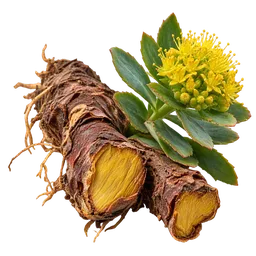
A sealed research city in Siberia. Sleep-deprived cadets. Cosmonauts orbiting in tin can silence. The herb that kept surfacing in their logbooks wasn't caffeine—it was a rose-scented root from the Arctic: rhodiola. Soviet scientists whispered that it could keep you alert without the crash, a plant that trained the body to ride stress instead of breaking under it.1
From Soviet secret to supermarket shelf
Long before Western wellness blogs caught on, rhodiola was brewed in Siberian kitchens, sipped by Vikings before raids, and tucked into the kits of high-latitude workers. The Soviets classified it as an "adaptogen"—a plant meant to help the body shoulder stress—with stories of soldiers staying sharp during sleep-deprivation tests and cosmonauts in better moods after weeks in cramped space modules. Psychiatrist Patricia Gerbarg called its effect "stimulating without the crash," and exercise scientist Eric Noreen recalled participants who seemed unusually upbeat on "Rhodi."1
What modern trials actually show
When researchers left the folklore behind and ran controlled trials, the picture became more nuanced. A Swedish phase III trial using the standardized extract SHR-5 (576 mg/day for 28 days) in people with stress-related fatigue found improvements in attention and burnout measures versus placebo, along with a blunted morning cortisol surge—the body's "get up and go" signal. In plain terms: some participants focused better and felt less wrung-out, with signs their internal stress alarm wasn't blaring as loudly.2 But rhodiola can also disappoint. In a six-week study of nursing students on rotating shifts, those taking rhodiola actually did worse on fatigue scales than the placebo group—an uncomfortable reminder that context matters and that not all stress is the same.3 A 2012 systematic review tried to stack the evidence and reached a cautious verdict: too many small, inconsistent trials to pool cleanly, with hints of benefit but methods that made firm conclusions slippery. Translation: interesting signals, uneven science.4
Mood, motivation, and the human scale
In depression, rhodiola's story is one of modest light rather than blazing sun. In a head-to-head trial against sertraline (Zoloft) for mild to moderate major depression, sertraline edged out rhodiola on symptom relief, but rhodiola caused fewer side effects—raising the possibility that for some, a gentler if weaker option could be part of the conversation.5 And in 2020, adding rhodiola to sertraline in a 12-week randomized trial led to greater drops in depression scores than sertraline alone at the higher rhodiola dose—suggesting a supporting role, though it's only one study and needs replication.6
The paradox that explains the mixed results
Rhodiola often follows a bell-shaped curve: too little does little; a middle range seems to help; too much can cancel the benefit. Biologists call this hormesis—the idea that small challenges coach our defenses while big ones overwhelm them. Reviews catalog this biphasic pattern across cell and animal work and tie it to longevity and neuroprotection endpoints. In animals, for example, low doses shortened barbiturate sleep (more alert), while very high doses lengthened it (more sedated). In humans, that could mean the right dose sharpens, while overshooting feels flat.7
Performance: sparks, not fireworks
Single-dose studies in fatigued young physicians and sleep-deprived cadets reported quicker thinking and less mental wear, with no clear advantage from taking more. Think of it as nudging your brain's pacing, not turning on a turbo.89 Newer work in strength athletes under "mental-fatigue" conditions found no difference versus placebo on feeling tired or on most cognitive measures, but a small bump in early-set rep counts—a spark, not a blaze.10
Quality matters more than you think
Here's an unglamorous twist: not all "rhodiola" is the same plant. True Rhodiola rosea carries marker compounds called rosavins alongside salidroside. Investigators testing commercial products found that about one in five lacked rosavin entirely, and many others were diluted with different Rhodiola species—sometimes even laced with unrelated actives. That's like buying "Arabica coffee" and getting chicory with a dash of caffeine. Look for products standardized to about 3% rosavins and 1% salidroside, ideally with third-party testing.1112
Tradition, translated for today
Europe's medicines regulator recognizes rhodiola as a traditional remedy for short-term stress symptoms like fatigue and weakness—but on tradition, not on rock-solid clinical proof. Their advice is practical: adults can use it for temporary relief, but seek medical guidance if you're using it longer than two weeks continuously. That neatly mirrors the herb's history—use during hard stretches, then reassess.13
Two expert voices that humanize the data
Psychiatrist Patricia Gerbarg, who sifted Soviet archives, summarized rhodiola's feel as "stimulating..without [a] crash," capturing why stressed workers and athletes reached for it in the first place.1
Researcher Alexander Panossian has described adaptogens like rhodiola as a kind of "stress-vaccine"—not a cure-all, but a trainer that rehearses the body's stress response so it's less jumpy when life gets loud.114
Safety: the part where honesty serves you best
Short-term studies generally find rhodiola well tolerated, with occasional dry mouth or dizziness. Still, rare red flags exist. A case report described tremor and restlessness—consistent with serotonin toxicity—when rhodiola was added to paroxetine (an SSRI). Another report linked rhodiola to a manic episode. If you're on antidepressants or have a history of bipolar disorder, involve your clinician, and avoid "more is better" dosing. This is a finesse herb.151617
How to work with the grain of the evidence
Aim for a standardized extract (often labeled SHR-5–like ratios) around 200–400 mg once daily, mornings or early afternoon to avoid sleep disruption. Start low; give it 1–2 weeks to judge day-to-day stamina and focus. In studies of fatigue, some of the biggest perceived improvements showed up by week one, with further gains by week eight—if it's helping, you'll usually feel the nudge early.2311
Use it for demanding periods, then cycle off. If you plan to take it longer than two weeks straight for stress-fatigue relief, follow EMA's lead and check in with a professional.13
Don't expect it to fix shift-work exhaustion or major depression on its own. Evidence there is mixed or modest; think adjunct, not anchor.356 If rhodiola has a lesson, it's that resilience is rarely about blasting harder. It's about tuning—finding the middle of the curve where you feel steady under load. That's what the cadets, cosmonauts, and lab volunteers were all, in their own ways, chasing. And why, decades after those Siberian nights, this Arctic root still has a seat at the table—quietly training the system that trains you.
Key takeaways
What to walk away with
- 01
Rhodiola's appeal is "stimulating without the crash," shifting from Soviet field use to measured benefits in modern studies with a promising evidence level.
- 02
Trials are mixed: SHR-5 improved attention and burnout over 28 days, yet shift-working students saw worse fatigue; effects likely depend on context and dose.
- 03
For mood, rhodiola was less effective than sertraline in mild–moderate depression but better tolerated; as an add-on, higher-dose rhodiola plus sertraline outperformed sertraline alone in one trial.
- 04
Practical dosing: standardized extract ~200–400 mg once daily (around 3% rosavins/1% salidroside), taken in the morning or early afternoon; start low and titrate to the smallest helpful dose.
- 05
Best use cases: adults under short, stress-heavy workloads seeking steady focus and stamina; athletes looking for small, situational performance gains—never a substitute for sleep, nutrition, or training.
- 06
Cautions: involve your clinician if on SSRIs/SNRIs or with bipolar history; rare reports link rhodiola to serotonin toxicity and mania. Avoid late-day dosing if stimulation sensitive.
Effect timeline
When to expect what
- Immediate
- Yes (mild) within hours to days in some studies
- Peak
- 2–6 weeks
- Duration needed
- Use during demanding periods; reassess at 2–8 weeks (seek advice if beyond 2 weeks for stress-fatigue)
- Wears off
- Often within 1–2 weeks after stopping
Research trajectory
What the studies actually show
-
SHR-5 extract (576 mg/day) improved attention and burnout measures and reduced cortisol awakening response over 28 days vs placebo. 2
Swedish phase III RCT in stress-related fatigue.
Supports anti-fatigue, focus-related benefits in a defined population.
-
In shift-working nursing students, rhodiola worsened fatigue vs placebo over 6 weeks. 3
PLOS ONE randomized trial.
Not all stress states respond similarly; context matters.
-
Against sertraline in mild–moderate depression, rhodiola was less effective but better tolerated; as augmentation, higher-dose rhodiola + sertraline outperformed sertraline alone in one trial. 5
J Affect Disord 2015 head-to-head; J Affect Disord 2020 augmentation.
Signals a potential adjunct role with a favorable side-effect profile.
-
Systematic review could not meta-analyze due to heterogeneity; overall evidence suggestive but limited. 4
BMC Complement Med Ther 2012 review.
Calibrates expectations: promising, not definitive.
-
Evidence of hormetic (bell-shaped) dose responses in rhodiola and salidroside across models. 7
Recent reviews synthesize biphasic effects.
Helps explain why dose and context change outcomes.
-
Triple-blind crossover study found small performance bumps in early sets but no mental-fatigue advantage vs placebo. 10
Nutrients 2025 strength protocol under induced mental fatigue.
Benefits may be subtle and task-specific.
Human trials
What real trials found
-
68-year-old woman on paroxetine develops restlessness, tremor after adding rhodiola; interpreted as serotonergic toxicity. 15
- Outcome
- Symptoms consistent with serotonin syndrome; highlights interaction risk with SSRIs.
- Why it matters
- Real-world safety caution for readers using antidepressants.
- Source
- Neuropsychiatrie case report (2015)
-
Mania associated with rhodiola use reported in Primary Care Companion (2022). 16
- Outcome
- Manic episode temporally related to rhodiola.
- Why it matters
- Caution in bipolar spectrum disorders.
- Source
- Prim Care Companion CNS Disord case report (2022)
-
Open-label 8-week fatigue study (WS 1375, 200 mg twice daily) in 100 adults. 11
- Outcome
- Largest symptom drop by week 1; continued improvement to week 8; well tolerated.
- Why it matters
- Gives a realistic timeline for perceived effects.
- Source
- Karger/Pharmacopsychiatry open-label trial (2017)
Expert insights
Voices in the field
"It stimulates you, without making you crash and burn." 1
Rhodiola acts like a kind of "stress-vaccine," making people less sensitive to stressors. 14
Practical guidance
Putting it to use
Who may benefit
Adults facing short-term, stress-heavy workloads who want a gentle lift in stamina and focus; some with mild low mood as adjunct to standard care; athletes seeking small, situational performance gains—not a replacement for sleep, nutrition, or training.
Who should avoid
Those with bipolar disorder prone to mania; people on serotonergic antidepressants without medical oversight; individuals with poorly controlled hypertension or hypotension should use caution given variable effects.
Dosing
Standardized extract around 200–400 mg once daily (often labeled ~3% rosavins/1% salidroside) in the morning or early afternoon; start low and titrate to the smallest dose that noticeably helps.
Timing
Use during crunch periods (exams, product sprints, travel). Many feel a nudge in the first week; if nothing by week two, reconsider.
Quality
Choose products that specify Rhodiola rosea (not just "Rhodiola"), list rosavins/salidroside percentages, and provide third-party testing—adulteration and species swaps are common.
Cautions
If you take SSRIs/SNRIs or have a bipolar history, involve your clinician; rare case reports link rhodiola to serotonin toxicity and mania. Avoid late-day dosing if sensitive to stimulation.
A closing thought
Rhodiola doesn't bulldoze biology; it negotiates. In an era of maximalist hacks, its bell-shaped curve is a quiet reminder that resilience often lives in the middle path—just enough challenge to grow, not so much that it breaks.
Frequently asked
Common questions
What dose should I start with?
How quickly might I feel rhodiola's effects?
Who is most likely to benefit?
Who should avoid or use extra caution?
Does rhodiola replace sleep or training?
Is rhodiola better than antidepressants?
Related
More on this supplement
Pulled from across the site — rankings, comparisons, combinations, and reviews where this supplement shows up.
Ingredient evidence
Ingredient evidence
NewRhodiola
All scored outcomes
Aug 27, 2026
Evidence guide
Rhodiola rosea
NewA Root for Harsh Places: How Rhodiola Turns Stress into Stamina—Sometimes in an Hour, Sometimes in a Month
Evidence guide
May 1, 2026
Ranking
Daily Stress
NewBest Supplements for Daily Stress Relief, Ranked by Clinical Evidence
Evidence ranking
Apr 4, 2026
Systematic review
Systematic review
NewRhodiola for Fatigue and Physical Performance
GRADE evidence review
May 5, 2026
Evidence map
Focus & memory
NewFocus & memory: evidence map across 45 supplements
Evidence coverage map
Jul 30, 2026
Sources
- 1. Before Steroids, Russians Secretly Studied Herbs (National Geographic, 2016) (2016)
- 2. A randomized, double-blind study of SHR-5 in stress-related fatigue (2009)
- 3. Rhodiola for mental and physical fatigue in nursing students: RCT (PLOS ONE) (2014)
- 4. Rhodiola rosea for physical and mental fatigue: systematic review (BMC) (2012)
- 5. Rhodiola vs sertraline for MDD: randomized placebo-controlled trial (2015)
- 6. Rhodiola + sertraline augmentation for MDD: randomized double-blind trial (2020)
- 7. Rhodiola and salidroside commonly induce hormesis: review (2023)
- 8. Night-duty physicians crossover study (SHR-5, repeated low dose) (2000)
- 9. Cadet single-dose study on mental work capacity (SHR-5) (2003)
- 10. Triple-blind crossover in strength under mental fatigue (Nutrients, 2025) (2025)
- 11. Open-label fatigue trial (WS 1375, 8 weeks) (2017)
- 12. Authenticity and quality of Rhodiola products (Phytomedicine) (2016)
- 13. EMA HMPC monograph summary (updated 2024) (2024)
- 14. Effects of Adaptogens on the CNS (Pharmaceuticals, 2010) (2010)
- 15. Interaction of Rhodiola and antidepressants: case report (Neuropsychiatrie) (2015)
- 16. Mania associated with Rhodiola rosea (case report, 2022) (2022)
- 17. NCCIH Rhodiola fact sheet (last updated 2020) (2020)
1,096 words · 17 sources · Rhodiola rosea