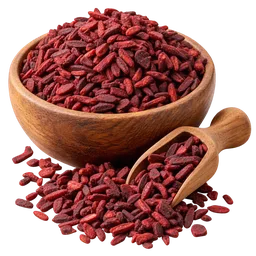
Red Yeast Rice
Best for
Lower cholesterol
Likely benefit 4–14 weeks 9 meta-analyses, n=27.6k #2 of 97 studied
- 13 papers
- 1 of 18 outcomes
- 1 positive
- 2 severe, 10 major interactions
Red yeast rice likely benefits adults seeking lower harmful cholesterol, with the strongest evidence supporting LDL reduction rather than broad benefits across every health outcome.
Median effective dose, most-studied outcomes
- Lower LDL cholesterol 1,200 mg 4–14 wk
- Lower total cholesterol 700 mg 4–14 wk
- Lower artery-clogging particle burden 5 mg 8 wk
Risk, worst reported severity
- Muscle ache severe
- hepatotoxicity severe
- clarithromycin major
- itraconazole major
What red yeast rice actually does
| Outcome | Effect | Evidence | Dose | Time | Rank |
|---|---|---|---|---|---|
| Clear benefits 1 | |||||
| Lower cholesterol Likely benefit High LDL cholesterol can build up in artery walls and raise the risk of heart disease. | | 9 meta-analyses 13 papers · n=28k | — | 4–14 wk | #2 /97 |
Effect tiers come from native-unit MCID where available, Cohen's d otherwise.
Dose, timing & forms
How much
For LDL cholesterol, the reviewed trials span an exceptionally broad 0.67 to 4,800 mg per day, largely because products differ in how much active monacolin they contain. The midpoint effective amount across these trials is 1,200 mg daily for LDL, while total cholesterol studies center around 700 mg daily.14 That label dose alone does not tell you how strong a product is, so do not assume two products with the same milligram number deliver the same exposure.3
When and how long
Trials test red yeast rice as a consistent daily routine over weeks, not as an occasional supplement. Cholesterol outcomes were commonly checked after about 8 weeks, with study durations ranging from 4 to 14 weeks.1 The trial evidence does not establish one best clock time, so follow the product directions and prioritize a schedule you can maintain every day.
Forms & standardisation
Look for a product that clearly identifies red yeast rice and states its monacolin content, especially monacolin K when the label provides it. Commercial products show major differences in monacolin strength, even when they look similar on the shelf.3 A standardized label improves transparency, but it does not erase the muscle and liver safety concerns associated with active monacolin exposure.24
Studied range, by outcome
| Outcome | Studied range | Median effective | Duration | Evidence |
|---|---|---|---|---|
| Lower LDL cholesterol | — | 1,200 mg | 4–14 wk | 13 papers 9 sig. endpoints |
| Lower total cholesterol | — | 700 mg | 4–14 wk | 13 papers 8 sig. endpoints |
| Lower artery-clogging particle burden | 5 mg | 5 mg | 8 wk | 1 paper 1 sig. endpoint |
| Improve your cholesterol balance | 5 mg | 5 mg | 8 wk | 1 paper 1 sig. endpoint |
| Lower cholesterol in atherogenic particles | 10 mg | — | 4 wk | 1 paper |
Adverse events and drug interactions
Safety events
Drug interactions
What this is and how it works
- Across 13 studies (n=27,612), red yeast rice lowered LDL cholesterol; a numerical effect size and MCID comparison were unavailable.1
- The reviewed evidence spans 13 papers and 18 outcomes, with benefit evidence concentrated on cholesterol reduction.
- Supplement strength varies widely between products, while muscle and liver safety concerns warrant clinician guidance.3
Bottom line
Red yeast rice makes the most sense for someone focused on lowering LDL who understands that this is a biologically active product, not a casual food-based add-on. The cholesterol evidence is convincing, but inconsistent product strength and the potential for muscle or liver problems make clinician guidance especially important if you take other medicines or have a history of either issue.134
Co-studied with
 Phytosterols19 shared
· d=1.17
Phytosterols19 shared
· d=1.17 Niacin19 shared
· d=1.17
Niacin19 shared
· d=1.17- Policosanol19 shared · d=1.17
Common questions
Does red yeast rice lower LDL cholesterol?
How long does red yeast rice take to affect cholesterol?
Is red yeast rice safe to take with other supplements or medicines?
Sources
Sources
- 1. A meta-analysis of red yeast rice: an effective and relatively safe alternative approach for dyslipidemia? (2014) ↑
- 2. Red yeast rice for dyslipidemia in statin-intolerant patients: a randomized trial (2009) ↑
- 3. Variability in strength of red yeast rice supplements purchased from mainstream retailers (2017) ↑
- 4. Traditional Chinese lipid-lowering agent red yeast rice results in significant LDL reduction but safety is uncertain (2015) ↑
Generated August 27, 2026
Related
More evidence for Red Yeast Rice
Ranking
High LDL and Total Cholesterol
NewBest Supplements to Lower LDL and Total Cholesterol
Evidence ranking
Apr 4, 2026
Evidence map
Metabolic health
NewMetabolic health: evidence map across 82 supplements
Evidence coverage map
Jul 30, 2026
Ingredient evidence
Ingredient evidence
NewArtichoke
All scored outcomes
Aug 27, 2026
Ingredient evidence
Ingredient evidence
NewAsian Psyllium
All scored outcomes
Aug 27, 2026
Ingredient evidence
Ingredient evidence
NewAvocado
All scored outcomes
Aug 27, 2026
Ingredient evidence
Ingredient evidence
NewBarberry (Berberis spp.)
All scored outcomes
Aug 27, 2026