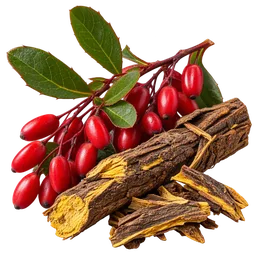
Barberry (Berberis spp.)
Best for
Keep blood sugar steadier
Large effect, needs confirmation 3000 mg/day 12 weeks 1 study, n=42
- 2 papers
- 4 of 17 outcomes
- 4 positive
Barberry (Berberis spp.) produced large improvements in blood glucose and cholesterol in adults with type 2 diabetes, but the finding needs confirmation because evidence comes from only two papers.
Median effective dose, most-studied outcomes
- Lower LDL cholesterol 3,000 mg 8–12 wk
- Lower total cholesterol 3,000 mg 8–12 wk
- Lower your triglyceride level 3,000 mg 8–12 wk
Risk, worst reported severity
- diarrhea mild
What barberry (berberis spp.) actually does
High LDL cholesterol can build up in artery walls and raise the risk of heart disease. 24250489 · 35255880
Steadier blood sugar can help avoid highs and lows that affect how you feel. 24250489
Insulin sensitivity describes how well the body responds to insulin to move sugar out of the blood. 24250489
| Outcome | Effect | Evidence | Dose | Time | Rank |
|---|---|---|---|---|---|
| Worth watching 3 | |||||
| Lower cholesterol Large effect, needs confirmation High LDL cholesterol can build up in artery walls and raise the risk of heart disease. | | 2 RCTs 2 papers · n=126 | 3–10 g | 8–12 wk | — |
| Keep blood sugar steadier Large effect, needs confirmation Steadier blood sugar can help avoid highs and lows that affect how you feel. | | 1 RCT 1 papers · n=42 | 3000 mg | 12 wk | — |
| Improve insulin sensitivity Large effect, needs confirmation Insulin sensitivity describes how well the body responds to insulin to move sugar out of the blood. | | 1 RCT 1 papers · n=42 | 3000 mg | 12 wk | — |
| Early research 1 | |||||
| Lower triglycerides Faint early signal High triglycerides are blood fats linked with a higher risk of heart disease. | | 2 RCTs 2 papers · n=126 | 3–10 g | 8–12 wk | — |
Effect tiers come from native-unit MCID where available, Cohen's d otherwise.
Dose, timing & forms
How much
The better-studied oral protocol used 3,000 mg daily for blood sugar, insulin response, LDL, and total cholesterol outcomes.1 Glucose and insulin measures were assessed after 12 weeks, while lipid outcomes were assessed across 8 to 12 weeks.1 That is a research protocol, not proof that more barberry produces better results.
When and how long
Use it consistently every day if you and your clinician decide it fits your plan. The available trials tracked changes over weeks, not an immediate effect after a single serving.1 The published evidence does not establish a best morning versus evening schedule, or a reliable advantage for taking it with food versus without food.
Forms & standardisation
Look for a product that clearly identifies the plant as Berberis and states the amount of barberry per daily serving. The clinical findings come from oral barberry preparations, so do not assume a product standardized to isolated berberine delivers the same result.1 Labels vary widely in plant part, extraction method, and berberine content, and the small trial base has not established one preferred standardization.
Studied range, by outcome
| Outcome | Studied range | Median effective | Duration | Evidence |
|---|---|---|---|---|
| Lower LDL cholesterol | 3,000 mg | 3,000 mg | 8–12 wk | 2 papers 1 sig. endpoint |
| Lower total cholesterol | 3,000 mg | 3,000 mg | 8–12 wk | 2 papers 1 sig. endpoint |
| Lower your triglyceride level | 3,000 mg | 3,000 mg | 8–12 wk | 2 papers 1 sig. endpoint |
| Lower your fasting blood sugar | 3,000 mg | 3,000 mg | 12 wk | 1 paper 1 sig. endpoint |
| Lower average blood sugar | 3,000 mg | — | 12 wk | 1 paper |
| Help cells use insulin better | 3,000 mg | 3,000 mg | 12 wk | 1 paper 1 sig. endpoint |
Adverse events and drug interactions
Safety events
What this is and how it works
- Across 2 papers (n=126), barberry lowered harmful cholesterol; glucose outcomes came from 1 study (n=42). 1
- The reviewed evidence spans 17 outcomes across 2 papers, including blood sugar, insulin response, and cholesterol.
- Evidence comes mainly from short trials in adults with type 2 diabetes, limiting confidence about other populations and products.
Barberry comes from Berberis shrubs, which grow bright red, sharply sour berries. People use the berries in food and traditional preparations, while supplements package barberry as powders, extracts, or blends. The clinical evidence so far tests oral barberry preparations, not every product sold under the name.1
Barberry contains berberine, a plant alkaloid that influences how cells handle fuel and how the liver clears LDL from the bloodstream.2 Think of it like adjusting a warehouse's receiving rules: cells take in and use fuel differently, while the liver puts more LDL particles into its removal line.2 That biology fits the early glucose and cholesterol results, but the human trials remain too few to settle the question.1
Bottom line
Barberry is worth watching for people interested in blood sugar or cholesterol support who understand that the current evidence is early, not settled.1 The reported effects look meaningful, but they come from only a few short trials. Skip the casual experimentation if you are prone to diarrhea or already use a plan that strongly affects blood sugar, and discuss it with a clinician first.
Common questions
Does barberry lower blood sugar?
Can barberry lower cholesterol?
Is barberry the same as berberine?
How long does barberry take to work?
Sources
Sources
Generated August 27, 2026
Related
More evidence for Barberry (Berberis spp.)
Evidence map
Metabolic health
NewMetabolic health: evidence map across 82 supplements
Evidence coverage map
Jul 30, 2026
Ingredient evidence
Ingredient evidence
NewBerberine
All scored outcomes
Aug 27, 2026
Ingredient evidence
Ingredient evidence
NewBitter Melon
All scored outcomes
Aug 27, 2026
Ingredient evidence
Ingredient evidence
NewChlorogenic Acid
All scored outcomes
Aug 27, 2026
Ingredient evidence
Ingredient evidence
NewChromium
All scored outcomes
Aug 27, 2026
Ingredient evidence
Ingredient evidence
NewCinnamon
All scored outcomes
Aug 27, 2026