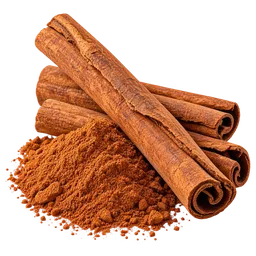
Cinnamon
Best for
Improve insulin sensitivity
Likely strong benefit 8–26 weeks 3 meta-analyses, n=2.1k #6 of 76 studied
- 38 papers
- 3 of 54 outcomes
- 3 positive
- 1 severe, 3 major interactions
Cinnamon delivers a likely strong benefit for insulin responsiveness, with the clearest evidence showing improved blood-sugar regulation across adults studied in supplementation trials.
Median effective dose, most-studied outcomes
- Lower your fasting blood sugar 1,500 mg 8–17 wk
- Lower average blood sugar 3,030 mg 8–17 wk
- Limit after-meal glucose rises 6,000 mg <1–16 wk
Risk, worst reported severity
- hepatitis severe
- dyspepsia moderate
- rosuvastatin major
- lipid modifying agents major
What cinnamon actually does
| Outcome | Effect | Evidence | Dose | Time | Rank |
|---|---|---|---|---|---|
| Strong benefits 1 | |||||
| Improve insulin sensitivity Likely strong benefit Insulin sensitivity describes how well the body responds to insulin to move sugar out of the blood. | | 3 meta-analyses 9 papers · n=2.1k | — | 8–26 wk | #6 /76 |
| Clear benefits 2 | |||||
| Keep blood sugar steadier Likely benefit Steadier blood sugar can help avoid highs and lows that affect how you feel. | | 5 meta-analyses 18 papers · n=5.8k | — | 8–17 wk | — |
| Avoid sharp blood sugar rises after meals Likely benefit Blood sugar normally rises after eating, but a smaller rise can make levels easier to manage. | | 1 meta-analysis 8 papers · n=739 | — | 0–16 wk | #5 /42 |
Effect tiers come from native-unit MCID where available, Cohen's d otherwise.
Dose, timing & forms
How much
For fasting glucose, trials span a very wide range, but about 1,500 mg daily sits near the middle of effective protocols. Studies tracking longer-term average glucose often use roughly 3,000 mg daily, while insulin-sensitivity protocols also vary substantially across products and populations.135 The huge dose spread does not mean more is better. It reflects different cinnamon species, preparations, and study designs.
When and how long
Use cinnamon consistently each day instead of saving it for occasional high-carb meals. Most fasting-glucose and longer-term glucose trials run for about 8 to 17 weeks, so judge your response over weeks, not days.15 For after-meal glucose, studies commonly pair cinnamon with a meal, which makes practical sense when the goal is to blunt that meal’s glucose rise.1
Forms & standardisation
Trial results cover cinnamon powder, capsules, and extracts, so the evidence does not crown one format as the clear winner.15 Choose a product that identifies the cinnamon species and lists the amount per serving. That transparency matters because cinnamon products differ in their natural coumarin content, a compound that becomes more relevant with concentrated, long-term use.
Studied range, by outcome
| Outcome | Studied range | Median effective | Duration | Evidence |
|---|---|---|---|---|
| Lower your fasting blood sugar | — | 1,500 mg | 8–17 wk | 18 papers 12 sig. endpoints |
| Lower average blood sugar | — | 3,030 mg | 8–17 wk | 14 papers 4 sig. endpoints |
| Limit after-meal glucose rises | — | 6,000 mg | <1–16 wk | 8 papers 4 sig. endpoints |
| Help cells use insulin better | — | 3,780 mg | 8–26 wk | 7 papers 2 sig. endpoints |
Adverse events and drug interactions
Safety events
Drug interactions
Recommended Cinnamon products
Real products that dose Cinnamon where the research does, in a clean formulation, from brands we've audited. We only list ones we'd stand behind.
-

Swanson
Full Spectrum Cinnamon 375 mg
Well dosed 2,250 mg/day A formulaBrand audit 69/100
-

Nutricost
Cinnamon 1,200 mg
Well dosed 1,200 mg/day A formulaBrand audit 57/100
-

BulkSupplements.com
Cinnamon Bark Extract
Well dosed 2,000 mg/day A formulaBrand audit 54/100
-

BulkSupplements.com
Cinnamon Bark Extract (1000 mg)
Well dosed 2,000 mg/day A formulaBrand audit 54/100
-

Swanson
True Cinnamon
Well dosed 1,200 mg/day B formulaBrand audit 69/100
-

Puritan's Pride
Cinnamon Alpha Lipoic Acid
Well dosed 1,400 mg/day A formulaBrand audit 68/100
Chosen for adequate Cinnamon dosing vs. the studied range, a clean formulation (grade A–C), and independent brand-quality audits. Not sponsored.
What this is and how it works
- Across 9 studies (n=2,063), cinnamon improved measures of insulin responsiveness; the supplied evidence reports no MCID comparison.1
- The reviewed evidence spans 38 papers and 54 outcomes, with insulin sensitivity representing the strongest claim.
- Findings cover varied cinnamon preparations, doses, and study populations, limiting precision about the best regimen.
Cinnamon comes from the aromatic inner bark of Cinnamomum trees. You know it as a warm baking spice, but capsules, powders, and extracts deliver much more concentrated amounts than the shake you add to oatmeal. Different species contain different natural compounds, so a label that simply says “cinnamon” leaves important details unanswered.
Cinnamon compounds appear to tune parts of the insulin-signaling chain that tell muscle and fat cells to pull glucose out of the bloodstream.4 Think of insulin as a text message telling a cell to open its door for glucose. Cinnamon appears to make the cell more likely to read that message, which fits the improved insulin sensitivity seen in clinical evidence.15
Bottom line
Cinnamon is a reasonable option for someone who wants modest, evidence-backed support for steadier blood sugar and stronger insulin response, especially when used daily for several weeks.15 Keep expectations grounded: it supports a larger routine rather than replacing food choices, activity, or clinical care. Skip casual high-dose experimentation, particularly if you use medicines that affect blood sugar, clotting, or cholesterol.
Common questions
Does cinnamon actually lower blood sugar?
How long does cinnamon take to work for blood sugar?
What kind of cinnamon is best for supplements?
Can cinnamon replace a blood sugar medication?
Sources
Sources
- 1. Cinnamon use in type 2 diabetes: an updated systematic review and meta-analysis (2013) ↑
- 2. Cinnamon intake lowers fasting blood glucose: meta-analysis (2011) ↑
- 3. Cinnamon improves glucose and lipids of people with type 2 diabetes (2003) ↑
- 4. Cinnamon extract enhances insulin signaling and glucose uptake in adipocytes (2003) ↑
- 5. The effect of cinnamon supplementation on glycemic control in adults: a systematic review and meta-analysis (2019) ↑
Generated August 27, 2026
Related
More evidence for Cinnamon
Evidence guide
Cinnamon (Cinnamomum spp.)
NewThe Dessert Spice That Tugged at Empires—and Today Nudges Blood Sugar (with a Catch)
Evidence guide
May 6, 2026
Ranking
Period Cramps (Primary Dysmenorrhea)
NewBest Supplements for Period Cramps, Ranked by Clinical Evidence
Evidence ranking
Apr 4, 2026
Evidence map
Metabolic health
NewMetabolic health: evidence map across 82 supplements
Evidence coverage map
Jul 30, 2026
Ingredient evidence
Ingredient evidence
NewBarberry (Berberis spp.)
All scored outcomes
Aug 27, 2026
Ingredient evidence
Ingredient evidence
NewBerberine
All scored outcomes
Aug 27, 2026
Ingredient evidence
Ingredient evidence
NewBitter Melon
All scored outcomes
Aug 27, 2026