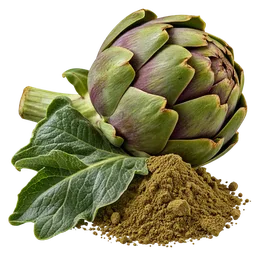
Artichoke
Best for
Lower cholesterol
Large effect, needs confirmation 1000–2700 mg/day 8 weeks 2 studies, n=114
- 5 papers
- 3 of 20 outcomes
- 3 positive
Artichoke leaf extract likely benefits liver enzyme levels, especially in people with nonalcoholic fatty liver disease, while cholesterol and indigestion benefits remain less certain.
Median effective dose, most-studied outcomes
- Keep liver enzymes steadier 2,037.5 mg 8–11 wk
- Lower LDL cholesterol 1,000 mg 8 wk
- Lower total cholesterol 2,700 mg 8 wk
Risk, worst reported severity
- abdominal pain
- doxorubicin moderate
- fosfomycin moderate
What artichoke actually does
Indigestion can cause upper-belly discomfort, early fullness, or burning after meals. 37323050
| Outcome | Effect | Evidence | Dose | Time | Rank |
|---|---|---|---|---|---|
| Clear benefits 1 | |||||
| Lower liver enzyme levels Likely benefit Liver blood tests can rise when liver cells are injured or bile flow is blocked. | | 1 meta-analysis 3 papers · n=689 | 50–2700 mg | 8–11 wk | #2 /39 |
| Modest benefits 1 | |||||
| Ease indigestion Likely modest benefit Indigestion can cause upper-belly discomfort, early fullness, or burning after meals. | | 1 meta-analysis 1 papers · n=244 | — | — | #3 /10 |
| Worth watching 1 | |||||
| Lower cholesterol Large effect, needs confirmation High LDL cholesterol can build up in artery walls and raise the risk of heart disease. | | 1 RCT 2 papers · n=114 | 1000–2700 mg | 8 wk | — |
Effect tiers come from native-unit MCID where available, Cohen's d otherwise.
Dose, timing & forms
How much
For liver enzyme support, studies used a very wide range, from 50 to 2,700 mg/day of oral extract. The more substantial liver-enzyme protocols clustered near 2,000 mg/day, but the varied products make that a description of research, not a universal starting dose.1 Cholesterol trials used 1,000 to 2,700 mg/day. Those cholesterol findings are attention-grabbing, but they come from a limited set of trials and deserve a cautious read.2
When and how long
Use artichoke extract daily and give it several weeks before deciding whether it is doing anything. Trials assessed sustained use rather than occasional capsules after a rich meal.123 Research does not establish a clear advantage for morning versus evening use, or for taking it with food versus without it, so follow the product directions and prioritize consistency.
Forms & standardisation
Look for an artichoke leaf extract, not powdered vegetable or an unspecified artichoke blend. The clinical evidence comes from concentrated leaf preparations, but studies used different extracts and standardization details, so labels are not interchangeable.123 A label that names the botanical species, Cynara scolymus, and identifies the extract amount gives you a more traceable product.
Studied range, by outcome
| Outcome | Studied range | Median effective | Duration | Evidence |
|---|---|---|---|---|
| Keep liver enzymes steadier | 50–2,700 mg | 2,037.5 mg | 8–11 wk | 3 papers 10 sig. endpoints |
| Lower LDL cholesterol | 1,000–2,700 mg | 1,000 mg | 8 wk | 2 papers 1 sig. endpoint |
| Lower total cholesterol | 1,000–2,700 mg | 2,700 mg | 8 wk | 2 papers 2 sig. endpoints |
Adverse events and drug interactions
Safety events
Drug interactions
What this is and how it works
- Across 3 studies (n=689), artichoke leaf extract improved liver enzyme blood tests, with no pooled magnitude or MCID reported.1
- Five papers reviewed here spanned 20 outcomes, including liver enzymes, cholesterol, and functional dyspepsia.
- Evidence is strongest for artichoke leaf extract in monitored adults with abnormal liver enzymes, not self-treatment of unexplained abnormalities.
Artichoke leaf extract comes from the leaves of Cynara scolymus, the same plant that produces the edible artichoke bud. Supplements concentrate leaf compounds such as caffeoylquinic acids and flavonoids, so a capsule is not simply a serving of steamed artichoke.
Artichoke leaf compounds appear to influence bile movement and the liver's handling of fats. Think of bile as the liver's dish-rinsing stream: it carries fats and certain waste products out through the digestive tract, and artichoke extract seems to keep that stream moving more smoothly.13 Human trials connect the extract with lower liver enzymes and shifts in blood cholesterol, though they do not prove that one mechanism explains every result.12
Bottom line
Artichoke leaf extract is most worth considering if you and a clinician are monitoring elevated liver enzymes and want an evidence-based supplement option alongside the basics. Its indigestion benefit looks smaller, while the cholesterol signal is exciting but early.123 Skip self-treatment for ongoing abdominal pain or unexplained abnormal liver tests, since those need medical evaluation first.
Common questions
Does artichoke leaf extract lower cholesterol?
Is artichoke leaf extract the same as eating artichokes?
How long does artichoke leaf extract take to work?
Sources
Sources
- 1. Effects of artichoke leaf extract on nonalcoholic fatty liver disease: A randomized double-blind clinical trial (2018) ↑
- 2. Artichoke leaf extract reduces plasma cholesterol in otherwise healthy hypercholesterolemic adults: A randomized, double blind placebo controlled trial (2008) ↑
- 3. Efficacy of artichoke leaf extract in patients with functional dyspepsia: A six-week placebo-controlled trial (2003) ↑
Generated August 27, 2026
Related
More evidence for Artichoke
Evidence map
Metabolic health
NewMetabolic health: evidence map across 82 supplements
Evidence coverage map
Jul 30, 2026
Ingredient evidence
Ingredient evidence
NewAsian Psyllium
All scored outcomes
Aug 27, 2026
Ingredient evidence
Ingredient evidence
NewAvocado
All scored outcomes
Aug 27, 2026
Ingredient evidence
Ingredient evidence
NewBarberry (Berberis spp.)
All scored outcomes
Aug 27, 2026
Ingredient evidence
Ingredient evidence
NewBerberine
All scored outcomes
Aug 27, 2026
Ingredient evidence
Ingredient evidence
NewBergamot (Citrus bergamia)
All scored outcomes
Aug 27, 2026