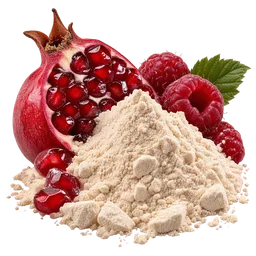
Ellagic Acid
Best for
Lower systemic inflammation
Promising early signal 180–500 mg/day 8 weeks 4 studies, n=202 #6 of 83 studied
- 9 papers
- 3 of 31 outcomes
- 3 positive
Ellagic acid shows a promising early signal for lower inflammation in adults with metabolic risk factors, while cholesterol and other outcomes remain supported by limited human evidence.
Risk, worst reported severity
- gastrointestinal events (bloating, diarrhoea, nausea, abdominal pain, constipation) mild
What ellagic acid actually does
The immune system can drive body-wide inflammation that affects long-term health and how people feel day to day. 34330312 · 35558999 · 38827464 +1
High LDL cholesterol can build up in artery walls and raise the risk of heart disease. 34330312
Blood pressure is the force of blood against artery walls, and high levels strain the heart. 36233611
| Outcome | Effect | Evidence | Dose | Time | Rank |
|---|---|---|---|---|---|
| Worth watching 2 | |||||
| Lower systemic inflammation Promising early signal The immune system can drive body-wide inflammation that affects long-term health and how people feel day to day. | | 4 RCTs 4 papers · n=202 | 180–500 mg | 8 wk | #6 /83 |
| Lower cholesterol Promising early signal High LDL cholesterol can build up in artery walls and raise the risk of heart disease. | | 1 RCT 1 papers · n=57 | 200 mg | 8 wk | — |
| Early research 1 | |||||
| Lower blood pressure Faint early signal Blood pressure is the force of blood against artery walls, and high levels strain the heart. | | 1 RCT 1 papers · n=30 | 500 mg | 12 wk | #2 /82 |
Effect tiers come from native-unit MCID where available, Cohen's d otherwise.
Dose, timing & forms
How much
Early human trials have tested roughly 180 to 500 mg daily, with the most developed signal involving inflammation-related measures rather than a proven symptom benefit.2 A 200 mg daily protocol appears in the single cholesterol finding, while a 500 mg daily protocol appears in the early blood-pressure result.34 These are research doses, not established targets, because the evidence remains small and preliminary.
When and how long
The existing trials examine regular daily use, not an occasional dose before a stressful day or a heavy meal.234 They do not establish a clear morning-versus-evening advantage or a proven need to take ellagic acid with food. Pick a consistent time that agrees with your stomach, and judge any change over the full trial period rather than after a few days.
Forms & standardisation
Look for a label that clearly states the actual ellagic acid amount, rather than only naming pomegranate or berry extract. Whole-food extracts bring along other polyphenols, so their effects cannot be pinned on ellagic acid alone.1 The small human trial base centers on supplemental ellagic acid, and it does not yet identify one extract ratio or delivery form as clearly best.23
Adverse events and drug interactions
Safety events
Recommended Ellagic Acid products
Real products that dose Ellagic Acid where the research does, in a clean formulation, from brands we've audited. We only list ones we'd stand behind.
-

Swanson
Pomegranate Extract 250 mg
Well dosed 250 mg/day A formulaBrand audit 69/100
-

XYMOGEN
OptiCleanse GHI Rice Original
Well dosed 250 mg/day A formulaBrand audit 80/100
-

XYMOGEN
OptiCleanse GHI Rice Raspberry Lemonade
Well dosed 250 mg/day B formulaBrand audit 80/100
-

Swanson Superior Herbs
Pomegranate Extract with Rhus Chinensis
Well dosed 250 mg/day A formula -

ProCaps Laboratories
Andrew's Five Favorites
Well dosed 200 mg/day A formula -

ProCaps
Women's Founder's
Well dosed 200 mg/day A formula
Chosen for adequate Ellagic Acid dosing vs. the studied range, a clean formulation (grade A–C), and independent brand-quality audits. Not sponsored.
What this is and how it works
- Across 4 studies (n=202), ellagic acid lowered inflammation markers; 1 study (n=57) also lowered harmful cholesterol.2
- Nine papers reviewed here span 31 outcomes, with strongest signals involving inflammation and cholesterol.
- Human evidence remains early, with cholesterol supported by only one small study.
Ellagic acid is a plant compound in foods such as pomegranate, raspberries, strawberries, blackberries, and walnuts. Plants make it as part of their protective chemical toolkit, and supplements isolate it or provide it through polyphenol-rich extracts.1
After you consume ellagic acid, gut microbes can transform some of it into related compounds called urolithins, although that conversion varies widely from person to person.1 Think of your gut microbes as a custom workshop: they rework the raw plant compound, and the final product differs depending on which workers you have. Early clinical findings fit with reduced activity in inflammatory signaling networks, including the NF-kappaB system, which acts like a cell's emergency broadcast switch.12
Bottom line
Ellagic acid is worth watching if you want a plant-polyphenol supplement with early evidence for inflammation markers and realistic expectations.2 It is not a well-established choice for cholesterol or blood pressure yet, since each signal rests on very limited human research.34 Skip the experiment or stop it if it causes ongoing digestive trouble.
Common questions
What is ellagic acid good for?
Is ellagic acid the same as pomegranate extract?
Does ellagic acid lower cholesterol?
Does ellagic acid cause stomach upset?
Sources
Sources
- 1. Ellagic Acid: A Review on Its Natural Sources, Chemical Stability, and Therapeutic Potential (2013) ↑
- 2. Effects of ellagic acid supplementation on inflammatory markers in adults with metabolic risk factors
- 3. Effects of ellagic acid supplementation on lipid profile in adults with metabolic risk factors
- 4. Effects of ellagic acid supplementation on blood pressure in adults
Generated August 27, 2026