Fish
Best for
Ease joint pain
Large effect, needs confirmation 1000 mg/day 12 weeks 1 study, n=60 #10 of 23 studied
- 7 papers
- 1 of 20 outcomes
- 1 positive
Fish oil improves movement with less pain in people with knee osteoarthritis, showing a large effect that needs confirmation from more reliable evidence.
Median effective dose, most-studied outcomes
- Move with less joint pain 1,000 mg 12 wk
- Move more easily with joint problems 1,000 mg 12 wk
Risk, worst reported severity
- Dizziness, vomiting, headache, fatigue (reported adverse effects)
- headache
What fish actually does
Comfortable joints can make walking, stairs, and everyday movement easier. 37735385
| Outcome | Effect | Evidence | Dose | Time | Rank |
|---|---|---|---|---|---|
| Worth watching 1 | |||||
| Ease joint pain Large effect, needs confirmation Comfortable joints can make walking, stairs, and everyday movement easier. | | 1 RCT 1 papers · n=60 | 1000 mg | 12 wk | #10 /23 |
Effect tiers come from native-unit MCID where available, Cohen's d otherwise.
Dose, timing & forms
How much
For the most promising finding, trials used 1,000 mg daily of fish oil for 12 weeks and tracked joint pain and day-to-day movement.3 That is a very different exposure from the food-based early-learning study, which examined 400 g of fish over 16 weeks rather than a fish-oil capsule.2 Do not convert a food amount directly into a fish-oil dose, since omega-3 content varies widely by species and preparation.1
When and how long
Use fish oil consistently every day if you are testing it for joint comfort. The relevant joint research followed a multi-week routine, so occasional doses do not match the studied approach.3 Taking an oil-containing supplement with a meal is a practical choice, especially if it otherwise causes stomach upset, but the available protocols do not establish that a particular time of day works better.3
Forms & standardisation
The joint finding concerns fish oil, while the learning and attention finding concerns fish as food. They are not interchangeable forms.23 If you choose an oil, look for a label that lists the actual EPA and DHA amounts, not only the total "fish oil" weight, because those active fat amounts can differ substantially between products.1 Current evidence does not establish a specific EPA-to-DHA ratio as best for joint comfort.3
Studied range, by outcome
| Outcome | Studied range | Median effective | Duration | Evidence |
|---|---|---|---|---|
| Support early learning and attention | — | — | 16 wk | 1 paper |
| Move with less joint pain | 1,000 mg | 1,000 mg | 12 wk | 1 paper 2 sig. endpoints |
| Move more easily with joint problems | 1,000 mg | 1,000 mg | 12 wk | 1 paper 6 sig. endpoints |
Adverse events and drug interactions
Safety events
What this is and how it works
- Across 1 study (n=60), fish oil improved movement and pain outcomes after 12 weeks; the reported effect was large but needs confirmation.3
- Seven papers reviewed here spanned 20 outcomes, including joint function, pain, cognition, and inflammatory processes.
- The strongest finding came from a 12-week knee osteoarthritis trial, limiting confidence beyond that population and duration.
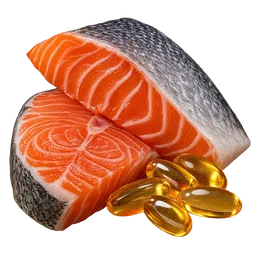
Fish refers to seafood eaten as food and, in supplement form, oils made from fatty fish. Those oils usually supply omega-3 fats called EPA and DHA, but a fish meal also brings protein and a very different nutrition package than a capsule.1
EPA and DHA become part of cell membranes, the flexible outer layer that helps cells send and receive signals. Think of them as swapping some stiff tiles in a cell's signal board for tiles that change which inflammatory messenger molecules the body produces.1 This gives fish oil a biologically plausible link to joint comfort, but biology alone does not establish a dependable real-world benefit.1
Bottom line
Fish oil is worth watching if joint discomfort limits everyday movement and you are comfortable treating it as a 12-week experiment, not a proven fix.3 The reported effect is large but comes from limited early evidence. Do not buy it for learning or attention based on the food-intake finding, and skip it if dizziness, vomiting, headache, or fatigue occur.
Co-studied with


Common questions
Does fish oil help joint pain?
Is eating fish the same as taking fish oil?
How long does fish oil take to work for joints?
Should I use fish or fish oil for a child’s learning?
Sources
Sources
Generated August 27, 2026
Related
More evidence for Fish
Ingredient evidence
Ingredient evidence
NewCholine
All scored outcomes
Aug 27, 2026
Ingredient evidence
Ingredient evidence
NewOmega-3
All scored outcomes
Aug 27, 2026
Ingredient evidence
Ingredient evidence
NewBoswellia
All scored outcomes
Aug 27, 2026
Ingredient evidence
Ingredient evidence
NewCannabidiol
All scored outcomes
Aug 27, 2026
Ingredient evidence
Ingredient evidence
NewChondroitin
All scored outcomes
Aug 27, 2026
Ingredient evidence
Ingredient evidence
NewChondroitin Sulfate
All scored outcomes
Aug 27, 2026