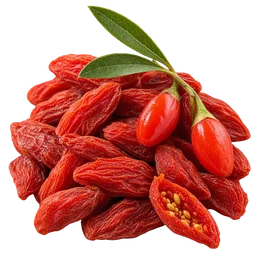
Goji
Best for
See more clearly
Faint early signal 25 g/day 13 weeks 1 study, n=114 #3 of 5 studied
- 7 papers
- 1 of 36 outcomes
- 1 positive
- 3 major interactions
Goji shows a faint early signal for visual acuity in healthy adults, but evidence remains too limited to support reliable benefits across broader eye, weight, metabolic, or performance outcomes.
Median effective dose, most-studied outcomes
- Read fine detail more easily 25 g 13 wk
Risk, worst reported severity
- hematuria/bleeding (elevated INR) moderate
- intestinal gas mild
- warfarin major
- doxorubicin moderate
What goji actually does
Clear vision helps a person read detail, recognize faces, and navigate everyday tasks. 29977809
| Outcome | Effect | Evidence | Dose | Time | Rank |
|---|---|---|---|---|---|
| Early research 1 | |||||
| See more clearly Faint early signal Clear vision helps a person read detail, recognize faces, and navigate everyday tasks. | | 1 study 1 papers · n=114 | 25 g | 13 wk | #3 /5 |
Effect tiers come from native-unit MCID where available, Cohen's d otherwise.
Dose, timing & forms
How much
The only consumer-facing outcome with a signal, visual acuity, used 25 g daily of goji berry for about 13 weeks in one small trial. 1 That result is early and small, so it does not justify chasing higher doses or expecting dramatic changes in reading, faces, or low-light detail.
When and how long
The useful practical takeaway is consistency, not a special time of day. The visual study used goji every day over roughly three months, rather than treating it as an as-needed vision booster. 1 Taking berries or a food-like preparation with a meal is a sensible way to fit it into a routine, but the trial does not establish that meal timing changes the result.
Forms & standardisation
The visual trial used goji berry itself, so dried fruit is closer to the available human evidence than a highly concentrated extract. 1 Labels often highlight zeaxanthin or polysaccharides, but no trial here establishes a target amount of either compound or shows that a standardized extract works better than the fruit.
Studied range, by outcome
| Outcome | Studied range | Median effective | Duration | Evidence |
|---|---|---|---|---|
| Read fine detail more easily | 25 g | 25 g | 13 wk | 1 paper 1 sig. endpoint |
Adverse events and drug interactions
Safety events
Drug interactions
Recommended Goji products
Real products that dose Goji where the research does, in a clean formulation, from brands we've audited. We only list ones we'd stand behind.
-

GT Genesis Today
Organic Goji 100
Well dosed 30 Gram(s)/day A formula -

GT Genesis Today
Organic Total Goji 100
Well dosed 30 Gram(s)/day A formula -

Tahiti Trader
Goji
Well dosed 30,000 mg/day A formula -

California Academy of Health
Absolute Goji
Well dosed 30,000 mg/day A formula -

EB Earth's Bounty
Goji Juice
Well dosed 12,000 mg/day A formula -

EB Earth's Bounty
100% Pure Goji Juice
Well dosed 30,000 mg/day A formula
Chosen for adequate Goji dosing vs. the studied range, a clean formulation (grade A–C), and independent brand-quality audits. Not sponsored.
What this is and how it works
- One randomized trial (n=114) reported improved visual acuity, but no noticeable-change threshold was established.1
- Seven papers reviewed here span 36 outcomes, with only one early-tier claim.
- Evidence comes from healthy adults, limiting conclusions for people with eye disease.
Goji is the dried red fruit of Lycium barbarum, a shrub long used in Asian foods and traditional preparations. You will see it sold as whole dried berries, juice, powder, or extracts, often marketed for eye health because the fruit supplies orange-red plant pigments.
Goji provides zeaxanthin, a yellow-orange pigment that concentrates in the macula, the tiny light-sensing spot at the back of your eye used for fine detail. Think of it as adding tint to a camera filter: it absorbs some high-energy light before that light reaches the sensor, though the one human trial does not establish that this process improves vision for most people. 1
Bottom line
Goji is reasonable for someone who enjoys the fruit and wants to test a food-based supplement with modest expectations about vision. The evidence is one small early trial, not a reliable case for broad eye, weight, metabolic, or performance benefits. Skip it if you take warfarin unless your prescribing clinician specifically clears it, and stop using it if you develop unusual symptoms.
Common questions
Does goji berry improve eyesight?
How long does goji berry take to work?
Can you take goji berry with warfarin?
Sources
Sources
Generated August 27, 2026
Related
More evidence for Goji
Ingredient evidence
Ingredient evidence
NewCarotenoid
All scored outcomes
Aug 27, 2026
Ingredient evidence
Ingredient evidence
NewLutein
All scored outcomes
Aug 27, 2026
Ingredient evidence
Ingredient evidence
NewSaffron
All scored outcomes
Aug 27, 2026
Ingredient evidence
Ingredient evidence
NewZeaxanthin
All scored outcomes
Aug 27, 2026