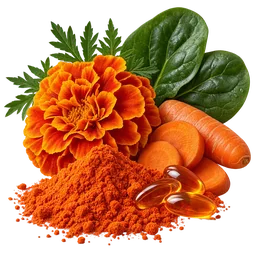
Carotenoid
Best for
Prevent age-related macular degeneration
Promising early signal 4–78 weeks 1 meta-analysis, n=21.2k #4 of 7 studied
- 9 papers
- 2 of 19 outcomes
- 2 positive
- 5 severe, 2 major interactions
Carotenoids show a promising early signal for supporting macular defenses, while evidence across other outcomes remains limited and sharper vision benefits remain uncertain.
Median effective dose, most-studied outcomes
- Increase protective macular pigment 22 mg 52–78 wk
- Read fine detail more easily 22 mg 52–78 wk
Risk, worst reported severity
- lung cancer severe
- intracerebral hemorrhage severe
- cyclosporine major
- antineoplastic agents major
What carotenoid actually does
| Outcome | Effect | Evidence | Dose | Time | Rank |
|---|---|---|---|---|---|
| Worth watching 1 | |||||
| Prevent age-related macular degeneration Promising early signal Age-related macular degeneration can take away sharp central vision for reading and recognizing faces. | | 1 meta-analysis 5 papers · n=21k | — | 4–78 wk | #4 /7 |
| Early research 1 | |||||
| See more clearly Faint early signal Clear vision helps a person read detail, recognize faces, and navigate everyday tasks. | | 2 RCTs 2 papers · n=106 | 12–24 mg | 52–78 wk | #2 /5 |
Effect tiers come from native-unit MCID where available, Cohen's d otherwise.
Dose, timing & forms
How much
For macular pigment and fine-detail vision, the repeated eye-study range is 12 to 24 mg daily, with 22 mg daily as the median effective amount in the reviewed protocols. These are early findings, not proof that a higher dose produces sharper sight or prevents age-related macular degeneration.1
When and how long
Think daily and long-term, not as an occasional visual boost. The eye studies followed participants for roughly one year or longer, so any change in macular pigment builds gradually rather than overnight.1 Pick a consistent time that you can sustain, ideally alongside a regular meal.
Forms & standardisation
Lutein and zeaxanthin have the strongest direct trial coverage for macular pigment, rather than the broad label term "carotenoids."1 Look for a label that names each pigment and its amount. Do not assume every carotenoid blend works like lutein and zeaxanthin, and do not substitute high-dose beta-carotene for these eye-focused forms.
Studied range, by outcome
| Outcome | Studied range | Median effective | Duration | Evidence |
|---|---|---|---|---|
| Increase protective macular pigment | 12–24 mg | 22 mg | 52–78 wk | 2 papers 9 sig. endpoints |
| Read fine detail more easily | 12–24 mg | 22 mg | 52–78 wk | 2 papers 11 sig. endpoints |
| Lower age-related AMD risk | 50 mg | — | — | 1 paper |
Adverse events and drug interactions
Safety events
Drug interactions
Recommended Carotenoid products
Real products that dose Carotenoid where the research does, in a clean formulation, from brands we've audited. We only list ones we'd stand behind.
-

BulkSupplements.com
Spirulina Powder (California-Grown) 500 mg
Well dosed 22 mg/day A formulaBrand audit 54/100
-

Micro Ingredients
Organic Spirulina Mini Tablet
Well dosed 36 mg/day A formula
Chosen for adequate Carotenoid dosing vs. the studied range, a clean formulation (grade A–C), and independent brand-quality audits. Not sponsored.
What this is and how it works
- Across 5 studies (n=21,216), carotenoids showed positive effects across 25 macular-defense endpoints.1
- Nine papers reviewed here spanned 19 outcomes, with strongest evidence centered on macular health.
- High-dose beta-carotene warrants caution among smokers and former heavy smokers because trial evidence found serious harm.2
Carotenoids are the yellow, orange, and red pigments found in plants and algae. Lutein and zeaxanthin are the best-known eye-focused members of this family because your macula, the small retinal area that handles fine detail, concentrates them.1
Bottom line
Lutein and zeaxanthin make the most sense for someone who wants to support macular pigment and accepts a slow, uncertain payoff. Skip the hype around instant vision upgrades: the evidence for sharper sight is still faint. Avoid self-directed high-dose beta-carotene if you smoke or have smoked heavily, because trial evidence found serious harm in smokers.2
Co-studied with
 Histidine6 shared
· d=1.84
Histidine6 shared
· d=1.84 Fishoil4 shared
· d=0.76
Fishoil4 shared
· d=0.76
Common questions
Do carotenoid supplements improve eyesight?
Are lutein and zeaxanthin the same as carotenoids?
Should smokers take beta-carotene supplements?
Sources
Sources
Generated August 27, 2026
Related
More evidence for Carotenoid
Ingredient evidence
Ingredient evidence
NewLutein
All scored outcomes
Aug 27, 2026
Ingredient evidence
Ingredient evidence
NewVitamin A
All scored outcomes
Aug 27, 2026
Ingredient evidence
Ingredient evidence
NewZeaxanthin
All scored outcomes
Aug 27, 2026
Ingredient evidence
Ingredient evidence
NewGoji
All scored outcomes
Aug 27, 2026
Ingredient evidence
Ingredient evidence
NewSaffron
All scored outcomes
Aug 27, 2026