Luteolin
What the trials found
Luteolin has no established human benefit across health outcomes because evidence remains limited to a short preclinical study rather than controlled human trials.
- 1 papers
- 0 of 15 outcomes
- 2 major interactions
Median effective dose, most-studied outcomes
- Support lower whole-body inflammation 55 mg/kg 3 wk
Risk, worst reported severity
- hepatic steatosis
- no overt toxicity reported
- atorvastatin major
- ceftiofur major
Dose, timing & forms
How much
There is no established human luteolin dose. The only reviewed study tested 10 to 100 mg/kg in animals over roughly 3.2 weeks, with a significant result for whole-body inflammation markers at some doses.1 Do not treat those animal doses as a conversion chart for capsules or as proof that a higher dose works better in people.
When and how long
No human trial protocol establishes whether luteolin works best in the morning, evening, with meals, or away from food. The reviewed research was short-term animal work, so a daily timing routine for people would be guesswork rather than evidence-based guidance.1 If you are considering a supplement, ask a clinician or pharmacist about timing around your medications.
Forms & standardisation
No specific luteolin extract, absorption-enhanced form, or label standardization has human outcome evidence in the reviewed material.1 Look for a label that clearly states the amount of luteolin per serving, but do not assume that a higher labeled amount creates a proven benefit. Luteolin is also naturally present in plant foods, although food content varies widely.2
Studied range, by outcome
| Outcome | Studied range | Median effective | Duration | Evidence |
|---|---|---|---|---|
| Reduce oxidative stress | 10–100 mg/kg | — | 3 wk | 1 paper |
| Support lower whole-body inflammation | 10–100 mg/kg | 55 mg/kg | 3 wk | 1 paper 1 sig. endpoint |
Adverse events and drug interactions
Safety events
Drug interactions
What this is and how it works
- One preclinical paper examined inflammation and oxidative-stress outcomes, but no human effect size or MCID is established.1
- One paper reviewed here spans 15 outcomes, with evidence limited to animal research rather than human supplementation.
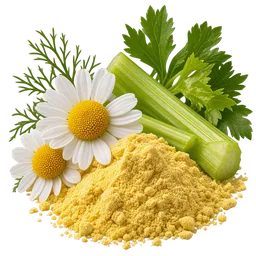
Luteolin is a flavonoid, a natural plant pigment found in foods such as celery, parsley, thyme, and some peppers.2 Supplements isolate it into capsules or powders, which is very different from getting small amounts through a varied diet.
Researchers are exploring whether luteolin changes the cell signals that tell the immune system to turn its inflammatory response up or down. Think of it as testing a hand on the immune system's volume knob, not proving that it fixes the cause of a person's symptoms.1 The reviewed experiment tracked inflammation and oxidative-stress markers in animals, but it does not establish a working mechanism or benefit in people.1
Bottom line
Luteolin is an interesting food-derived compound, but it is not yet a well-supported supplement choice for a specific health goal. The reviewed evidence is one short animal study, so people seeking reliable human benefits or a proven dose should wait for better trials.1 Anyone using prescription medicines should check with a pharmacist or clinician before trying it.
Common questions
What is luteolin used for?
Does luteolin reduce inflammation?
What is the best luteolin dose?
Is luteolin the same as quercetin?
Sources
Sources
Generated August 27, 2026
Related
More evidence for Luteolin
Ingredient evidence
Ingredient evidence
NewBlack Seed
All scored outcomes
Aug 27, 2026
Ingredient evidence
Ingredient evidence
NewBoswellia
All scored outcomes
Aug 27, 2026
Ingredient evidence
Ingredient evidence
NewGarlic
All scored outcomes
Aug 27, 2026
Ingredient evidence
Ingredient evidence
NewMangosteen
All scored outcomes
Aug 27, 2026
Ingredient evidence
Ingredient evidence
NewOmega-3
All scored outcomes
Aug 27, 2026
Ingredient evidence
Ingredient evidence
NewPalmitoylethanolamide
All scored outcomes
Aug 27, 2026