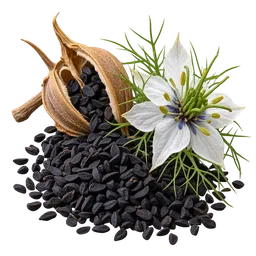
Black Seed
Best for
Relieve allergic rhinitis symptoms
Large effect, needs confirmation 500 mg/day 2 weeks 1 study, n=65 #3 of 8 studied
- 38 papers
- 3 of 100 outcomes
- 3 positive
- 2 severe, 5 major interactions
Black seed shows a large early effect on allergy symptoms in people with allergic diseases, including reduced reactions to triggers, but confirmation is needed before treating the result as established.
Median effective dose, most-studied outcomes
- Support lower whole-body inflammation 2,000 mg 1–12 wk
- Lighten the overall allergy load 500 mg 2 wk
Risk, worst reported severity
- renal failure acute severe
- hypoxia and pneumonia (hospitalization, SAE) severe
- cyclosporine major
- tacrolimus major
What black seed actually does
Allergic rhinitis can affect your nose, eyes, breathing, sleep, and daily comfort. 39121267
| Outcome | Effect | Evidence | Dose | Time | Rank |
|---|---|---|---|---|---|
| Worth watching 2 | |||||
| Relieve allergic rhinitis symptoms Large effect, needs confirmation Allergic rhinitis can affect your nose, eyes, breathing, sleep, and daily comfort. | | 1 RCT 1 papers · n=65 | 500 mg | 2 wk | #3 /8 |
| Lower allergy reactivity Promising early signal Allergy reactivity is the body's response to allergens that can drive allergy symptoms. | | 2 RCTs 2 papers · n=137 | 200–500 mg | 2–13 wk | #2 /9 |
| Early research 1 | |||||
| Lower systemic inflammation Faint early signal The immune system can drive body-wide inflammation that affects long-term health and how people feel day to day. | | 10 RCTs 10 papers · n=401 | 1–3150 mL | 1–13 wk | — |
Effect tiers come from native-unit MCID where available, Cohen's d otherwise.
Dose, timing & forms
How much
The limited allergy evidence centers on an oral 500 mg protocol used for roughly 2 weeks.1 Inflammation-focused trials have tested substantially broader amounts, around 1,000 to 3,150 mg/day, but the overall signal is small and inconsistent, so that range does not establish a reliable target dose.2 If allergy comfort is your goal, treat the 500 mg protocol as an early research reference, not a proven personal prescription.1
When and how long
The allergy study used black seed consistently across a short course, which matters more than taking it only on a high-pollen day.1 The available evidence does not establish a best morning versus evening schedule, or a clear advantage for taking it with food. Pick a time you can repeat daily, and stop rather than pushing through nausea or itching.
Forms & standardisation
Do not assume black seed oil, ground seed, and capsules work interchangeably. The early allergy finding supports an oral 500 mg product, but it does not identify a best oil standardization or a proven thymoquinone percentage to look for on a label.1 Choose a product that clearly names Nigella sativa and lists the amount per serving, rather than relying on vague "black cumin" branding.
Studied range, by outcome
| Outcome | Studied range | Median effective | Duration | Evidence |
|---|---|---|---|---|
| Support lower whole-body inflammation | 1,000–3,150 mg | 2,000 mg | 1–12 wk | 5 papers 1 sig. endpoint |
| Lighten the overall allergy load | 500 mg | 500 mg | 2 wk | 1 paper 2 sig. endpoints |
| Calm allergy signaling | 500 mg | — | 2 wk | 1 paper |
Adverse events and drug interactions
Safety events
Drug interactions
Recommended Black Seed products
Real products that dose Black Seed where the research does, in a clean formulation, from brands we've audited. We only list ones we'd stand behind.
-

Life Extension
Black Cumin Seed Oil
Well dosed 1,000 mg/day A formulaBrand audit 90/100
-

Life Extension
Black Cumin Seed Oil and Bio-Curcumin Turmeric Extract
Well dosed 1,000 mg/day A formulaBrand audit 90/100
-

Swanson
Black Cumin Seed 400 mg Full Spectrum
Well dosed 800 mg/day A formulaBrand audit 69/100
-

BulkSupplements.com
Black Cumin Seed Oil Softgels
Well dosed 1,000 mg/day A formulaBrand audit 54/100
-

BulkSupplements.com
Black Cumin Seed Oil Softgels 1000 mg
Well dosed 1,000 mg/day A formulaBrand audit 54/100
-

Swanson
Black Cumin Seed Oil 500 mg
Well dosed 1,000 mg/day A formulaBrand audit 69/100
Chosen for adequate Black Seed dosing vs. the studied range, a clean formulation (grade A–C), and independent brand-quality audits. Not sponsored.
What this is and how it works
- One study (n=65) reported easier allergy symptoms in patients with allergic diseases; effect size and MCID were not provided.1
- Two studies (n=137) also reported reduced reactions to allergy triggers, but this evidence remains an early signal.
- The review covers 38 papers spanning 100 outcomes, with allergy evidence concentrated in small studies.
Black seed comes from the tiny dark seeds of Nigella sativa, a flowering plant long used in food and traditional remedies. You will see it sold as whole seeds, oil, powders, and capsules, often under the name black cumin.
Its best-known constituent, thymoquinone, interacts with inflammatory messengers that help immune cells broadcast an alarm, including eicosanoid pathways.2 Think of it as adjusting an overly sensitive smoke alarm, not removing the source of the smoke. That biology gives researchers a reason to study allergy symptoms, but the human trials do not yet establish black seed as a broad inflammation supplement.12
Bottom line
Black seed is worth watching if seasonal allergies disrupt your day and you understand that the most eye-catching result still needs confirmation. It is not a well-established answer for whole-body inflammation. Skip self-experimenting if you take prescription medicines, especially medicines with narrow dosing margins, until a pharmacist or clinician checks the combination.
Co-studied with
 Wheatbran8 shared
· d=0.12
Wheatbran8 shared
· d=0.12 Piperine7 shared
· d=0.81
Piperine7 shared
· d=0.81- Drug:Omeprazole3 shared · d=0.52
Common questions
What does black seed help with?
How long does black seed take to work for allergies?
Is black seed the same as black cumin?
Sources
Sources
Generated August 27, 2026
Related
More evidence for Black Seed
Evidence guide
Black Seed Oil (Nigella sativa)
NewFrom Tombs and Kitchens to Clinical Trials: The Black Seed Oil Journey
Evidence guide
Apr 28, 2026
Evidence map
Metabolic health
NewMetabolic health: evidence map across 82 supplements
Evidence coverage map
Jul 30, 2026
Ingredient evidence
Ingredient evidence
NewStinging Nettle
All scored outcomes
Aug 27, 2026
Ingredient evidence
Ingredient evidence
NewVitamin D
All scored outcomes
Aug 27, 2026
Ingredient evidence
Ingredient evidence
NewQuercetin
All scored outcomes
Aug 27, 2026
Ingredient evidence
Ingredient evidence
NewBoswellia
All scored outcomes
Aug 27, 2026