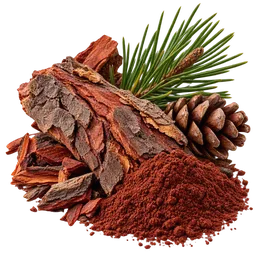
Maritime Pine / Pycnogenol
What the trials found
Maritime Pine / Pycnogenol shows its strongest human signal for circulation-related leg heaviness and swelling, but evidence remains insufficient for a reliable broad benefit across outcomes.
- 8 papers
- 0 of 29 outcomes
- 1 severe
Median effective dose, most-studied outcomes
- Ease swelling and leg heaviness 150 mg —
- Make dark spots less noticeable 40 mg 12 wk
Risk, worst reported severity
- rhabdomyolysis severe
- flatulence mild
- antithrombotic agents moderate
- antihypertensives moderate
Dose, timing & forms
How much
For circulation-related leg swelling and heaviness, studies used 100 to 200 mg daily, with 150 mg daily as a useful middle-ground reference point. 1 For dark spots, research used lower daily amounts, beginning around 40 mg, and tracked results over a full 12-week skin-renewal window. 1 Start with the protocol that matches your goal instead of assuming a higher dose delivers a better result. 1
When and how long
Use it daily, not only on days your legs feel heavy or you want a cosmetic boost. The research follows regular supplementation over weeks, and the skin-pigment protocols require patience because pigment fades on a much slower schedule than a workout effect. 1 Taking it with a meal is a practical choice if it causes stomach upset, even though the key issue in the studies is consistent daily use. 1
Forms & standardisation
Choose a product that clearly says Pycnogenol or identifies French maritime pine bark, rather than a vague "pine bark complex." The named extract has the most recognizable human trial history, while different bark extracts can carry very different polyphenol profiles. 1 A label that identifies the extract and lists a per-serving amount makes it far easier to match a studied protocol. 1
Studied range, by outcome
| Outcome | Studied range | Median effective | Duration | Evidence |
|---|---|---|---|---|
| Ease swelling and leg heaviness | 100–200 mg | 150 mg | — | 2 papers 1 sig. endpoint |
| Make dark spots less noticeable | 40–100 mg | 40 mg | 12 wk | 1 paper 3 sig. endpoints |
Adverse events and drug interactions
Safety events
Drug interactions
What this is and how it works
- Pycnogenol’s most convincing clinical signal involves heavy, swollen legs, without reported pooled effect size or MCID comparison.1
- The reviewed evidence spans 8 papers and 29 outcomes, covering multiple clinical targets rather than one defined population.
- Findings come from a review of varied clinical uses, so dose, formulation, and population effects remain difficult to separate.
Pycnogenol is a standardized extract made from the bark of French maritime pine trees. It contains plant compounds called procyanidins, the same broad family that gives foods such as berries and cocoa some of their sharp, tannic character. Unlike a generic pine bark powder, the name Pycnogenol identifies a specific commercial extract with a defined manufacturing process. 1
Its polyphenols appear to support the lining of blood vessels and protect nitric oxide, a molecule that tells vessels when to relax. Think of nitric oxide as the hand signal that helps traffic flow through a narrow street. When that signal lasts longer, circulation in the small vessels can run more smoothly. 1
Bottom line
Pycnogenol makes the most sense if circulation-related leg heaviness or swelling is your main target and you are willing to use it consistently. The evidence for dark spots is interesting but still narrower, so treat it as a measured experiment rather than a guaranteed cosmetic fix. Skip self-directed use if you take clot-preventing or blood-pressure-lowering medicines, and get clinical advice first. 1
Co-studied with
 Arginine10 shared
· d=0.34
Arginine10 shared
· d=0.34 Asparticacid10 shared
· d=0.34
Asparticacid10 shared
· d=0.34- Drug:Rivaroxaban1 shared · d=0.57
 Same1 shared
· d=0.57
Same1 shared
· d=0.57
Common questions
What is Pycnogenol best known for?
How long does Pycnogenol take to work?
Is Pycnogenol the same as pine bark extract?
Can you take Pycnogenol with blood thinners or blood pressure medicine?
Sources
Sources
Generated August 27, 2026
Related