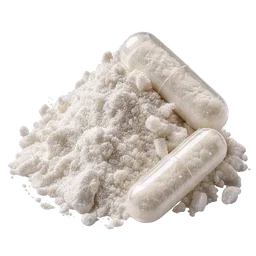
Carnosine
Best for
Protect muscles from exercise stress
Promising early signal 2000 mg/day 6–12 weeks 1 study, n=99 #2 of 4 studied
- 25 papers
- 1 of 86 outcomes
- 1 positive
Carnosine shows a promising early signal for sustaining intense effort, while evidence across other outcomes remains too limited for a proven broad benefit.
Median effective dose, most-studied outcomes
- Buffer exercise-related muscle stress 2,000 mg 6–12 wk
Risk, worst reported severity
- Elevated globulins detected at week 6 (participant lost to follow-up) moderate
- Sleep disturbances (reported adverse change) moderate
- aspirin moderate
- oxaliplatin moderate
What carnosine actually does
Exercise can create oxidative stress in muscle tissue during demanding training. 39215872
| Outcome | Effect | Evidence | Dose | Time | Rank |
|---|---|---|---|---|---|
| Worth watching 1 | |||||
| Protect muscles from exercise stress Promising early signal Exercise can create oxidative stress in muscle tissue during demanding training. | | 1 RCT 1 papers · n=99 | 2000 mg | 6–12 wk | #2 /4 |
Effect tiers come from native-unit MCID where available, Cohen's d otherwise.
Dose, timing & forms
How much
For the clearest early exercise-related signal, the studied oral protocol is 2,000 mg daily. Trials in this area ran for roughly 6 to 12 weeks, so this is a daily training-block supplement, not something to judge from a single workout.1 The evidence base is too small to claim that higher doses produce better results.
When and how long
The available protocol evidence supports taking carnosine consistently every day across a multiweek training period.1 It does not establish a magic pre-workout window. A routine you can stick with matters more than trying to time a capsule around one hard session.
Forms & standardisation
Look for a label that names L-carnosine and clearly lists the amount per serving. Do not assume evidence for beta-alanine transfers to carnosine, since they are different supplements with different handling in the body.1 There is no well-established extract ratio or active-compound standardization marker beyond clear L-carnosine dosing.
Studied range, by outcome
| Outcome | Studied range | Median effective | Duration | Evidence |
|---|---|---|---|---|
| Buffer exercise-related muscle stress | 2,000 mg | 2,000 mg | 6–12 wk | 1 paper 2 sig. endpoints |
Adverse events and drug interactions
Safety events
Drug interactions
Recommended Carnosine products
Real products that dose Carnosine where the research does, in a clean formulation, from brands we've audited. We only list ones we'd stand behind.
-

NutraBio
L-Carnosine 500 mg
Well dosed 500 mg/day A formulaBrand audit 90/100
-

Nootropics Depot
L-Carnosine Powder
Well dosed 1,000 mg/day A formulaBrand audit 87/100
-

Pure Encapsulations
L-Carnosine
Well dosed 1,500 mg/day A formulaBrand audit 78/100
-

NOW
L-Carnosine 500 mg
Well dosed 1,500 mg/day B formulaBrand audit 87/100
-

Swanson
L-Carnosine 500 mg
Well dosed 1,000 mg/day A formulaBrand audit 69/100
-

Doctor's Best
Carnosine 500 mg
Well dosed 1,000 mg/day B formulaBrand audit 82/100
Chosen for adequate Carnosine dosing vs. the studied range, a clean formulation (grade A–C), and independent brand-quality audits. Not sponsored.
What this is and how it works
- One study (n=99) examined whether carnosine helps people sustain intense effort longer.1
- The reviewed evidence spans 25 papers and 86 outcomes, with strongest support focused on exercise-related performance.
- Direct human evidence remains thin, so carnosine is not yet a proven general performance enhancer.
Carnosine is a naturally occurring pair of amino-acid building blocks, beta-alanine and histidine. Your muscles contain it in relatively high amounts, especially because fast, demanding work creates both acidity and reactive chemical byproducts.1
Think of carnosine as a cleanup crew inside hard-working muscle: it helps mop up reactive carbonyl fragments before they stick to proteins and interfere with their job.1 It also helps buffer rising acidity during intense effort, although the direct supplement evidence for better exercise outcomes is still early.1
Bottom line
Carnosine is worth watching if you train hard and want an experimental option for exercise-related muscle stress, but the direct human evidence is still thin. It is not the pick for someone seeking a proven performance boost. People using blood-pressure medicines, aspirin, or oxaliplatin should check with a clinician before using it, and anyone who develops sleep changes or unusual symptoms should stop and get advice.1
Co-studied with
Common questions
What does carnosine do in the body?
Does carnosine improve high-intensity exercise?
Is carnosine the same as beta-alanine?
Sources
Sources
Generated August 27, 2026