Polyunsaturated fatty acid
Best for
Lower systemic inflammation
Likely modest benefit 4–24 weeks 1 meta-analysis, n=1.4k
- 2 papers
- 1 of 6 outcomes
- 1 positive
Polyunsaturated fatty acids likely provide a modest benefit for lowering body-wide inflammation markers, while evidence remains insufficient for larger improvements across other health outcomes.
What polyunsaturated fatty acid actually does
The immune system can drive body-wide inflammation that affects long-term health and how people feel day to day. 35526074
| Outcome | Effect | Evidence | Dose | Time | Rank |
|---|---|---|---|---|---|
| Modest benefits 1 | |||||
| Lower systemic inflammation Likely modest benefit The immune system can drive body-wide inflammation that affects long-term health and how people feel day to day. | | 1 meta-analysis 1 papers · n=1.4k | — | 4–24 wk | — |
Effect tiers come from native-unit MCID where available, Cohen's d otherwise.
Dose, timing & forms
How much
The available evidence supports only a modest effect on a combined panel of inflammation markers, and it does not establish one reliable dose range for polyunsaturated fatty acids as a broad category.1 Use the outcome-specific dosing information alongside this section rather than assuming that a dose of one omega family applies to another. The meaningful test is steady use over weeks, not chasing a high dose for a faster result.1
When and how long
The inflammation trials assess daily intake over roughly 4 to 24 weeks, so consistency matters more than a particular clock time.1 Take the product in the way its studied form and label direct, and build it into a meal routine if that makes daily use easier. The current evidence does not show that morning versus evening changes inflammation outcomes.1
Forms & standardisation
“Polyunsaturated fatty acid” is a category, not a specific supplement form. Check the label for the actual fatty-acid family and named compounds, since omega-3 and omega-6 products are not interchangeable. The limited reviewed evidence does not establish a preferred extract, ratio, or delivery format for lowering whole-body inflammation.1
What this is and how it works
- One study (n=1,420) reported lower body-wide inflammation across eight endpoints, but no effect size or MCID comparison was provided.1
- Two papers reviewed here span six outcomes, with the strongest evidence focused on inflammation markers.
- Findings apply to polyunsaturated fatty-acid supplementation broadly, not necessarily every fatty-acid type or product.
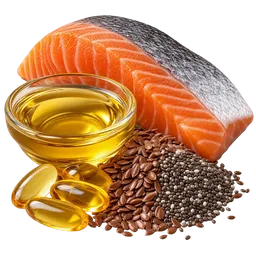
Polyunsaturated fatty acids are fats with more than one flexible chemical bond in their structure. They include omega-3 and omega-6 families, which you get from foods such as fish, nuts, seeds, and plant oils. Your body uses them as building materials for cell membranes and signaling compounds.
Bottom line
Polyunsaturated fatty acids are worth considering if your goal is a small, gradual shift in whole-body inflammation markers, especially as part of a consistent nutrition routine.1 Do not expect the current evidence to deliver a dramatic change in pain, physical function, or cardiovascular outcomes. If you want a product for a specific goal, choose one that clearly states its fatty-acid type rather than relying on a vague category label.
Common questions
Do polyunsaturated fatty acids lower inflammation?
Are polyunsaturated fatty acids the same as omega-3s?
How long do polyunsaturated fatty acids take to affect inflammation markers?
Sources
Sources
Generated August 27, 2026
Related
More evidence for Polyunsaturated fatty acid
Ingredient evidence
Ingredient evidence
NewBlack Seed
All scored outcomes
Aug 27, 2026
Ingredient evidence
Ingredient evidence
NewBoswellia
All scored outcomes
Aug 27, 2026
Ingredient evidence
Ingredient evidence
NewGarlic
All scored outcomes
Aug 27, 2026
Ingredient evidence
Ingredient evidence
NewLuteolin
All scored outcomes
Aug 27, 2026
Ingredient evidence
Ingredient evidence
NewMangosteen
All scored outcomes
Aug 27, 2026
Ingredient evidence
Ingredient evidence
NewOmega-3
All scored outcomes
Aug 27, 2026