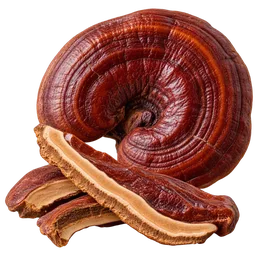
Reishi mushroom
Best for
Reduce insomnia symptoms
Promising early signal 3000 mg/day 4 weeks 1 study, n=48 #6 of 13 studied
- 9 papers
- 1 of 51 outcomes
- 1 positive
- 1 severe, 2 major interactions
Reishi mushroom shows a promising early signal for sleep, while evidence across other outcomes remains too limited to support broader conclusions.
Median effective dose, most-studied outcomes
- Sleep more easily through the night 3,000 mg 4 wk
Risk, worst reported severity
- congenital anomaly severe
- stool disorder mild
- warfarin major
- afatinib major
What reishi mushroom actually does
Less severe insomnia can mean fewer nights spent struggling with sleep. 22203880
| Outcome | Effect | Evidence | Dose | Time | Rank |
|---|---|---|---|---|---|
| Worth watching 1 | |||||
| Reduce insomnia symptoms Promising early signal Less severe insomnia can mean fewer nights spent struggling with sleep. | | 1 RCT 1 papers · n=48 | 3000 mg | 4 wk | #6 /13 |
Effect tiers come from native-unit MCID where available, Cohen's d otherwise.
Dose, timing & forms
How much
When and how long
Forms & standardisation
Current sleep evidence does not identify a specific reishi extract, polysaccharide percentage, spore product, or fruiting-body preparation as superior.1 A standardized label can improve consistency between bottles, but standardization is not proof that a product reproduces the sleep result. Reishi products vary substantially in their polysaccharide and triterpene content.2
Studied range, by outcome
| Outcome | Studied range | Median effective | Duration | Evidence |
|---|---|---|---|---|
| Have less fatigue | 3,200 mg | — | 4 wk | 1 paper |
| Sleep more easily through the night | 3,000 mg | 3,000 mg | 4 wk | 1 paper 1 sig. endpoint |
Adverse events and drug interactions
Safety events
Drug interactions
What this is and how it works
- One randomized study (n=48) reported a positive sleep outcome; effect size and noticeable-change threshold were not provided.1
- Nine papers reviewed here span 51 outcomes, with sleep representing the strongest reported signal.
- Evidence remains preliminary because the positive sleep finding comes from a single small study.
Reishi is a tough, glossy mushroom called Ganoderma lucidum. Traditional preparations usually use the mushroom's fruiting body or spores, then turn them into powders, teas, or concentrated extracts.
Reishi contains long sugar molecules called polysaccharides and bitter triterpenes that interact with immune signaling, like adjusting the volume knobs on the body's alarm network rather than flipping one master switch.2 That biology does not yet explain the sleep finding, and researchers have not established a proven sleep-specific pathway in people.1
Bottom line
Reishi is most worth considering if you want to explore an early sleep signal and accept that the evidence rests on limited research.1 Do not choose it for fatigue based on current results.1 People who take warfarin, use cancer medicines, are pregnant, or have a history of liver problems should speak with a clinician before using it.3
Common questions
Does reishi mushroom help with insomnia?
Can you take reishi every night?
Does reishi reduce fatigue?
Sources
Sources
Generated August 27, 2026
Related
More evidence for Reishi mushroom
Evidence guide
Reishi (Ganoderma lucidum, lingzhi)
NewBitter, Bright, and Patient: When Reishi's 2,000-Year Myth Meets 12-Week Science
Evidence guide
Apr 28, 2026
Evidence map
Sleep
NewSleep: evidence map across 37 supplements
Evidence coverage map
Jul 30, 2026
Ingredient evidence
Ingredient evidence
NewAshwagandha
All scored outcomes
Aug 27, 2026
Ingredient evidence
Ingredient evidence
NewCaffeine
All scored outcomes
Aug 27, 2026
Ingredient evidence
Ingredient evidence
NewCarnitine
All scored outcomes
Aug 27, 2026
Ingredient evidence
Ingredient evidence
NewCoffee
All scored outcomes
Aug 27, 2026