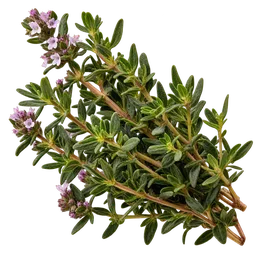
Thyme
What the trials found
Thyme does not establish meaningful respiratory symptom relief in adults, because limited human evidence spans mixed formulations and outcomes without a reliable cross-outcome effect estimate.
- 5 papers
- 0 of 35 outcomes
- 6 severe
Risk, worst reported severity
- respiratory distress severe
- ataxia severe
- aspirin moderate
- warfarin moderate
Dose, timing & forms
How much
The only salient oral protocol for cold and flu symptoms used 16.2 mL of a thyme preparation over 2 weeks.1 That is a product-specific research dose, not a proven target for every thyme tea, capsule, tincture, or essential oil. Since the study did not establish a clear symptom benefit, there is no evidence-based reason to increase beyond a labeled product dose.1
When and how long
The available respiratory protocol ran for 2 weeks by mouth, but it does not establish that morning versus evening dosing changes results.1 It also does not show that taking thyme with food works better than taking it without food. Follow the label for the exact preparation instead of copying timing from a different thyme product.2
Forms & standardisation
The respiratory study examined a liquid herbal preparation, so its findings do not automatically transfer to dried leaf capsules, tea, or concentrated essential oil.1 Look for a label that names Thymus vulgaris, identifies the plant part and extract format, and states the amount per serving. Avoid assuming that a product standardized for thymol has proven clinical superiority, because human comparative evidence is not established.2
Studied range, by outcome
| Outcome | Studied range | Median effective | Duration | Evidence |
|---|---|---|---|---|
| Ease cold and flu symptoms | 16.2 mL | — | 2 wk | 1 paper |
Adverse events and drug interactions
Safety events
Drug interactions
What this is and how it works
- One placebo-controlled adult trial examined a thyme–ivy extract for respiratory symptoms, but no effect size or participant count is available.1
- Five papers reviewed here span 35 outcomes, limiting confidence in any single cross-outcome conclusion.
- Concentrated thyme products, especially essential oils, warrant caution alongside medicines affecting bleeding.2
Thyme usually refers to the fragrant leaves of Thymus vulgaris, a Mediterranean herb used in food, teas, and liquid herbal preparations. Its sharp scent comes from volatile plant compounds, especially thymol and carvacrol, although the amount varies widely by species, growing conditions, and product format.2
Thyme's aromatic compounds can disturb microbial outer membranes in laboratory research, like poking tiny leaks in a soap bubble, and they also influence inflammation-related signaling.2 That is biologically interesting, but it does not prove that a thyme product changes cold, cough, or flu symptoms in people. The limited human respiratory evidence has not established a clear clinical effect.1
Bottom line
Thyme is reasonable as a food herb, but the current human evidence does not make it a strong pick for respiratory symptom relief.1 Skip self-directed high-dose or essential-oil use, especially if you take medicines that affect bleeding, and ask a pharmacist or clinician before using a concentrated product.2
Common questions
Does thyme help with cold symptoms?
Can you take thyme essential oil by mouth?
What is the best form of thyme supplement?
Sources
Sources
Generated August 27, 2026
Related
More evidence for Thyme
Ingredient evidence
Ingredient evidence
NewEchinacea
All scored outcomes
Aug 27, 2026
Ingredient evidence
Ingredient evidence
NewEchinacea angustifolia
All scored outcomes
Aug 27, 2026
Ingredient evidence
Ingredient evidence
NewEchinacea purpurea
All scored outcomes
Aug 27, 2026
Ingredient evidence
Ingredient evidence
NewEuropean Elder / Elderberry
All scored outcomes
Aug 27, 2026
Ingredient evidence
Ingredient evidence
NewVitamin C
All scored outcomes
Aug 27, 2026
Ingredient evidence
Ingredient evidence
NewZinc
All scored outcomes
Aug 27, 2026