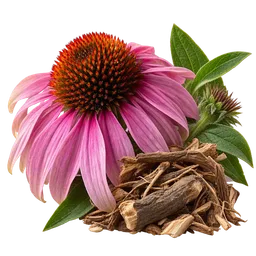
Echinacea
Best for
Feel less sick with a cold
Likely modest benefit 1 weeks 1 meta-analysis, n=6k #1 of 10 studied
- 6 papers
- 2 of 14 outcomes
- 2 positive
- 3 severe, 4 major interactions
Echinacea offers a likely modest benefit for easing common-cold symptoms, while evidence for preventing colds is too small to matter noticeably in everyday life.
Median effective dose, most-studied outcomes
- Prevent acute respiratory infections 8,460 mg —
Risk, worst reported severity
- thrombocytopenia severe
- autoimmune hepatitis / acute cholestatic autoimmune hepatitis severe
- darunavir major
- etoposide major
What echinacea actually does
| Outcome | Effect | Evidence | Dose | Time | Rank |
|---|---|---|---|---|---|
| Modest benefits 2 | |||||
| Feel less sick with a cold Likely modest benefit Cold symptoms such as cough, congestion, and fever can make ordinary days harder. | | 1 meta-analysis 2 papers · n=6.0k | — | 1 wk | #1 /10 |
| Get fewer common infections Proven but unnoticeable A respiratory, skin, or soft-tissue infection can interrupt work, school, and daily routines. | | 2 meta-analyses 2 papers · n=4.9k | — | — | #2 /13 |
Effect tiers come from native-unit MCID where available, Cohen's d otherwise.
Dose, timing & forms
How much
Cold and respiratory-infection trials span an unusually wide 120 to 16,800 mg/day, largely because researchers tested very different teas, powders, and extracts. That range is not a practical target or a reason to chase a higher number on the label. For active cold symptoms, a short course of about 5 days has been studied, with only modest symptom benefit.124
When and how long
Think in terms of a consistent daily course, not an occasional capsule. Prevention trials gave echinacea daily across the study period, while treatment research started it around a cold episode and continued for roughly five days.12 Take it as directed by the specific product, since the research does not establish one universal morning, evening, or food-based schedule.
Forms & standardisation
Look for the full Latin species name, especially Echinacea purpurea, plus the plant part and whether the product is a tea, juice, tincture, or standardized extract. Those details matter because the clinical trials used distinct preparations, and milligram amounts do not translate cleanly between them.12 A label that lists its extraction method and active-compound standardization is more informative than a front-label claim about immune support.
Studied range, by outcome
| Outcome | Studied range | Median effective | Duration | Evidence |
|---|---|---|---|---|
| Prevent acute respiratory infections | — | 8,460 mg | — | 2 papers 2 sig. endpoints |
| Ease cold and flu symptoms | 5,100–10,200 mg | — | 1 wk | 1 paper |
Adverse events and drug interactions
Safety events
Drug interactions
What this is and how it works
- Across 2 studies (n=6,011), Echinacea modestly improved common-cold symptoms, with no MCID comparison available 1.
- Six papers reviewed here span 14 outcomes, including symptom treatment and prevention of respiratory infections.
- Prevention evidence shows a proven but unnoticeable reduction in colds and respiratory infections 2.
Its signature plant compounds, called alkylamides, interact with immune-cell signals, including cannabinoid type 2 receptors that act like volume knobs for parts of the immune response.3 That signaling activity gives echinacea a biologically plausible role during respiratory infections, but human trials show only small real-world symptom changes.14
Bottom line
Echinacea suits someone who wants a modest, short-term option for managing cold symptoms and understands that the payoff is small.14 Skip the hype around cold prevention, since the observed reduction in infections is too slight to matter much day to day.24 It is not a good self-experiment if you have autoimmune or liver concerns, or take prescription medicines that can interact with it.5
Co-studied with
Common questions
Does echinacea stop you from catching a cold?
How quickly does echinacea work once cold symptoms start?
Is echinacea safe to take every day?
Sources
Sources
- 1. Echinacea for treating the common cold: a randomized trial (2010) ↑
- 2. Safety and efficacy profile of Echinacea purpurea to prevent common cold episodes: a randomized, double blind, placebo controlled trial (2012) ↑
- 3. Echinacea alkylamides are a new class of cannabinomimetics: cannabinoid type 2 receptor-dependent and independent immunomodulatory effects (2008) ↑
- 4. Echinacea for preventing and treating the common cold (2014) ↑
- 5. Echinacea
Generated August 27, 2026
Related
More evidence for Echinacea
Evidence guide
Echinacea (Echinacea purpurea, E. angustifolia, E. pallida)
NewPrairie Panacea, Airplane Colds, and a Hidden Microbiome: The Echinacea Plot Twist
Evidence guide
May 6, 2026
Ingredient evidence
Ingredient evidence
NewEchinacea angustifolia
All scored outcomes
Aug 27, 2026
Ingredient evidence
Ingredient evidence
NewEchinacea purpurea
All scored outcomes
Aug 27, 2026
Ingredient evidence
Ingredient evidence
NewEuropean Elder / Elderberry
All scored outcomes
Aug 27, 2026
Ingredient evidence
Ingredient evidence
NewThyme
All scored outcomes
Aug 27, 2026
Ingredient evidence
Ingredient evidence
NewVitamin C
All scored outcomes
Aug 27, 2026