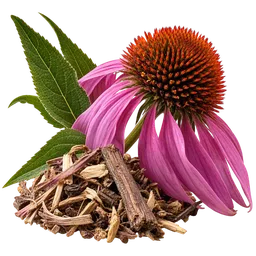
Echinacea purpurea
Best for
Feel less sick with a cold
Faint early signal 2.5–4000 mL/day 1–16 weeks 4 studies, n=206 #9 of 10 studied
- 9 papers
- 3 of 19 outcomes
- 2 positive
- 3 severe, 7 major interactions
Echinacea purpurea offers a faint early signal for managing cold symptoms, while evidence for preventing infections or shortening recovery remains too uncertain for dependable claims.
Median effective dose, most-studied outcomes
- Prevent acute respiratory infections 2,800 mg 2–23 wk
- Return to routine sooner 3,200 mg 8–16 wk
Risk, worst reported severity
- oral aphthous ulcer severe
- serious adverse events (unrelated fractures) severe
- ritonavir major
- indinavir major
What echinacea purpurea actually does
Cold symptoms such as cough, congestion, and fever can make ordinary days harder. 15156472 · 35559249 · 39702335 +1
| Outcome | Effect | Evidence | Dose | Time | Rank |
|---|---|---|---|---|---|
| Early research 3 | |||||
| Feel less sick with a cold Faint early signal Cold symptoms such as cough, congestion, and fever can make ordinary days harder. | | 6 RCTs 4 papers · n=206 | 2.5–4000 mL | 1–16 wk | #9 /10 |
| Get fewer common infections Barely detectable A respiratory, skin, or soft-tissue infection can interrupt work, school, and daily routines. | | 4 RCTs 3 papers · n=882 | 2.5–4000 mL | 2–23 wk | #4 /13 |
| Recover from illness sooner Not enough research Recovery marks the return to usual daily life as illness symptoms settle. | | 5 RCTs 2 papers · n=58 | 1200–16800 mg | 1–16 wk | — |
Effect tiers come from native-unit MCID where available, Cohen's d otherwise.
Dose, timing & forms
How much
For preventing respiratory infections, studies used roughly 2,400 to 4,000 mg daily of oral Echinacea purpurea preparations over longer cold-season periods. 2 Studies that tracked returning to usual activities used about 1,800 to 4,000 mg daily, but the observed recovery benefit was trivial, so a higher dose does not create a convincing faster-recovery effect. 12 Liquid products have been studied for short periods during colds, yet symptom results remain inconsistent. 1
When and how long
Prevention trials used echinacea daily for weeks, not as an occasional dose on the first day of a cold. 2 For short-term cold use, follow the specific product instructions because liquids and solid extracts are not interchangeable and trial schedules varied substantially. 1 Taking it with food is a practical option if it unsettles your stomach, but clinical trials do not establish a single best time of day. 1
Forms & standardisation
The strongest longer-term trial coverage comes from defined oral Echinacea purpurea extracts, rather than generic tea or an unspecified “echinacea blend.” 2 Choose a label that names the species and identifies whether it uses root, aerial parts, or both. Extract composition varies enough that results from one standardized product do not automatically carry over to every capsule or tincture. 12
Studied range, by outcome
| Outcome | Studied range | Median effective | Duration | Evidence |
|---|---|---|---|---|
| Ease cold and flu symptoms | 2.5–15 mL | — | 1–2 wk | 3 papers |
| Prevent acute respiratory infections | 2,400–4,000 mg | 2,800 mg | 2–23 wk | 3 papers 2 sig. endpoints |
| Return to routine sooner | 1,800–4,000 mg | 3,200 mg | 8–16 wk | 2 papers 2 sig. endpoints |
Adverse events and drug interactions
Safety events
Drug interactions
Recommended Echinacea purpurea products
Real products that dose Echinacea purpurea where the research does, in a clean formulation, from brands we've audited. We only list ones we'd stand behind.
-

Nature's Answer
Echinacea Root Grape Flavored
Well dosed 3,000 mg/day A formulaBrand audit 75/100
-

Nature's Answer
Echinacea & Goldenseal Alcohol-Free
Well dosed 3,000 mg/day A formulaBrand audit 75/100
-

Nature's Way
Echinacea Purpurea Herb 500 mg
Well dosed 1,500 mg/day A formulaBrand audit 72/100
-

Nature's Way
Echinacea Goldenseal
Well dosed 1,800 mg/day A formulaBrand audit 72/100
-

Nature's Truth
Echinacea 1,300 mg
Well dosed 1,300 mg/day A formulaBrand audit 66/100
-

Nature's Truth
Echinacea & Goldenseal Root
Well dosed 2,800 mg/day A formulaBrand audit 66/100
Chosen for adequate Echinacea purpurea dosing vs. the studied range, a clean formulation (grade A–C), and independent brand-quality audits. Not sponsored.
What this is and how it works
- Across 4 studies (n=206), cold-symptom outcomes favored easier management; no pooled effect size or noticeable-change threshold was reported.1
- Nine papers reviewed here span 19 outcomes, including 3 studies involving 882 participants on respiratory-infection prevention.1
- Evidence for resuming usual activities sooner remains insufficient, based on 2 studies involving only 58 participants.1
Echinacea purpurea is a purple coneflower native to North America. Supplements use preparations from its roots, flowering tops, or both, sold as capsules, tablets, tinctures, and teas. Different preparations contain different amounts of its naturally occurring compounds, which makes brand-to-brand comparisons tricky. 12
Echinacea contains alkamides, compounds that interact with immune-cell signaling, including cannabinoid type 2 receptors found largely on immune cells. Think of these receptors as volume knobs on an immune alarm system: echinacea compounds appear to adjust parts of the alarm, rather than directly attacking a virus. 4 That biological activity does not translate into a dependable reduction in colds in clinical trials. 1
Bottom line
Echinacea purpurea is a reasonable option for adults who understand that its cold-season benefits remain uncertain and, at best, small. It is not a dependable way to prevent colds or speed recovery. Avoid self-starting it if you use immune-suppressing medicines or certain antiviral medicines, and stop use urgently if signs of a serious allergic reaction appear. 12
Co-studied with
Common questions
Does Echinacea purpurea prevent colds?
Should you take echinacea when a cold starts?
Can children take echinacea?
What is the best form of echinacea?
Sources
Sources
- 1. Echinacea for preventing and treating the common cold (2014) ↑
- 2. The effect of Echinacea purpurea on the frequency, severity and duration of upper respiratory tract infections: a randomized, double-blind, placebo-controlled study (2012) ↑
- 3. Echinacea for treating upper respiratory tract infections in children: a randomized controlled trial (2003) ↑
- 4. Echinacea alkamides are a new class of cannabinomimetics. Cannabinoid type 2 receptor-dependent and independent immunomodulatory effects (2006) ↑
Generated August 27, 2026
Related
More evidence for Echinacea purpurea
Ranking
Colds and Upper Respiratory Infections
NewThe 7 Supplements That Actually Help You Catch Fewer Colds
Evidence ranking
Apr 4, 2026
Ingredient evidence
Ingredient evidence
NewEuropean Elder / Elderberry
All scored outcomes
Aug 27, 2026
Ingredient evidence
Ingredient evidence
NewEchinacea
All scored outcomes
Aug 27, 2026
Ingredient evidence
Ingredient evidence
NewEchinacea angustifolia
All scored outcomes
Aug 27, 2026
Ingredient evidence
Ingredient evidence
NewThyme
All scored outcomes
Aug 27, 2026
Ingredient evidence
Ingredient evidence
NewVitamin C
All scored outcomes
Aug 27, 2026