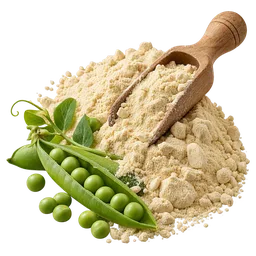
Pea protein
What the trials found
Pea protein has insufficient research to establish meaningful benefits across workout recovery outcomes, although one early study reported muscle-thickness gains during resistance training at 50 grams daily.
- 3 papers
- 1 of 5 outcomes
What pea protein actually does
| Outcome | Effect | Evidence | Dose | Time | Rank |
|---|---|---|---|---|---|
| Early research 1 | |||||
| Recover better after exercise Not enough research Recovery helps your body feel ready for the next training session after hard exercise. | | 2 RCTs 2 papers · n=30 | — | 1–2 wk | — |
Effect tiers come from native-unit MCID where available, Cohen's d otherwise.
Dose, timing & forms
How much
For muscle size, the reviewed trial used 50 g per day of pea protein alongside resistance training.1 That is a protein-food strategy, not an occasional pre-workout trick: the limited recovery research used a much larger body-weight-based protocol and did not show a meaningful strength-restoration effect, so it does not provide a useful target for post-workout recovery.
When and how long
Use pea protein consistently on training and non-training days if your goal is to raise daily protein intake. The muscle-size trial paired daily supplementation with resistance training, rather than testing a single perfectly timed shake, so consistency matters more than chasing a narrow post-workout window.1
Forms & standardisation
Look for a product that clearly states how many grams of protein you get per serving, since scoop sizes can hide big differences. Pea protein isolate is the form used in the resistance-training trial, but the current evidence does not identify a special proprietary extract or amino-acid ratio that reliably improves recovery.1
Studied range, by outcome
| Outcome | Studied range | Median effective | Duration | Evidence |
|---|---|---|---|---|
| Build muscle size | 50 g | 50 g | 1 wk | 1 paper 1 sig. endpoint |
| Restore strength after exercise | 900 mg/kg/day | — | 1 wk | 1 paper |
What this is and how it works
- Two studies (n=30) assessed five workout-recovery endpoints, but the overall direction of benefit remains unclear. 1
- Three papers reviewed here spanned five outcomes, including muscle thickness, soreness, and strength recovery.
- A 50-gram daily dose produced an early muscle-thickness signal during resistance training, requiring confirmation. 1
Pea protein comes from yellow split peas, the same humble legume behind many soups and pantry staples. Manufacturers remove most of the starch and fiber, then concentrate the protein into a powder that mixes into shakes, oats, or foods. It is a plant-based protein choice for people who prefer to avoid dairy.
Protein digestion breaks pea protein into amino acids, including leucine, which acts like the foreman who tells a construction crew to start rebuilding muscle tissue after training. A resistance-training trial found that pea protein supplementation aligned with gains in muscle thickness, although this small evidence base does not establish a recovery benefit.1
Bottom line
Pea protein is a sensible choice if you want a dairy-free way to add protein around a resistance-training routine, and there is an early signal for muscle-size gains at 50 g daily.1 Skip the expectation that it will noticeably erase soreness or rapidly restore strength after hard exercise, because that evidence is not there yet.
Common questions
Is pea protein good for building muscle?
Does pea protein help muscle soreness after a workout?
Is pea protein as effective as whey protein?
Sources
Sources
Generated August 27, 2026
Related
More evidence for Pea protein
Ingredient evidence
Ingredient evidence
NewArginine
All scored outcomes
Aug 27, 2026
Ingredient evidence
Ingredient evidence
NewAshwagandha
All scored outcomes
Aug 27, 2026
Ingredient evidence
Ingredient evidence
NewBCAAs (Branched-Chain Amino Acids)
All scored outcomes
Aug 27, 2026
Ingredient evidence
Ingredient evidence
NewBetaine
All scored outcomes
Aug 27, 2026
Ingredient evidence
Ingredient evidence
NewCreatine
All scored outcomes
Aug 27, 2026
Ingredient evidence
Ingredient evidence
NewL-Leucine
All scored outcomes
Aug 27, 2026