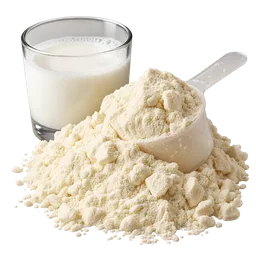
Milk Protein
Best for
Build more muscle
Proven but unnoticeable 2 meta-analyses, n=13.3k #8 of 37 studied
- 8 papers
- 3 of 22 outcomes
- 3 positive
Milk protein produces proven but unnoticeable gains in muscle and strength for people doing resistance training, with the clearest evidence for building and preserving muscle rather than dramatic performance changes.
Median effective dose, most-studied outcomes
- Build muscle size 30 g —
- Increase everyday strength 45 g 30 wk
- Preserve fat-free mass 70.07 g —
What milk protein actually does
Recovery helps your body feel ready for the next training session after hard exercise. 39771010
| Outcome | Effect | Evidence | Dose | Time | Rank |
|---|---|---|---|---|---|
| Modest benefits 2 | |||||
| Build more muscle Proven but unnoticeable More muscle can support strength, movement, and the physical changes you train for. | | 2 meta-analyses 3 papers · n=13k | — | — | #8 /37 |
| Get stronger Proven but unnoticeable Strength helps your muscles produce more force for lifting, carrying, and daily movement. | | 2 meta-analyses 2 papers · n=5.9k | 10–80 g | 30 wk | — |
| Early research 1 | |||||
| Recover better after exercise Barely detectable Recovery helps your body feel ready for the next training session after hard exercise. | | 1 RCT 1 papers · n=22 | 25 g | 0 wk | — |
Effect tiers come from native-unit MCID where available, Cohen's d otherwise.
Dose, timing & forms
How much
For training-related muscle support, about 30 g is the middle of the studied effective range, though trials span from small food-level servings to much larger daily intakes. The wide 3.14 to 137 g/day range is not a target to chase. It reflects different diets, products, and study designs, while the added muscle and strength edge remains small on average.1 For preserving lean tissue, studies have also used higher total daily amounts, around 70 g, usually as part of a broader nutrition plan rather than a single post-workout shake.1
When and how long
Use milk protein on training days and rest days if it helps you reliably reach your daily protein plan. Research on protein and resistance training supports regular intake across weeks and months, not occasional large servings.1 A serving after lifting is convenient because your muscles are primed to use amino acids, but total daily intake and consistent resistance training drive the result.13
Forms & standardisation
Choose a dairy protein food or powder you enjoy using consistently. Milk protein concentrates and isolates contain both whey and casein, while skim milk provides the same protein families in a food format that has been tested alongside resistance training.2 Check the label for grams of total protein per serving and for milk allergens. Unlike botanical supplements, milk protein does not rely on a special active-compound standardization.
Studied range, by outcome
| Outcome | Studied range | Median effective | Duration | Evidence |
|---|---|---|---|---|
| Build muscle size | — | 30 g | — | 3 papers 8 sig. endpoints |
| Increase everyday strength | 10–80 g | 45 g | 30 wk | 2 papers 3 sig. endpoints |
| Preserve fat-free mass | — | 70.07 g | — | 1 paper 1 sig. endpoint |
| Preserve lean tissue | — | 70.07 g | — | 1 paper 1 sig. endpoint |
| Restore strength after exercise | 25 g | — | <1 wk | 1 paper |
What this is and how it works
- Across 3 studies (n=13,300), milk protein improved muscle-building endpoints across 13 measures, with gains classified as proven but unnoticeable.1
- Eight papers reviewed here span 22 outcomes, primarily involving adults combining milk protein with resistance training.
- Benefits reflect small additional gains alongside regular training and adequate recovery, not a standalone performance transformation.
Milk protein is the protein naturally found in dairy foods and dairy-based powders. It combines whey, which digests relatively quickly, with casein, which digests more gradually, so it delivers amino acids over different parts of the digestion process.3
After you drink it, milk protein breaks into amino acids, including leucine, which tells muscle cells to switch on their protein-building machinery after resistance exercise.3 Think of it as delivering both a quick delivery van and a slower supply truck to a construction site: whey raises amino acids sooner, while casein keeps supplies arriving later.3
Bottom line
Milk protein fits people who lift regularly and want an easy, food-like way to raise protein intake. It supports small additional gains when training and recovery already support progress, not dramatic changes on its own.1 Skip it if dairy triggers an allergy or digestive symptoms, and choose another protein source if you simply do not tolerate milk well.
Co-studied with
Common questions
Is milk protein better than whey protein?
Does milk protein build noticeable muscle?
Should you take milk protein right after a workout?
Sources
Sources
- 1. A systematic review, meta-analysis and meta-regression of the effect of protein supplementation on resistance training-induced gains in muscle mass and strength in healthy adults (2018) ↑
- 2. Consumption of fat-free fluid milk after resistance exercise promotes greater lean mass accretion than does consumption of soy or carbohydrate in young, novice, male weightlifters (2007) ↑
- 3. Ingestion of whey hydrolysate, casein, or soy protein isolate: effects on mixed muscle protein synthesis at rest and following resistance exercise in young men (2009) ↑
- 4. The effect of milk versus carbohydrate supplementation on muscle damage and repair following heavy resistance exercise (2004) ↑
Generated August 27, 2026
Related
More evidence for Milk Protein
Evidence map
Metabolic health
NewMetabolic health: evidence map across 82 supplements
Evidence coverage map
Jul 30, 2026
Ingredient evidence
Ingredient evidence
NewArginine
All scored outcomes
Aug 27, 2026
Ingredient evidence
Ingredient evidence
NewAshwagandha
All scored outcomes
Aug 27, 2026
Ingredient evidence
Ingredient evidence
NewBCAAs (Branched-Chain Amino Acids)
All scored outcomes
Aug 27, 2026
Ingredient evidence
Ingredient evidence
NewBetaine
All scored outcomes
Aug 27, 2026
Ingredient evidence
Ingredient evidence
NewCreatine
All scored outcomes
Aug 27, 2026