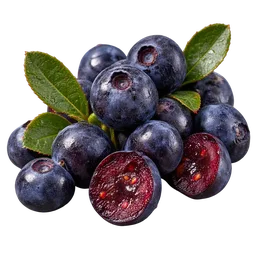
Bilberry
Best for
Reduce screen eye strain
Faint early signal 240–480 mg/day 8–12 weeks 2 studies, n=177 #1 of 3 studied
- 11 papers
- 1 of 34 outcomes
- 1 positive
Bilberry shows a faint early signal for easing close-work eye strain, while evidence across other vision outcomes remains too limited for stronger promises.
Median effective dose, most-studied outcomes
- Ease screen-related eye strain 240 mg 8–12 wk
Risk, worst reported severity
- headache mild
- malaise mild
- doxorubicin moderate
- antineoplastic agents moderate
What bilberry actually does
| Outcome | Effect | Evidence | Dose | Time | Rank |
|---|---|---|---|---|---|
| Early research 1 | |||||
| Reduce screen eye strain Faint early signal Screen use can leave eyes feeling tired, dry, sore, or blurred by the end of the day. | | 2 RCTs 2 papers · n=177 | 240–480 mg | 8–12 wk | #1 /3 |
Effect tiers come from native-unit MCID where available, Cohen's d otherwise.
Dose, timing & forms
How much
For screen-related eye strain, studies tested 240 to 480 mg daily of bilberry extract for about 8 to 12 weeks. The signal was small and comes from only two studies, so treat this as a cautious trial for comfort, not a dependable vision upgrade.1
When and how long
Use bilberry daily and give it weeks, rather than taking it only before a heavy screen day. The eye-fatigue research followed regular supplementation for 8 to 12 weeks, but it does not establish a clearly superior morning, evening, or meal-time schedule.1
Forms & standardisation
Look for a product that clearly identifies bilberry as Vaccinium myrtillus and lists its anthocyanin content, rather than relying on vague “berry complex” wording. Anthocyanins are the pigment compounds most often used to explain bilberry’s antioxidant and blood-vessel effects, but current eye-strain evidence does not prove that a higher label percentage produces better results.12
Studied range, by outcome
| Outcome | Studied range | Median effective | Duration | Evidence |
|---|---|---|---|---|
| Ease screen-related eye strain | 240–480 mg | 240 mg | 8–12 wk | 2 papers 5 sig. endpoints |
| Support overall antioxidant capacity | 470 mg | — | — | 1 paper |
Adverse events and drug interactions
Safety events
Drug interactions
Recommended Bilberry products
Real products that dose Bilberry where the research does, in a clean formulation, from brands we've audited. We only list ones we'd stand behind.
-

Pure Encapsulations
Bilberry 160 mg
Well dosed 640 mg/day A formulaBrand audit 78/100
-

Nature's Answer
Bilberry-20 340 mg Alcohol-Free
Well dosed 340 mg/day A formulaBrand audit 75/100
-

Life Extension
Eye Pressure Support with Mirtogenol
Well dosed 240 mg/day B formulaBrand audit 90/100
-

Puritan's Pride
Bilberry Fruit Extract 1000 mg
Well dosed 500 mg/day A formulaBrand audit 68/100
-

SuperSmart
Bilberry Extract 200 mg
Well dosed 200 mg/day A formulaBrand audit 63/100
-

Nutricost
Bilberry 500 mg Unflavored
Well dosed 500 mg/day A formulaBrand audit 57/100
Chosen for adequate Bilberry dosing vs. the studied range, a clean formulation (grade A–C), and independent brand-quality audits. Not sponsored.
What this is and how it works
- Across 2 studies (n=177), bilberry improved close-work eye-strain measures; effect size and MCID were not reported.1
- The review covered 11 papers spanning 34 outcomes, with strongest evidence focused on close-work visual strain.
- Findings do not support grand promises about sharper vision or improved night vision.
Bilberry is a small, dark blue European berry, usually sold as a fruit extract rather than as a fresh food. Its ink-like color comes from anthocyanins, plant pigments that also give berries and purple vegetables their deep shades.2
Bilberry anthocyanins act like a rust-control crew around delicate tissues, helping limit the chain reactions that oxidative stress can start.2 They also influence blood-vessel signaling, which researchers think could matter for eye comfort during sustained close work, though that link still needs stronger human trials.12
Bottom line
Bilberry is most reasonable for someone curious about a low-key, several-week experiment for screen-related eye comfort who understands the expected effect is small. Skip the grand promises about sharper vision or night vision, because the evidence does not support them. Check with a clinician first if you use blood-thinning or cancer medicines.
Co-studied with
Common questions
Does bilberry actually help screen eye strain?
How long does bilberry take to work for eye fatigue?
Is bilberry the same as blueberry?
Who should avoid bilberry supplements?
Sources
Sources
Generated August 27, 2026
Related
More evidence for Bilberry
Evidence guide
Bilberry (Vaccinium myrtillus)
NewFrom Night-Flight Myth to Screen-Strained Eyes: What Bilberry Really Does—and Doesn't—Do
Evidence guide
Apr 2, 2026
Evidence map
Metabolic health
NewMetabolic health: evidence map across 82 supplements
Evidence coverage map
Jul 30, 2026
Ingredient evidence
Ingredient evidence
NewAstaxanthin
All scored outcomes
Aug 27, 2026
Ingredient evidence
Ingredient evidence
NewLutein
All scored outcomes
Aug 27, 2026
Ingredient evidence
Ingredient evidence
NewAnthocyanidins
All scored outcomes
Aug 27, 2026
Ingredient evidence
Ingredient evidence
NewBlack Currant
All scored outcomes
Aug 27, 2026