Moringa
What the trials found
Moringa has not enough research to establish increased breast-milk supply in early postpartum patients, leaving dependable benefit unproven for breastfeeding families.
- 19 papers
- 1 of 57 outcomes
- 1 major interaction
Median effective dose, most-studied outcomes
- Increase breast milk supply 16,000 mg 12 wk
Risk, worst reported severity
- hematological parameter changes moderate
- increased cholesterol (at very high intake) moderate
- oxytocin major
- fluoxetine moderate
What moringa actually does
Milk coming in and early feeding can shape the start of breastfeeding. 36440058
| Outcome | Effect | Evidence | Dose | Time | Rank |
|---|---|---|---|---|---|
| Early research 1 | |||||
| Breastfeeding success after birth Not enough research Milk coming in and early feeding can shape the start of breastfeeding. | | 1 RCT 1 papers · n=88 | 900 mg | 0 wk | — |
Effect tiers come from native-unit MCID where available, Cohen's d otherwise.
Dose, timing & forms
How much
There is no well-established moringa dose for breastfeeding. One early-postpartum trial used 900 mg/day of moringa leaf capsules for three days and found no statistically clear overall increase in milk volume, despite a higher average volume on day 3.1 A separate longer protocol used roughly 12 to 20 g/day of leaf material for 12 weeks, but one small study cannot set a dependable target dose.
When and how long
The short postpartum capsule study began within six hours after delivery and split the daily amount into two doses over the first three days.1 That is a research protocol, not proof that taking moringa at a particular time of day improves supply. Use it consistently rather than as an occasional rescue, and get lactation support quickly if feeding, pumping, or infant weight gain is difficult.
Forms & standardisation
Breastfeeding research has used leaf capsules and leaf material, not a single proven standardized extract.1 Look for a product that clearly identifies Moringa oleifera leaf and the amount per serving. Avoid assuming that a tea, a whole-leaf powder, and a concentrated extract work interchangeably.
Studied range, by outcome
| Outcome | Studied range | Median effective | Duration | Evidence |
|---|---|---|---|---|
| Increase breast milk supply | 12,000–20,000 mg | 16,000 mg | 12 wk | 1 paper 1 sig. endpoint |
| Continue full breastfeeding longer | 900 mg | — | <1 wk | 1 paper |
| Support overall antioxidant capacity | 2,400 mg | — | 12 wk | 1 paper |
Adverse events and drug interactions
Safety events
Drug interactions
Recommended Moringa products
Real products that dose Moringa where the research does, in a clean formulation, from brands we've audited. We only list ones we'd stand behind.
-

Vedic Powders
Moringa Powder
Well dosed 6 Gram(s)/day A formula -

Herbal Goodness
Organic Moringa Leaf Tea
Well dosed 6 Gram(s)/day A formula -

Nova Nutritions
Organic Moringa Powder
Well dosed 4 Gram(s)/day A formula -

Hawaii Pharm
Moringa Alcohol Free
Well dosed 4,624 mg/day A formula -

Herbal Terra
Moringa Alcohol Free
Well dosed 4,624 mg/day A formula -

tnvitamins
Moringa 10,000 mg
Well dosed 10,000 mg/day B formula
Chosen for adequate Moringa dosing vs. the studied range, a clean formulation (grade A–C), and independent brand-quality audits. Not sponsored.
What this is and how it works
- One study (n=88) measured breast-milk volume, but no reliable increase or noticeable-change threshold was established. 1
- The reviewed evidence covers 19 papers and 57 outcomes, with breast-milk supply supported by only one early-tier claim.
- Evidence applies to early postpartum patients; findings do not establish dependable effects across breastfeeding populations.
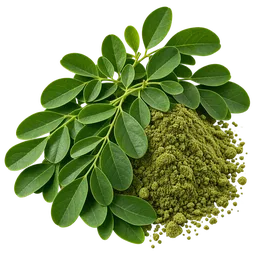
Moringa comes from the leaves of Moringa oleifera, a fast-growing tree eaten as a vegetable in many parts of Asia and Africa. You will see it sold as green leaf powder, tea, capsules, or concentrated extracts. Its main consumer appeal is nutrient density, but supplement products vary widely from the fresh food.
Researchers are exploring whether moringa leaf compounds influence prolactin, the hormone that signals breast tissue to make milk, much like turning up the production instruction sent to a small factory. The early postpartum trial did not establish that mechanism or show a clear overall milk-volume increase, so a biological explanation remains unproven.1
Bottom line
Moringa is a reasonable food, but the evidence does not establish it as a dependable way to increase breast milk supply.1 If you are considering it while breastfeeding, prioritize hands-on lactation support and speak with a clinician or pharmacist first if you use medicines or have a medical condition. Skip the expectation of a fast, dramatic change.
Common questions
Does moringa increase breast milk supply?
How quickly does moringa work for breastfeeding?
Is moringa leaf powder the same as a moringa capsule?
Should you take moringa if you are struggling to breastfeed?
Sources
Sources
Generated August 27, 2026
Related
More evidence for Moringa
Evidence map
Metabolic health
NewMetabolic health: evidence map across 82 supplements
Evidence coverage map
Jul 30, 2026
Ingredient evidence
Ingredient evidence
NewAnthocyanidins
All scored outcomes
Aug 27, 2026
Ingredient evidence
Ingredient evidence
NewAstaxanthin
All scored outcomes
Aug 27, 2026
Ingredient evidence
Ingredient evidence
NewBilberry
All scored outcomes
Aug 27, 2026
Ingredient evidence
Ingredient evidence
NewBlack Currant
All scored outcomes
Aug 27, 2026
Ingredient evidence
Ingredient evidence
NewBlueberry
All scored outcomes
Aug 27, 2026