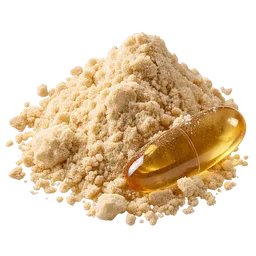
Phosphatidylserine
Best for
Feel less stressed day to day
Faint early signal 200–800 mg/day 1–6 weeks 7 studies, n=92
- 13 papers
- 2 of 39 outcomes
- 1 positive
Phosphatidylserine shows a faint early signal for easing daily stress, while evidence for memory benefits remains unconvincing across the broader ingredient evidence.
Median effective dose, most-studied outcomes
- Support healthier cortisol patterns 600 mg 1–2 wk
- Recall information across tasks 300 mg 8–26 wk
- Handle daily demands with less stress 300 mg 4–6 wk
Risk, worst reported severity
- tenesmus moderate
- cholinergic toxicity moderate
What phosphatidylserine actually does
| Outcome | Effect | Evidence | Dose | Time | Rank |
|---|---|---|---|---|---|
| Early research 2 | |||||
| Feel less stressed day to day Faint early signal Daily stress is the sense that life's demands are stretching beyond what you can handle. | | 1 RCT 7 papers · n=92 | 200–800 mg | 1–6 wk | — |
| Remember more Barely detectable Memory helps you hold onto information and bring it back when you need it. | | 4 RCTs 4 papers · n=273 | 100–300 mg | 8–26 wk | — |
Effect tiers come from native-unit MCID where available, Cohen's d otherwise.
Dose, timing & forms
How much
For the strongest available signal, stress and cortisol protocols studied 400 to 800 mg daily, with 600 mg daily sitting near the middle of effective dosing. These trials assessed hormone responses after about one to two weeks, while daily-stress studies used lower amounts, commonly 200 to 300 mg daily, for roughly four to six weeks.1 Memory research generally used 100 to 300 mg daily for much longer, but the overall memory effect remains too small to justify chasing a higher dose.2
When and how long
Use it consistently each day, because the trials tested regular supplementation rather than taking it only before a stressful event.1 Studies do not establish a clear best clock time. A practical approach is to take it with a meal at a time you can repeat reliably, and split the daily amount if a larger serving bothers your stomach.
Forms & standardisation
Look for a label that clearly names phosphatidylserine and states the amount of phosphatidylserine per serving, not only the weight of a proprietary blend. Plant-derived products are the modern norm, but the research does not establish that one commercial source or brand delivers better stress or memory results than another.12 Avoid assuming that a product with added fats or a bigger blend automatically matches the preparations used in trials.
Studied range, by outcome
| Outcome | Studied range | Median effective | Duration | Evidence |
|---|---|---|---|---|
| Support healthier cortisol patterns | 400–800 mg | 600 mg | 1–2 wk | 5 papers 3 sig. endpoints |
| Recall information across tasks | 100–300 mg | 300 mg | 8–26 wk | 4 papers 9 sig. endpoints |
| Handle daily demands with less stress | 200–300 mg | 300 mg | 4–6 wk | 2 papers 1 sig. endpoint |
| Regulate stress signaling | 800 mg | 800 mg | 1 wk | 1 paper 1 sig. endpoint |
Adverse events and drug interactions
Safety events
Recommended Phosphatidylserine products
Real products that dose Phosphatidylserine where the research does, in a clean formulation, from brands we've audited. We only list ones we'd stand behind.
-

NOW
Sunflower Phosphatidyl Serine 100 mg
Well dosed 300 mg/day A formulaBrand audit 87/100
-

Seeking Health
Phosphatidyl Serine 150 mg
Well dosed 300 mg/day A formulaBrand audit 85/100
-

Doctor's Best
Phosphatidyl Serine with SerinAid 100 mg
Well dosed 300 mg/day A formulaBrand audit 82/100
-

Jarrow Formulas
PS100 100 mg
Well dosed 300 mg/day A formulaBrand audit 81/100
-

Designs for Health
Phosphatidyl Serine Powder
Well dosed 200 mg/day A formulaBrand audit 80/100
-

Pure Encapsulations
PS 100 (Phosphatidylserine)
Well dosed 300 mg/day A formulaBrand audit 78/100
Chosen for adequate Phosphatidylserine dosing vs. the studied range, a clean formulation (grade A–C), and independent brand-quality audits. Not sponsored.
What this is and how it works
Phosphatidylserine helps cell membranes pass messages between receptors and the machinery inside a cell. Think of it as keeping a phone's touch screen responsive, so stress signals can register and then stand down instead of staying stuck at full volume.1 In stress testing, phosphatidylserine changed hormone responses tied to the hypothalamic-pituitary-adrenal stress system, although that does not prove a large everyday stress benefit.1
Bottom line
Phosphatidylserine suits someone who wants to test a subtle, early-stage option for everyday stress, especially if they will track their response honestly for several weeks. It is not a convincing memory supplement based on current results. Skip self-experimentation and seek individualized clinical advice if you have significant symptoms, take regular medicines, or develop side effects such as nausea or a racing heartbeat.
Co-studied with
- Phosphatidicacid15 shared · d=0.66
 Omega314 shared
· d=0.96
Omega314 shared
· d=0.96 Linolenicacid6 shared
· d=0.96
Linolenicacid6 shared
· d=0.96 Astaxanthin6 shared
· d=0.96
Astaxanthin6 shared
· d=0.96 Vitamine6 shared
· d=0.96
Vitamine6 shared
· d=0.96
Common questions
Does phosphatidylserine help with stress?
Does phosphatidylserine improve memory?
How long does phosphatidylserine take to work?
Sources
Sources
Generated August 27, 2026
Related
More evidence for Phosphatidylserine
Evidence guide
Phosphatidylserine
NewThe Quiet Switch: How a Brain Lipid Left the Slaughterhouse, Entered the Soy Field, and Keeps Rewriting Memory's Story
Evidence guide
Mar 27, 2026
Ranking
Attention-Deficit/Hyperactivity Disorder
NewBest Supplements to Ease ADHD Symptoms in Children (2026)
Evidence ranking
May 17, 2026
Evidence map
Focus & memory
NewFocus & memory: evidence map across 45 supplements
Evidence coverage map
Jul 30, 2026
Evidence map
Stress
NewStress: evidence map across 46 supplements
Evidence coverage map
Jul 30, 2026
Ingredient evidence
Ingredient evidence
NewAshwagandha
All scored outcomes
Aug 27, 2026
Ingredient evidence
Ingredient evidence
NewEurycoma Longifolia
All scored outcomes
Aug 27, 2026