New Phosphatidylserine Published Mar 27, 2026
The Quiet Switch: How a Brain Lipid Left the Slaughterhouse, Entered the Soy Field, and Keeps Rewriting Memory's Story
Sharper memory for daily tasks, calmer stress response under pressure, and better focus during performance
Evidence summary
Phosphatidylserine is a brain-lipid supplement that most consistently sharpens memory in older adults with age-related decline and also blunts stress-hormone surges.
- In a 12-week trial of older adults with AAMI, 300 mg/day bovine phosphatidylserine improved memory scores versus placebo.2
- Soy-derived phosphatidylserine shows mixed cognitive effects, with stronger gains in people starting lower on memory tests.3
- Stress studies show cortisol and ACTH blunting during short experimental challenges, not proven long-term performance gains.5
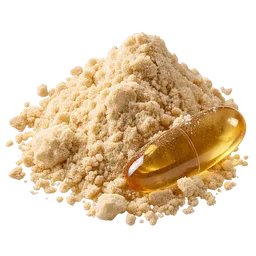
From brain jars to bean pods
Before PS was a capsule on a shelf, it was a character in the great 19th-century hunt for the brain's lipids. Early chemists like Gobley and Thudichum teased apart "phosphatides," the oily building blocks of cell membranes. Over a century later, PS emerged as one of the brain's favored lipids—tucked inside neuron membranes where signals spark and memories are stamped.1 For decades, supplements were extracted from bovine cortex. Then the world learned the phrase "mad cow disease." Regulators tightened rules around cattle materials; the supplement industry pivoted to plant sources—mostly soy, sometimes sunflower. The molecule is the same scaffold, but its fatty acid "tails" now come from plants, not animals. That safety-driven switch matters for science: many of the biggest early wins used bovine-derived PS, while most modern products are soy-based.61612
The first plot twist: measurable memory
In 1991, a multicenter U.S. trial gave 149 older adults with age-associated memory issues 300 mg/day of bovine-derived PS for 12 weeks. The researchers' summary was plain but striking: "patients treated with the drug improved relative to those treated with placebo on performance tests related to learning and memory tasks of daily life."2 That line, dry as it reads, felt like a door cracking open. When the switch to soy came, results grew more mixed—and more nuanced. A 6-month Japanese trial in community-dwelling older adults found that overall test scores rose across all groups (placebo included), but people who started lower improved more on delayed verbal recall with soy-PS—an effect that shows up where memory tends to fray first.4 A separate AAMI trial with soy-PS ran 12 weeks plus a 3-week washout; it tracked learning, attention, and reaction time in 120 adults, reflecting both safety and the reality that some measures don't budge quickly.316 If you're sensing a theme—benefits that depend on who you are and how you start—you're reading the evidence the right way. Regulators read it cautiously, too. In 2010, the European Food Safety Authority concluded "a cause and effect relationship has not been established" for PS and cognitive claims in the general population, in part because bovine- and soy-based PS are not nutritionally identical.12
The stress subplot: taming the body's alarm bell
PS doesn't only live in memory tests; it shows up when life gets loud. In a small placebo-controlled study from the 1990s, 10 days of 800 mg/day (bovine-derived) PS "significantly blunted the ACTH and cortisol responses to physical exercise."5 Years later, a sports-nutrition team repeated the idea with soy-PS: "PS supplementation with 600 mg per day for 10 days blunts the cortisol response to exercise-induced stress," they wrote, noting a healthier testosterone-to-cortisol balance for recovery.6 Even more real-world: golfers. In a six-week randomized trial, 200 mg/day soy-PS increased the number of "good" ball flights off the tee—less choking under pressure, more shots landing as intended.7 Another study tested a phosphatidylserine/phosphatidic acid complex during the Trier Social Stress Test and found HPA-axis responses "normalized," particularly in chronically stressed men at a 400 mg dose.8 Taken together, these are small studies—but they sketch a consistent character: PS can make the body's stress sirens less shrill, especially during brief, high-pressure tasks.
The unexpected chapter: attention and youth
PS's story has even wandered into classrooms. In a 200-child, 30-week randomized trial, a PS-omega-3 conjugate improved specific parent-rated hyperactive/impulsive behaviors and parent emotional impact; overall, it was well tolerated.910 But science rarely draws straight lines. A 2024 trial in children with both epilepsy and ADHD—underpowered and stopped early—found no advantage over placebo.11 In other words, PS is not a blanket solution for attention; formulation, comorbidities, and who you test all matter.
What's actually happening in the membrane?
Think of each neuron as a house whose walls are alive. PS helps keep those walls flexible, so receptors can move, fuse, and reset after a signal. Under stress, PS seems to help down the body's chemical megaphone (cortisol) so performance costs less physiologically. In aging, a better-tuned membrane may make it easier to register, store, and retrieve names or lists—especially for those already slipping. That's the accessible version of a messy biophysics story the trials only hint at.2468
"PS supplementation with 600 mg per day for 10 days blunts the cortisol response to exercise-induced stress."6 "Patients treated with [PS] improved relative to those treated with placebo on..tasks of daily life."2 "A cause and effect relationship has not been established [for general cognitive claims]."12
These three quotes, side-by-side, are the sober arc: a compound that can help in specific contexts; promise, not panacea.
How readers typically put PS to work
For memory complaints in mid- to late-life, human trials most often used 100 mg, three times daily, for 12–24 weeks; some benefits appear by 6–12 weeks.234
For stress and performance, effects can show up within 10–14 days at 400–800 mg/day (short cycles), or as low as 200 mg/day in task-specific settings like golf.5678
Modern products are soy- or sunflower-derived. Health Canada's safety assessment for soy-PS places a conservative 300 mg/day cap for supplemented foods; that's not a U.S. rule, but it's a useful guardrail for everyday intake outside clinical protocols.1314 If you have a soy allergy, choose sunflower-derived PS; soy-PS contains very little protein but still carries labeling in many markets.13 And because PS supports acetylcholine-based signaling, it may lessen the effect of anticholinergic medications (used for overactive bladder, motion sickness, some tremors)—an interaction to discuss with your clinician.15
The open questions
Two threads keep researchers curious. First, source and structure: if bovine-derived PS carried stronger early signals, how much of that was the molecule versus the population studied? Second, personalization: trials repeatedly hint that those starting with lower memory scores benefit most. Future studies are homing in on who, exactly, stands to gain—and how PS might pair with lifestyle work (sleep, exercise, language learning) to keep the neurons' "walls" supple.412
A modest, useful philosophy of PS
PS is not a magic memory pill. It is membrane nutrition—a way to make cellular walls a little more cooperative under pressure and age. In a noisy world, that quiet help may be enough: a steadier tee shot, a calmer stress response, or a list remembered when you need it. The soybean field, it turns out, can still whisper to the brain—so long as we listen without wishful thinking.24612
Key takeaways
What to walk away with
- 01
PS's supply pivot—from bovine cortex to soy/sunflower—kept the molecule but changed its fatty acid tails, reshaping both safety perceptions and the evidence base.
- 02
Evidence is strongest for memory in older adults with complaints: classic bovine PS (300 mg/day, ~12 weeks) improved daily-life tasks; soy-PS shows signals in domains like delayed verbal recall when baseline is lower.
- 03
For stress buffering, short cycles of 400–600 mg/day (sometimes up to 800 mg) can blunt cortisol/ACTH during exercise or social stress; task-specific effects appeared at 200 mg/day in golfers.
- 04
Dosing for memory commonly used 100 mg three times daily for 12–24 weeks; consistency matters more than clock time, and changes tend to appear after weeks 6–12.
- 05
Who benefits most: adults with mild, self-noticed memory slips, people under frequent performance stress, and athletes aiming for steadier physiology under load.
- 06
Cautions match the mechanism: PS may oppose anticholinergic drugs; soy-allergic readers can choose sunflower-derived PS—soy-PS has minimal protein but is labeled for transparency.
Effect timeline
When to expect what
- Immediate
- Yes (mild)
- Peak
- 6-12 weeks
- Duration needed
- 8-12 weeks minimum
- Wears off
- ~2-4 weeks after stopping (based on trials with 3-week washouts)
Research trajectory
What the studies actually show
-
Bovine-derived PS (300 mg/day, 12 weeks) improved memory measures in older adults with AAMI. 2
The 1991 Neurology multicenter trial became a landmark, igniting interest in PS for age-related memory.
Establishes proof-of-concept for clinical benefit in targeted older adults.
-
Soy-PS shows mixed but promising effects, with stronger signals in those starting with lower memory scores or specific domains (e.g., delayed verbal recall). 4
A 6-month Japanese RCT found domain-specific gains in lower-baseline participants; other AAMI trials emphasized safety and nuanced outcomes.
Points to personalization rather than blanket effects.
-
Short cycles of PS can blunt stress hormones (cortisol/ACTH) during exercise or social stress. 6
Early bovine-PS (800 mg/day) and later soy-PS (600 mg/day) trials converged on reduced cortisol; a PS/PA complex normalized HPA responses at 400 mg/day in high-stress men.
Mechanistic plausibility for performance under pressure and recovery.
-
Behavioral subscales in ADHD may improve with PS-omega-3 conjugates, but results are not uniform across populations (e.g., epilepsy comorbidity). 11
A large child RCT showed specific improvements and safety; a 2024 epilepsy-ADHD trial was underpowered and negative.
Highlights formulation and population specificity, tempering expectations.
Human trials
What real trials found
-
149 adults with age-associated memory impairment took 300 mg/day bovine PS for 12 weeks; memory tasks of daily life improved vs placebo. 2
- Outcome
- Improved learning and daily-life memory performance; greatest in those starting lower.
- Why it matters
- Anchor evidence for memory in older adults; set dose/time expectations.
- Source
- Neurology (1991) randomized, double-blind trial
-
Healthy golfers took 200 mg/day soy PS for six weeks; ball flight quality and perceived stress tracked during tee offs. 7
- Outcome
- Significant increase in 'good' shots vs placebo.
- Why it matters
- Real-world performance under pressure; stress physiology meets skill execution.
- Source
- Journal of the International Society of Sports Nutrition (2007) RCT
-
200 children with ADHD received PS-omega-3 conjugate for 15 weeks (with open-label extension). 9
- Outcome
- Improvements on select behavioral subscales; good tolerability over 30 weeks.
- Why it matters
- Shows a boundary case: possible benefit in specific subdomains; highlights safety.
- Source
- European Psychiatry (2011/2013) RCT + safety extension
Expert insights
Voices in the field
Patients treated with [phosphatidylserine] improved relative to those treated with placebo on...tasks of daily life. 2
PS supplementation with 600 mg per day for 10 days blunts the cortisol response to exercise-induced stress. 6
A cause and effect relationship has not been established [for phosphatidylserine and general cognitive claims]. 12
Practical guidance
Putting it to use
Who may benefit
Adults with mild, self-noticed memory slips; people under frequent performance stress (presentations, competitions); athletes seeking calmer physiology under load. Benefits seem greatest when baseline performance is lower or stress is high.
Who should avoid
People with confirmed soy allergy should avoid soy-derived PS or choose non-soy sources; those relying on anticholinergic drugs should avoid unsupervised PS due to potential counteraction.
Dosing
For memory complaints, many studies used 100 mg three times daily for 12–24 weeks. For stress buffering, short cycles of 400–600 mg/day (sometimes up to 800 mg/day) have been studied; task-specific benefits appeared at 200 mg/day in golfers.
Timing
Take with meals if you're sensitive; consistency matters more than clock time. Expect stress effects within 10–14 days, memory changes around weeks 6–12.
Quality
Choose soy- or sunflower-derived PS from companies that disclose source and standardization. Plant sources replaced bovine for safety reasons during the BSE era; modern evidence largely uses soy PS.
Cautions
If you take anticholinergic medications (for overactive bladder, motion sickness, or certain tremors), PS may oppose their intended effect—check with your clinician. Soy-allergic? Opt for sunflower-derived PS; soy-PS contains minimal protein but is labeled for transparency.
A closing thought
Brains age the way paper ages—edges curl, ink fades. PS doesn't rewrite the book; it tends the pages, keeping them flexible enough to when life asks for the next chapter.
Frequently asked
Common questions
Does soy-derived PS work as well as the older bovine form?
What dose should I use for memory versus stress?
How long until I notice effects?
Are there important interactions or people who should avoid PS?
What if I'm allergic to soy?
Related
More on this supplement
Pulled from across the site — rankings, comparisons, combinations, and reviews where this supplement shows up.
Ingredient evidence
Ingredient evidence
NewPhosphatidylserine
All scored outcomes
Aug 27, 2026
Ranking
Attention-Deficit/Hyperactivity Disorder
NewBest Supplements to Ease ADHD Symptoms in Children (2026)
Evidence ranking
May 17, 2026
Evidence map
Focus & memory
NewFocus & memory: evidence map across 45 supplements
Evidence coverage map
Jul 30, 2026
Evidence map
Stress
NewStress: evidence map across 46 supplements
Evidence coverage map
Jul 30, 2026
Sources
- 1. Historical perspective: phosphatidylserine and phosphatidylethanolamine from the 1800s to the present (2018)
- 2. Effects of phosphatidylserine in age-associated memory impairment (Neurology) (1991)
- 3. The influence of soy-derived phosphatidylserine on cognition in age-associated memory impairment (2002)
- 4. Soybean-derived phosphatidylserine improves memory function of the elderly Japanese subjects with memory complaints (2010)
- 5. Blunting by chronic phosphatidylserine administration of the stress-induced activation of the HPA axis in healthy men (1992)
- 6. The effects of phosphatidylserine on endocrine response to moderate intensity exercise (2008)
- 7. The effect of phosphatidylserine on golf performance (2007)
- 8. Soy PS/phosphatidic acid complex normalizes HPA-axis stress reactivity in chronically stressed men (2014)
- 9. Effect of PS containing omega-3 on ADHD symptoms in children (double-blind RCT) (2011)
- 10. Safety of PS containing omega-3 in ADHD children (30-week study) (2013)
- 11. PS-Omega-3 supplementation for ADHD in children with epilepsy: randomized trial (underpowered, negative) (2024)
- 12. EFSA Scientific Opinion on phosphatidylserine health claims (2010) (2010)
- 13. Health Canada safety assessment of phosphatidylserine (soy) as a supplemental ingredient (2022)
- 14. Cleveland Clinic—Phosphatidylserine: benefits, side effects, interactions (2023)
- 15. FDA final rule: Use of materials derived from cattle in human food and cosmetics (BSE protections) (2020)
- 16. Safety of soy-derived phosphatidylserine in elderly people (2002)
1,114 words · 16 sources · Phosphatidylserine