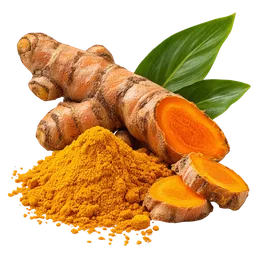
Turmeric
Best for
Lower liver enzyme levels
Proven strong benefit 80–3000 mg/day 1–16 weeks 1 meta-analysis, n=1.1k #1 of 39 studied
- 110 papers
- 8 of 174 outcomes
- 8 positive
- 8 severe, 10 major interactions
Turmeric provides a proven strong benefit for lowering liver enzymes, while evidence for memory and other outcomes is more limited and outcome-specific.
Median effective dose, most-studied outcomes
- Support lower whole-body inflammation 810 mg 1–30 wk
- Feel less intense pain 1,000 mg 1–20 wk
- Quiet TNF-alpha signaling 800 mg 1–52 wk
Risk, worst reported severity
- Bleeding / hemorrhage (excessive bleeding) severe
- hepatotoxicity severe
- warfarin major
- everolimus major
What turmeric actually does
The immune system can drive body-wide inflammation that affects long-term health and how people feel day to day. 24982601 · 25302215 · 29316908 +25
Comfortable joints can make walking, stairs, and everyday movement easier. 29316908 · 29622343 · 31351488 +9
Rheumatoid arthritis causes immune-driven joint inflammation that can bring pain, swelling, stiffness, and fatigue. 35935936 · 35979355 · 37325651 +1
| Outcome | Effect | Evidence | Dose | Time | Rank |
|---|---|---|---|---|---|
| Strong benefits 2 | |||||
| Lower liver enzyme levels Proven strong benefit Liver blood tests can rise when liver cells are injured or bile flow is blocked. | | 1 meta-analysis 5 papers · n=1.1k | 80–3000 mg | 1–16 wk | #1 /39 |
| Remember more Likely strong benefit Memory helps you hold onto information and bring it back when you need it. | | 1 meta-analysis 5 papers · n=691 | 80–4000 mg | 4–52 wk | #1 /42 |
| Modest benefits 5 | |||||
| Lower systemic inflammation Likely modest benefit The immune system can drive body-wide inflammation that affects long-term health and how people feel day to day. | | 12 meta-analyses 28 papers · n=34k | — | 1–52 wk | #4 /83 |
| Ease joint pain Proven modest benefit Comfortable joints can make walking, stairs, and everyday movement easier. | | 6 meta-analyses 12 papers · n=5.0k | 90–2000 mg | 8–52 wk | #6 /23 |
| Ease rheumatoid arthritis symptoms Proven modest benefit Rheumatoid arthritis causes immune-driven joint inflammation that can bring pain, swelling, stiffness, and fatigue. | | 4 meta-analyses 4 papers · n=906 | 80–6000 mg | 10–20 wk | #1 /7 |
| Feel less pain Likely real but unnoticeable Pain relief can make it easier to move, rest, focus, and get through the day. | | 9 meta-analyses 16 papers · n=13k | 120–4000 mg | 1–20 wk | — |
| Move with less stiffness Proven but unnoticeable Stiff joints can make everyday movements feel restricted or uncomfortable. | | 4 meta-analyses 5 papers · n=3.0k | 90–2000 mg | 13–20 wk | #3 /10 |
| Worth watching 1 | |||||
| Seniors move more easily Promising early signal Comfortable movement makes it easier to walk, get around, and take part in everyday life. | | 4 RCTs 4 papers · n=315 | 500–2000 mg | 8–12 wk | #1 /19 |
Effect tiers come from native-unit MCID where available, Cohen's d otherwise.
Dose, timing & forms
How much
For joint pain and everyday function, trials most often land around 500 to 2,000 mg daily of a turmeric or curcumin extract, with about 1,000 mg daily sitting near the middle of effective protocols.2 Give it a fair test for roughly 8 to 12 weeks, since joint studies usually measure results over that window.2 Memory research used a much lower 90 mg twice-daily dose of a bioavailable curcumin formula for 18 months, so do not assume that more milligrams automatically means better results.1
When and how long
Take turmeric consistently every day, not only when pain flares. Joint studies assess it over weeks, so a daily routine matters more than chasing an immediate effect.2 If your product's serving is split into two capsules, dividing it between meals is a simple way to stay consistent. For memory, the key published protocol used twice-daily dosing over the long term.1
Forms & standardisation
Look for a product that clearly identifies the extract and the amount of curcuminoids or curcumin per serving. The strongest human trial coverage comes from formulated extracts designed to improve absorption, not plain culinary turmeric powder.12 Piperine-containing products can boost absorption, but they also raise the stakes for medication interactions, so check with a pharmacist before combining one with prescriptions.5
Studied range, by outcome
| Outcome | Studied range | Median effective | Duration | Evidence |
|---|---|---|---|---|
| Support lower whole-body inflammation | — | 810 mg | 1–30 wk | 18 papers 16 sig. endpoints |
| Feel less intense pain | 120–4,000 mg | 1,000 mg | 1–20 wk | 13 papers 29 sig. endpoints |
| Quiet TNF-alpha signaling | 80–2,400 mg | 800 mg | 1–52 wk | 10 papers 9 sig. endpoints |
| Move more easily with joint problems | 90–2,000 mg | 1,000 mg | 4–26 wk | 9 papers 11 sig. endpoints |
| Move with less joint pain | 90–2,000 mg | 1,000 mg | 5–52 wk | 8 papers 11 sig. endpoints |
| Support overall antioxidant capacity | 80–1,500 mg | 500 mg | 8–52 wk | 6 papers 5 sig. endpoints |
| Ease the daily burden of arthritis | 90–2,000 mg | 1,025 mg | 8–52 wk | 5 papers 2 sig. endpoints |
| Move more freely after rest | 90–2,000 mg | 810 mg | 13–20 wk | 5 papers 5 sig. endpoints |
| Keep liver enzymes steadier | 80–3,000 mg | 625 mg | 8–16 wk | 5 papers 11 sig. endpoints |
| Move through daily life more safely | 500–2,000 mg | 1,050 mg | 8–12 wk | 4 papers 4 sig. endpoints |
| Recall information across tasks | 80–4,000 mg | 400 mg | 4–52 wk | 4 papers 5 sig. endpoints |
| Support a calmer IL-6 response | 80–4,000 mg | 1,500 mg | 1–26 wk | 4 papers 3 sig. endpoints |
| Reduce inflammatory alarm signaling | 200–1,500 mg | 400 mg | 1–52 wk | 4 papers 4 sig. endpoints |
| Lower rheumatoid arthritis activity | 80–6,000 mg | 875 mg | 10–20 wk | 4 papers 6 sig. endpoints |
| Support a steadier stress response | 750–2,000 mg | 1,500 mg | 1–12 wk | 2 papers 6 sig. endpoints |
| Move with less arthritis pain | 100–2,000 mg | 1,050 mg | 10 wk | 1 paper 2 sig. endpoints |
| Strengthen antioxidant defenses | 1,000 mg | — | 12 wk | 1 paper |
Adverse events and drug interactions
Safety events
Drug interactions
Recommended Turmeric products
Real products that dose Turmeric where the research does, in a clean formulation, from brands we've audited. We only list ones we'd stand behind.
-

NOW
Turmeric Curcumin Gels
Well dosed 1,900 mg/day A formulaBrand audit 87/100
-

NOW
Turmeric Curcumin
Well dosed 1,330 mg/day A formulaBrand audit 87/100
-

Protocol For Life Balance
Curcumin Turmeric Root Extract 665 mg
Well dosed 1,330 mg/day A formulaBrand audit 86/100
-

Seeking Health
Optimal Curcumin 250 mg
Well dosed 250 mg/day A formulaBrand audit 85/100
-

Pure Encapsulations
Curcumin
Well dosed 1,500 mg/day A formulaBrand audit 78/100
-

Solaray
Turmeric
Well dosed 600 mg/day A formulaBrand audit 76/100
Chosen for adequate Turmeric dosing vs. the studied range, a clean formulation (grade A–C), and independent brand-quality audits. Not sponsored.
What this is and how it works
- Across 5 studies (n=1081), turmeric lowered liver enzymes in randomized trials.3
- The reviewed evidence spans 110 papers and 174 outcomes, including joint pain, memory, and liver enzymes.
- Strongest findings involve concentrated extracts, with doses and formulations varying across trials.
Curcuminoids interact with NF-kB, a molecular switch that tells immune cells to turn up inflammatory signals. Picture NF-kB as a building's fire alarm panel: curcumin appears to turn down an alarm that stays too loud, rather than shutting off the whole system.4 In a placebo-controlled memory trial, a bioavailable curcumin formula also tracked with changes in brain amyloid and tau measures, which offers one possible clue to its cognitive signal.1
Bottom line
Turmeric makes the most sense if you want a modest, evidence-backed addition for ongoing joint discomfort and are willing to use it daily for several weeks.2 The memory and liver-enzyme findings are exciting, but they do not make turmeric a shortcut for brain or liver health.13 Skip self-experimenting if you take warfarin, transplant medicines, or have liver concerns, and get clinician guidance first.5
Co-studied with

Common questions
Does turmeric actually help joint pain?
Is turmeric the same thing as curcumin?
How long does turmeric take to work for joints?
Who should avoid turmeric supplements?
Sources
Sources
- 1. Memory and Brain Amyloid and Tau Effects of a Bioavailable Form of Curcumin in Non-Demented Adults (2018) ↑
- 2. Efficacy and safety of Curcuma domestica extracts in patients with knee osteoarthritis (2014) ↑
- 3. The effect of curcumin supplementation on liver enzymes: A systematic review and meta-analysis of randomized controlled trials (2021) ↑
- 4. Curcumin: A Review of Its Effects on Human Health (2007) ↑
- 5. Turmeric
Generated August 27, 2026
Related
More evidence for Turmeric
Evidence guide
Turmeric (Curcuma longa) / Curcumin
NewThe Golden Paradox: When a Sacred Spice Meets the Skeptical Clinic
Evidence guide
Mar 31, 2026
Ranking
Arthritis and joint pain
NewBest Supplements for Arthritis and Joint Pain, Ranked by Clinical Evidence
Evidence ranking
Apr 4, 2026
Ranking
Depression
NewBest Supplements for Depression, Ranked by Clinical Evidence
Evidence ranking
Apr 4, 2026
Ranking
Brain fog and mental clarity
NewBest Supplements for Brain Fog and Mental Clarity, Ranked by Evidence
Evidence ranking
Apr 4, 2026
Ranking
Fatty Liver Disease
NewBest Supplements for Fatty Liver Disease (NAFLD), Ranked by Evidence
Evidence ranking
Apr 4, 2026
Ranking
Memory and recall
NewThe 10 Best Supplements for Memory, Ranked by Evidence
Evidence ranking
May 9, 2026