New Andrographis paniculata (King of Bitters) Published Apr 3, 2026
The Bitter Ally: How Andrographis Earned a Place on Winter's Frontlines
Relief of cold/upper-respiratory symptoms and possibly shorter illness when started early; exploratory roles in mild COVID-19 and gut inflammation.
Evidence summary
Andrographis most consistently shortens recovery from upper-respiratory infections and eases sore throat and cough, with the strongest signal coming from standardized extracts like Kan Jang.
- Across 33 randomized trials, Andrographis improved sore throat and cough versus placebo, but study quality was inconsistent.6
- Trials mainly tested standardized Andrographis blends, especially Kan Jang, in common colds and upper-respiratory infections.4
- Several trials were small, and methodological quality varied across the evidence base.
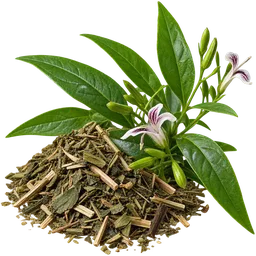
A century ago, a piercingly bitter herb quietly moved through clinics in India and China. Today, the same plant is under modern lights—randomized trials, meta-analyses, and even national programs—asking a simple question: does bitterness buy you better winters?
A bitter thread through time
You lift a teacup and wince—the taste is so sharp it feels like a bell rung on your tongue. That bell has a name: Andrographis paniculata, the "King of Bitters," long used across Ayurveda and Chinese medicine to cool fevers and soothe raw throats under the name Chuan Xin Lian. European agencies have cataloged its traditional uses, while Southeast Asian countries still cultivate it by the acre. Bitter wasn't a flavor; it was a strategy. 1214
When folk wisdom met clipboards
The modern story begins in Scandinavia in the 1990s with Kan Jang—an Andrographis–Eleutherococcus blend standardized for andrographolides, the plant's headline molecules. In schoolchildren taking two tablets daily through winter, the proportion catching a cold dropped from roughly 62% on placebo to 30% on Kan Jang by month three. Prevention here looked like patience—the benefit appeared after weeks, not days. 1 Other trials switched from prevention to speed: start at first sneeze. In adults with acute upper-respiratory infections, early Kan Jang for five days nudged recovery forward, reducing sick-leave time by about a fifth compared with placebo. Symptoms like sore throat and runny nose eased faster when treatment began in the opening 48 hours. 4 Zoom out and you see the meta-picture. A 2017 systematic review pooling 33 randomized trials (over 7,000 participants) reported that Andrographis preparations, alone or in formulas, improved cough and sore throat versus placebo and were generally well tolerated—but the authors flagged uneven study quality and variable products. Translation: real signal, messy edges. 10
The pandemic stress test
Thailand put the herb on an unlikely stage during COVID-19. Government programs approved Andrographis ("fah talai jone") for mild or asymptomatic cases amid drug shortages, while spokespeople emphasized it wasn't a vaccine or a shield, just a tool for early illness. Inmates treated during outbreaks, ministries issuing dose guidance—this was ethnobotany meeting emergency logistics. 1819 Randomized trials followed. In one quadruple-blind study, patients with mild COVID-19 taking Kan Jang for 14 days were less likely to deteriorate, cleared virus sooner, and recovered faster than placebo, though effects on markers like CRP were inconsistent across subsets. Another Thai RCT found ground-leaf Andrographis performed similarly to favipiravir for mild disease on key outcomes. Promising, yes—definitive, not yet. 2357
"If the label does not show the level of andrographolides, then don't use it." —Dr. Kitiyot, Chulalongkorn University, on choosing quality products. 21
An unexpected detour: the gut
While the winter story grew, gastroenterologists probed a different frontier—ulcerative colitis. An Andrographis extract (HMPL-004) outperformed placebo for clinical response at the higher dose over eight weeks in a 224-person trial; earlier work found it comparable to mesalamine in Chinese centers. The sequel, a large Phase III program, stopped for futility at interim—no clear advantage emerged. The lesson wasn't failure as much as humility: a plant can be helpful in one arena and underwhelm in another. 22232425
"Patients on 1,800 mg daily were more likely to achieve clinical response than placebo." —W. Sandborn, MD, lead author, American Journal of Gastroenterology (2013). 22
How might bitterness help?
Strip away the botanical poetry and you find ordinary immunology told vividly. During a cold, your body's alarm system can over-broadcast—more fire trucks than fire. Andrographolides seem to down that over-broadcasting, easing the throat's rawness and the nose's faucet without sedating you. Think of it as coaching the response rather than carpet-bombing microbes. That aligns with trials showing faster symptom resolution when started early. 410
The paradoxes of a popular herb
Popularity brings its own plot twists. Australia's medicines regulator (TGA) flagged two unusual safety signals in recent years: taste loss or distortion—sometimes taking weeks to normalize—and rare but severe allergic reactions, including anaphylaxis, occasionally in people who had previously tolerated the herb. Thailand's clinicians also noticed small rises in ALT liver enzymes among GI patients who self-medicated during the pandemic. None of this erases the cold-relief story; it simply sharpens the practice: choose standardized products, start early for infections, and stop immediately if taste vanishes or allergy signs appear. 151620
What this means for your winter strategy
For fast relief: Start a standardized Andrographis product at the first scratchy-throat moment; many trials used daily andrographolides around 60–90 mg for 5–10 days. 4
For prevention: Benefits appeared after sustained use—think months, not days—as in the school study where differences emerged by month three. 1
For COVID-19: Small to mid-sized RCTs suggest benefit in mild illness when started early, but this complements—not replaces—vaccination and guideline-based care. 237
For gut inflammation: Early promise met mixed later results; discuss with a gastroenterologist rather than self-experiment. 222425
The road ahead
Expect clearer maps, not miracles: better standardization (how much andrographolide per dose), head-to-head trials versus common over-the-counter cold medicines, and genetics of who's prone to allergy or taste effects. When that bitter bell rings this winter, you'll know what it's signaling—and how to listen wisely.
Key takeaways
What to walk away with
- 01
Trials suggest faster relief of sore throat/runny nose when started early; prevention needs weeks of use.
- 02
A 2017 meta-analysis supports symptom improvement but notes variable study quality.
- 03
Small RCTs in mild COVID-19 show benefits; use alongside standard care, not instead.
- 04
Safety watchouts: rare anaphylaxis, taste loss/distortion, and possible ALT rises in self-medicating patients.
- 05
Standardization matters—look for labeled andrographolide content.
Effect timeline
When to expect what
- Immediate
- Within hours
- Peak
- 3-5 days for acute colds; ~3 months for prevention
- Duration needed
- 5–10 days for acute illness; 8–12+ weeks for seasonal prevention
- Wears off
- Symptoms benefit fades within days after stopping; prevention effect wanes within 2–4 weeks
Research trajectory
What the studies actually show
-
Meta-analysis of 33 RCTs found Andrographis improved sore throat and cough vs placebo, with caveats about study quality. 10
Researchers pooled trials across languages to map the signal through methodological noise.
Supports use for acute upper-respiratory symptoms while pushing for better product standardization.
-
Early Kan Jang use shortened recovery and reduced sick-leave days in URTIs. 4
A quadruple-blind design captured the benefit of striking early in the illness arc.
Guides timing: start at first symptoms for best odds.
-
Quadruple-blind RCTs in mild COVID-19 showed lower progression and faster recovery with Kan Jang vs placebo; a Thai RCT found parity with favipiravir. 2
Pandemic conditions stress-tested the herb in real clinics.
Signals potential as an adjunct in early COVID-19, pending larger confirmatory trials.
Human trials
What real trials found
-
Rural Swedish school prevention trial: Kan Jang over winter lowered colds in month three versus placebo. 1
- Outcome
- Incidence 30% vs 62% after three months' use
- Why it matters
- Shows prevention requires sustained dosing and time to benefit
- Source
- Randomized, placebo-controlled trial in schoolchildren
-
Quadruple-blind RCT: Kan Jang in mild COVID-19 2
- Outcome
- Lower progression to severe disease; faster recovery vs placebo
- Why it matters
- Illustrates potential in early viral illness
- Source
- Multicenter randomized trial
-
Thai RCT: Andrographis powder vs favipiravir in mild COVID-19 3
- Outcome
- No significant difference across primary outcomes
- Why it matters
- Balances expectations; suggests comparability in mild disease
- Source
- Hospital-based randomized trial
Expert insights
Voices in the field
If the label does not show the level of andrographolides, then don't use it. 21
Patients with mildly to moderately active ulcerative colitis treated with Andrographis extract at 1,800 mg daily were more likely to achieve clinical response than those receiving placebo. 22
Practical guidance
Putting it to use
Who may benefit
Adults seeking non-sedating support for early colds or mild, early viral URTIs; individuals open to seasonal prevention with sustained use; patients discussing adjuncts with clinicians for mild COVID-19.
Who should avoid
History of severe allergic reactions or anaphylaxis to herbal products; prior allergy to Andrographis or Echinacea; those who previously experienced Andrographis-related taste loss; individuals with active, unstable liver disease without clinician oversight.
Dosing
For colds: products delivering ~60–90 mg andrographolides daily for 5–10 days; COVID-19 trials used ~90 mg/day for 14 days or 180 mg/day with powdered leaf regimens. Start within 48 hours of symptom onset for best effect.
Timing
Prevention benefits emerged after months, not weeks; acute relief appeared within the first 3–5 days when started early.
Quality
Choose standardized extracts with labeled andrographolide content and GMP manufacturing; avoid unlabeled 'proprietary blends.'
Cautions
Stop immediately if you develop altered or lost taste, hives, wheeze, throat tightness, or facial swelling; seek medical care. Monitor if you have liver disease, especially NAFLD, and avoid self-medicating for prevention.
A closing thought
Bitterness in nature often doubles as a warning. With Andrographis, it's a reminder to match respect with rigor: start early, choose well, and listen carefully for the rare signals that say, "not for me."
Frequently asked
Common questions
Does Andrographis prevent colds?
How fast might it help if I start at first symptoms?
Is it useful for COVID-19?
What dose should I look for?
What are the main risks?
Sources
- 1. Prevention of common colds with Andrographis paniculata dried extract. Pilot double-blind trial (1997)
- 2. Kan Jang in mild COVID-19: randomized, quadruple-blind trial (2023)
- 3. Andrographis powder vs favipiravir in mild COVID-19 (2023)
- 4. Early intervention with Kan Jang for URTIs: quadruple-blind RCT (2021)
- 5. Kan Jang in mild COVID-19: interim analysis (2022)
- 6. Controlled clinical study of standardized Andrographis extract in common cold (1996)
- 7. Andrographis extract in mild COVID-19 (medRxiv preprint) (2021)
- 8. Andrographis for children's colds vs Echinacea (Kan Jang) (2004)
- 9. Traditional uses summary (Herbal Reality, TCM/Ayurveda) (2023)
- 10. Systematic review/meta-analysis: Andrographis for acute RTIs (2017)
- 12. EMA HMPC assessment report on Andrographis folium (2014)
- 14. MedicineTraditions monograph (Chuan Xin Lian) (2025)
- 15. TGA safety advisory: taste disturbance with Andrographis (2020)
- 16. TGA 2024 update: allergic reactions including anaphylaxis (2024)
- 18. Thai Cabinet approves Andrographis for asymptomatic COVID-19 (2021)
- 19. Thai Newsroom: government support and cautions (2021)
- 20. Andrographis use and liver enzymes during COVID-19 in Thailand (2022)
- 21. Chulalongkorn University advisory (PRNewswire) (2025)
- 22. Andrographis extract (HMPL-004) in ulcerative colitis (AJG) (2013)
- 23. HMPL-004 vs mesalazine in UC (double-blind comparison) (2010)
- 24. Phase III HMPL-004 discontinued for futility (2014)
- 25. HMPL-004 prevents murine colitis via T-cell effects (preclinical) (2013)
1,120 words · 22 sources · Andrographis paniculata (King of Bitters)