New Bifidobacterium longum Published Apr 14, 2026
The Y-Shaped Ally: How Bifidobacterium longum Went From Nursery Clue to Whole-Body Candidate
Steadier stress response, gut comfort, and seasonal allergy relief with gentle immune support
Evidence summary
Bifidobacterium longum has the strongest human evidence for easing gut-brain symptoms in people with IBS, including lower depression scores and calmer limbic reactivity.
- Across 1 study (n=44), Bifidobacterium longum NCC3001 lowered depression scores and limbic reactivity in IBS patients.4
- Bifidobacterium longum subsp. infantis carries genes for human-milk oligosaccharide use, explaining dominance in breast-fed infants.
- Human studies remain small and strain-specific, so broad whole-body claims outrun the evidence.
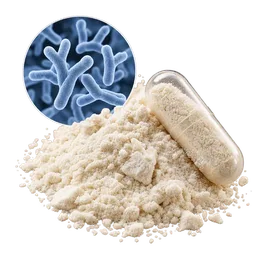
A century ago, a French pediatrician peered into an infant's stool and saw tiny Y-shaped microbes flourishing in breast-fed babies but missing in the sick. He suspected the difference mattered. Today, one of those Y-shaped natives—Bifidobacterium longum—keeps turning up in unexpected places: easing seasonal sniffles, softening stress signals in the brain, and, in some patients, subtracting the daily ache of an irritable gut. What changed between the nursery and now?
The first clue: a Y-shaped microbe in milk-fed babies
In 1899–1900, Paris pediatrician Henri Tissier isolated odd, forked bacteria from healthy, breast-fed infants and linked their absence to infant diarrhea. He called them "bifid," for their branched shape. The genus would later be formally named Bifidobacterium, with Bifidobacterium longum among its human-adapted members. Tissier's hunch—that these microbes helped keep babies well—set off a century of detective work. 1
Milk's secret handshake
Fast forward to 2008, when genome sleuthing revealed why certain bifidobacteria are so at home in early life: B. longum subspecies infantis carries a toolkit of genes that let it feast on human-milk oligosaccharides, complex sugars babies can't digest but their microbes can. Think of milk as passing a signed note to favored gut residents, inviting them to bloom and guard the nursery. 2 UC Davis researchers put it more colorfully: "Mothers are recruiting another life form to babysit their babies." The point wasn't poetry—it was strategy. Feed the right microbes; they, in , defend the gut lining and crowd out troublemakers. 3
From gut to brain: when bacteria quiet the alarm system
The plot thickened when clinicians asked whether specific B. longum strains could nudge the stress circuitry. In a placebo-controlled trial in people with IBS, six weeks of B. longum NCC3001 reduced depression scores and dampened the brain's response to negative emotional images on fMRI—like turning down a smoke alarm that had been too sensitive. Quality-of-life scores rose, even though core IBS symptoms didn't change in that small pilot. 4 A different strain, B. longum 1714, tested in healthy volunteers, blunted cortisol spikes during a lab stressor and slightly improved a hippocampus-dependent memory task after four weeks—subtle shifts, but consistent with the idea that certain microbes can take the edge off the stress response. Follow-up magnetoencephalography even captured altered neural rhythms during social stress. 56 Neuroscientist John Cryan, who helped pioneer the field, put it this way: "We might be able to get tailored treatments for people to manage their own mental health." The promise is individualization, not one-size-fits-all bugs. 16
The sore-stomach chapter: when strain and dose decide the story
If you've heard of B. longum, it may be because of the 35624 strain (formerly called B. infantis 35624). In a 4-week trial in women with IBS, 1×10^8 CFU/day relieved pain, bloating, and bowel dysfunction versus placebo; oddly, higher and lower doses didn't help, hinting that formulation and dose matter as much as species. 7 A larger U.S. study later found that 35624 improved abdominal discomfort and bloating in non-patients with frequent symptoms. 8 Taxonomy caught up in 2016: genome work reassigned 35624 from subspecies infantis to subspecies longum—same strain, better address—underscoring why labels evolve as science refines who's who. 9
The immune subplot: a sugar coat with a calming voice
On the immune front, B. longum 35624 wears a distinctive exopolysaccharide—a sugary jacket on its surface—that appears to talk immune cells down from overreaction. Knock out that coat in the lab, and dendritic cells pour out inflammatory signals; restore it, and the storm eases. In mouse colitis, the coated strain protected; the uncoated did not. It's a tidy illustration of why effects are strain-specific: two microbes with the same last name can wear very different uniforms. 10
Pollen season tests and elders in long-term care
Japan has treated Bifidobacterium as a daily companion for decades. In randomized trials during cedar-pollen season, B. longum BB536 reduced eye and nasal symptoms and cut rescue medication use. In an exposure-chamber study, BB536 also eased ocular scores during controlled pollen challenges. 11 In frail elders, 12 weeks of BB536 helped maintain natural killer (NK) cell activity versus placebo, and a small study reported fewer influenza cases during BB536 use. These are modest signals, but they hint at immune tuning rather than immune "boosting." 1213
What matters most: identity, dose, and time
Experts emphasize that probiotic benefits are tied to the exact strain, the dose that was tested, and the outcome measured. "A probiotic is defined by its genus, species and strain designation," notes Mary Ellen Sanders—so look for all three on a label. Clinical recommendations should link a specific strain and dose to a specific benefit. 14 Safety for the generally healthy is well supported, but live microbes can pose risks to people who are severely immunocompromised or have central lines; rare bloodstream infections have been reported in such settings. If that's you, ask a clinician first. 15
How people put B. longum to work
For stress and mood edges: human trials with 1714 ran four weeks; NCC3001 ran six weeks. Expect any effects to build over weeks, not hours. 54
For IBS-type discomfort: trials with 35624 often used one capsule daily for 4–8 weeks; some real-world cohorts extended to 12 weeks for greater gains. Results vary and are dose- and product-specific. 78
For seasonal allergies: BB536 trials spanned 13–14 weeks through pollen season or four weeks before controlled exposure. 11
Probiotics don't usually set up permanent residence in adults; benefits can fade after you stop. In infants, especially those fed human milk, certain B. longum subspecies can persist longer—a reminder that context (diet, age) shapes colonization. 1517
Where the trail leads next
Three threads stand out. First, precision: genome-level IDs (like the 35624 reclassification) will keep sharpening labels—and expectations. 9 Second, mechanisms: that exopolysaccharide "coat" shows how surface chemistry can change immune conversations, opening doors to postbiotic by-products with defined actions. 10 Third, mind–gut links: early trials suggest some B. longum strains can soften stress signatures and shift brain activity, but meta-analyses across many probiotic strains show mixed mood effects. The field is moving from "probiotics work" to "this strain, in this dose, for this person, for this goal." 564[^9_0] And we shouldn't forget the original nursery clue. Human milk seems to script the infant gut by feeding bifidobacteria first. The adult version of that script may be simpler: choose the right Y-shaped ally, give it time, and let it do quiet work—cooling alarms, easing edges, and, sometimes, changing the day.
Key takeaways
What to walk away with
- 01
Identity matters: specific B. longum strains drive different effects—from gut comfort to mood and immune calm—so buy by strain name, not just species.
- 02
Historical to modern link: infant-adapted genetics (milk-sugar use in subsp. infantis) explain early-life dominance and set the stage for later benefits.
- 03
Practical dosing: human trials commonly use 1×10^8–10^10 CFU/day for 4–12 weeks; match dose/strain to the studied outcome and be consistent.
- 04
Timing: take once daily, ideally with food; benefits tend to accrue over weeks rather than days.
- 05
Who may benefit: IBS-type discomfort (35624), gentler stress edges (1714 or NCC3001), and seasonal pollen symptoms (BB536) when taken through the trial window.
- 06
Safety first: if severely immunocompromised or with central lines, valvular disease, or recent major GI surgery, use only under medical supervision.
Effect timeline
When to expect what
- Immediate
- No
- Peak
- 4–6 weeks (some allergy protocols 8–12 weeks)
- Duration needed
- 4–12 weeks depending on goal and strain
- Wears off
- Often 1–4 weeks after stopping in adults; persistence longer in breastfed infants with HMO diet.
Research trajectory
What the studies actually show
-
B. longum subsp. infantis is genomically equipped to consume human-milk oligosaccharides, explaining dominance in breast-fed infants. 2
PNAS genome paper mapped HMO-use genes and framed microbe–milk co-evolution.
Reveals diet-microbe matchmaking and why early-life bifidobacteria thrive.
-
B. longum NCC3001 reduced depression scores and limbic reactivity in IBS patients over 6 weeks. 4
Placebo-controlled trial with fMRI readouts linked microbial intake to brain-level changes.
First human brain-imaging evidence for a B. longum strain's psychobiotic effect.
-
The 35624 strain's exopolysaccharide coat dampens pro-inflammatory responses and TH17 recruitment; removing it flips the immune reaction. 10
Isogenic mutant experiments in cells and mouse colitis pinpointed the EPS as the immune 'calmer.'
Mechanism clues for why some B. longum strains ease inflammatory tone.
Human trials
What real trials found
-
Women with IBS took B. infantis (now B. longum) 35624 for 4 weeks; 1×10^8 CFU/day reduced pain, bloating, and bowel dysfunction vs placebo. 7
- Outcome
- Symptom relief at a specific dose; higher dose failed—highlighting dose/formulation specificity.
- Why it matters
- Establishes a clinical signal for a named strain and dose.
- Source
- Whorwell et al., AJG, 2006
-
IBS patients received B. longum NCC3001 for 6 weeks; depression scores fell and fMRI showed reduced limbic reactivity. 4
- Outcome
- Improved mood and brain activity without large IBS symptom change.
- Why it matters
- Introduces gut-brain effects in a patient group.
- Source
- Pinto-Sanchez et al., Gastroenterology, 2017
-
Healthy volunteers took B. longum 1714 for 4 weeks; attenuated cortisol response to stress and small memory gains; neural oscillations shifted in follow-up study. 5
- Outcome
- Reduced stress signaling with subtle cognitive effects; brain activity changes during social stress.
- Why it matters
- Shows psychobiotic potential in non-patients.
- Source
- Allen et al., Translational Psychiatry, 2016; O'Connor et al., 2019
Expert insights
Voices in the field
"Mothers are recruiting another life form to babysit their babies." 3
"We might be able to get tailored treatments for people to manage their own mental health." 16
Practical guidance
Putting it to use
Who may benefit
Adults with IBS-type discomfort (35624), individuals facing seasonal pollen symptoms (BB536), and people seeking gentler stress edges (1714/NCC3001) who can commit 4–8+ weeks to a trial.
Dosing
Human trials commonly use 1×10^8–10^10 CFU/day of a named strain for 4–12 weeks (e.g., 35624 at 1×10^8 CFU/day for IBS; NCC3001 for 6 weeks; 1714 for 4 weeks; BB536 across a season). Match dose/strain to the studied outcome.
Timing
Take once daily, ideally with food, and give it a month to 'settle in.' Benefits grow by consistency, not urgency.
Quality
Look for full identity (genus–species–subspecies–strain), CFU through end-of-shelf-life, and published human trials for that strain/dose. Trusted guidelines stress strain-specificity.
Cautions
If you're severely immunocompromised, have a central venous catheter, valvular heart disease, or recent major GI surgery, use only under medical supervision due to rare infection risk with live microbes.
A closing thought
The microbe Tissier spotted beside the crib now shows up in brain scans and allergy diaries. The lesson isn't that one bacterium fixes everything—it's that identity and context matter. Feed the right ally, in the right dose, for the right task, and small, reliable nudges can accumulate into better days.
Frequently asked
Common questions
Which B. longum strains align with specific goals?
What dose and for how long should I take it?
When during the day should I take B. longum?
Who should avoid or use extra caution with B. longum?
How will I know if it's working?
Sources
- 1. Getting better with bifidobacteria (2005)
- 2. The genome sequence of Bifidobacterium longum subsp. infantis reveals adaptations for milk utilization (2008)
- 3. Decoding breast milk secret reveals clues to lasting health (UC Davis) (2014)
- 4. B. longum NCC3001 reduces depression scores and alters brain activity in IBS (2017)
- 5. B. longum 1714 as a translational psychobiotic (healthy volunteers) (2016)
- 6. B. longum 1714 modulates brain activity during social stress (2019)
- 7. Efficacy of B. infantis 35624 in women with IBS (2006)
- 8. Benefit of B. infantis 35624 for abdominal discomfort/bloating in non-patients (2017)
- 9. Genome analysis of B. longum subsp. longum 35624 (formerly infantis) and EPS characterization (2016)
- 10. Surface exopolysaccharide of B. longum 35624 dampens proinflammatory responses (2016)
- 11. Probiotics in the treatment of Japanese cedar pollinosis (BB536) (2006)
- 12. Clinical effects of B. longum BB536 on immune function in elderly receiving enteral feeding (2012)
- 13. Effects of B. longum BB536 on influenza infection and immunity in the elderly (2010)
- 14. World Gastroenterology Organisation Global Guidelines: Probiotics and Prebiotics (2024) (2024)
- 15. NIH ODS: Immune function and infectious diseases—Safety of probiotics (2024)
- 16. Gut feelings: drugs that nurture microbes could shape mental health (Cryan) (2023)
- 17. Persistence of supplemented B. infantis in breastfed infants (EVC001) (2017)
1,120 words · 17 sources · Bifidobacterium longum