New Chlorella Published Apr 4, 2026
The Algae That Almost Fed the Future—and What It Really Does for Us Now
Gentle cholesterol and blood pressure support, immune system boost, and B12 for vegans
Evidence summary
Chlorella most consistently improves cardiometabolic risk markers in adults across trials, especially LDL cholesterol, total cholesterol, blood pressure, and fasting glucose.
- Across 19 RCTs, Chlorella lowered LDL cholesterol, total cholesterol, blood pressure, and fasting glucose, with bigger effects above 4 g/day 4.
- In healthy adults, eight weeks of supplementation raised natural killer cell activity and key immune cytokines versus placebo.
- Baseline gut microbes and metabolites shaped individual responses, so Chlorella benefits were not uniform.
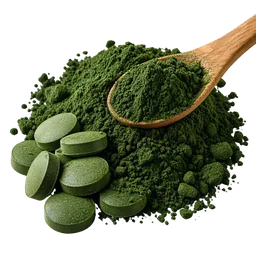
In the anxious years after World War II, scientists imagined algae farms perched on skyscrapers, piping emerald paste into kitchens to end world hunger. The star ingredient was a tiny freshwater sphere named Chlorella—so efficient at turning light into food that policy makers briefly considered it a planetary rescue plan. Then came reality, and even a memorable nickname: "the gag factor."116
From moonshot to breakfast scoop
Chlorella's story begins in 1890, when Dutch microbiologist Martinus Beijerinck first described the green, single-celled alga and learned to grow it in pure culture—a small act that later powered both photosynthesis research and big dreams of feeding the world.15 In the late 1940s–50s, algae—especially Chlorella—caught the imagination of foundations and universities as an ultra-efficient protein source. Historian Warren Belasco chronicled that fervor: pilot plants, sober editorials, even talk of "algae burgers."1 NASA engineers tested algae-based life-support loops, pairing animals with algal bioreactors to swap carbon dioxide for oxygen—primitive rehearsals for closed habitats on future missions.220 But the rescue plan met two obstacles. First, economics and flavor: as one science historian quipped, early tasters spoke of the "gag factor."16 Second, farming algae at scale proved harder than a petri dish suggested. The food dream receded. Yet the organism remained—nutrient-dense, chlorophyll-rich, and oddly versatile. Today, instead of replacing farms, Chlorella shows up in powders and tablets, tackling specific, testable problems.
What the best trials show
When researchers pooled 19 randomized trials (797 people), daily Chlorella modestly lowered total and LDL cholesterol, systolic and diastolic blood pressure, and fasting glucose—especially at doses above 4 g/day for eight weeks or more.4 A newer analysis focused on lipid outcomes found consistent LDL and total cholesterol reductions (triglycerides and HDL unchanged).6 Not all meta-analyses agree; a 2023 review combining Spirulina and Chlorella trials judged Chlorella's effects on blood pressure and lipids overall neutral—reminding us that strains, doses, and study populations matter.5 If you zoom into single trials, you see mechanisms you can feel. In mildly high cholesterol, 5 g/day for four weeks not only nudged cholesterol down but spiked blood carotenoids like lutein and zeaxanthin—pigments that act like dietary sponges for cholesterol in the gut.7 It's a vivid way to translate lab talk: Chlorella seems to slip more traffic cops (carotenoids) onto the intestinal highway where cholesterol merges.
The immune subplot: quiet upgrades
Short, careful trials suggest Chlorella can tune the immune orchestra without blasting the speakers. In healthy adults, eight weeks of tablets increased natural killer cell activity (our early-response anti-viral/cancer sentinels) and nudged immune signaling molecules upward compared with placebo.8 Four weeks of a Chlorella-derived supplement boosted salivary IgA—the antibody that guards our mouth and gut mucosa.9 And in a striking Japanese study, pregnant women who took Chlorella during gestation had lower dioxin levels in breast milk and higher IgA, hinting that the algae's dense nutrients and fibers may trap certain pollutants while enriching immune factors passed to infants.10
The vegan paradox: an algae with real B12
Many algae carry look-alike forms of vitamin B12 that don't work in humans. Chlorella appears to be an exception in some preparations. In B12-deficient vegetarians and vegans, 9 g/day for two months significantly lowered methylmalonic acid—a functional marker of B12 deficiency—suggesting the B12 present was bioavailable.11 It's an open-label study, funded by industry, so we treat it as a signal, not a verdict. Still, it's a rare, hopeful data point in the "plant B12" debate, now joined by research showing responses depend on the gut you bring to the supplement: in a randomized study, benefits varied with each person's microbiome and baseline metabolites.12
How to use it so it works
Chlorella's nutrients sit behind a tough cell wall—nature's armored door. Modern processing cracks or pulverizes that wall, improving access to pigments like lutein; even high-pressure "microfluidization" has been shown to boost lutein release and uptake in intestinal cell models.19 Practical translation:
Aim for 3–5 g/day with meals for eight to twelve weeks if your goal is LDL/BP or general metabolic support; that aligns with trials showing benefits.47
If you're chasing immune nudges (NK cells, mucosal IgA), four to eight weeks is the window most studies used.89
For B12 support (especially if vegan), some evidence used 9 g/day; monitor blood markers with your clinician rather than assuming.11
Quality matters. Look for "broken" or "pulverized" cell-wall Chlorella from producers that publish heavy-metal and microbiological testing; safety is a key gate for microalgae foods, and reputable makers treat it that way.3
Cautions that actually matter
Because Chlorella is rich in vitamin K, it can reduce the effect of warfarin; dose adjustments and consistent vitamin K intake are the rule—there's even a case report of diminished anticoagulation after starting Chlorella.1314 Some people report photosensitivity; general advice is to be cautious if you're on medications that already increase sun sensitivity.14 As with any whole-food concentrate, allergens are possible. If you're pregnant, note that a small Japanese trial found fewer cases of anemia, proteinuria, and edema with 6 g/day from the second trimester—promising, but one study isn't policy.18
The future, again—only humbler
The algae that almost fed the future may yet help feed future astronauts: closed-loop life-support research continues to revisit algae as oxygen makers, water polishers, and even food in sealed habitats.220 On Earth, the most compelling vision is smaller: tailoring algae to people. As UC San Diego's Stephen Mayfield put it, "The only way to avoid a really bleak future is to start transitioning now to a much more sustainable future, and algae as food is one of those transitions."3 And from an earlier era of algae pioneers, a line worth keeping: "William Oswald was a man ahead of his time," recalled a colleague of the engineer who built spinning algal life-support prototypes in the 1960s.17 Between those quotes lies a practical sweet spot: not algae burgers, not miracle claims—just a dense green cell that, in the right hands, can nudge cholesterol down, support frontline immunity, and—sometimes—solve a vegan's B12 riddle. That's less dramatic than saving the world. It's also more useful.
Key takeaways
What to walk away with
- 01
Across 19 RCTs, chlorella modestly reduced LDL/total cholesterol, systolic/diastolic BP, and fasting glucose—especially at >4 g/day for at least 8 weeks.
- 02
Eight weeks of supplementation increased natural killer cell activity and key immune cytokines versus placebo in healthy adults, suggesting subtle immune support.
- 03
Benefits can be person-specific: a randomized study found responses depended on baseline gut microbes and metabolites.
- 04
Practical use: 3–5 g/day with meals for 8–12 weeks, then reassess labs; daily consistency matters more than exact timing.
- 05
Best fit: people with mildly elevated LDL/BP, vegans monitoring B12, and those seeking gentle immune support; pregnancy use should be clinician-guided within whole-food, iron/folate-rich plans.
- 06
Cautions: coordinate INR checks if on warfarin (vitamin K can blunt its effect) and add sun precautions with photosensitizing drugs.
Effect timeline
When to expect what
- Immediate
- No
- Peak
- 4–12 weeks
- Duration needed
- 8–12 weeks minimum for cardiometabolic and immune endpoints; 8+ weeks for B12 markers
- Wears off
- Often within 2–4 weeks after stopping, based on gene-expression patterns returning toward baseline post-intake.
Research trajectory
What the studies actually show
-
Across 19 RCTs, Chlorella reduced LDL and total cholesterol, systolic/diastolic BP, and fasting glucose—especially >4 g/day for ≥8 weeks. 4
Large meta-analysis aggregated diverse populations and doses.
Establishes dose/duration thresholds for cardiometabolic effects.
-
In healthy adults, eight weeks of supplementation increased natural killer cell activity and key immune cytokines vs placebo. 8
Randomized, double-blind trial measured immune function directly, not just symptoms.
Supports a modest, measurable immune-support role without overstating it.
-
Chlorella's benefits can be person-specific; in a randomized study, responses depended on baseline gut microbes and metabolites. 12
'Responder' vs 'non-responder' patterns emerged in microbiome-anchored analyses.
Explains mixed results and points toward personalized use.
Human trials
What real trials found
-
Pregnant women taking Chlorella had lower dioxins in breast milk and higher IgA. 10
- Outcome
- Lower dioxin toxic equivalents in milk; higher immune IgA passed to infants.
- Why it matters
- Human, real-world exposure reduction with immune benefit for newborns.
- Source
- Journal of Medicinal Food (2007)
-
B12-deficient vegans/vegetarians took 9 g/day Chlorella for 60 days. 11
- Outcome
- Methylmalonic acid fell ~34% on average, signaling improved B12 status.
- Why it matters
- Addresses a classic vegan micronutrient gap with a whole-food source.
- Source
- Journal of Medicinal Food (2015)
-
Japanese pregnancy trial using 6 g/day from mid-pregnancy to delivery. 18
- Outcome
- Lower risk of anemia, proteinuria, and edema vs controls.
- Why it matters
- Suggests a pragmatic prenatal application; needs replication.
- Source
- Plant Foods for Human Nutrition (2010)
Expert insights
Voices in the field
The only way to avoid a really bleak future is to start transitioning now to a much more sustainable future, and algae as food is one of those transitions. 3
William Oswald was a man ahead of his time. He developed and demonstrated sustainable technology decades before sustainability became a popular goal. 17
People who tried to eat algae talked about the Gag Factor. 16
Practical guidance
Putting it to use
Who may benefit
People with mildly elevated LDL/BP seeking small adjunctive improvements; vegans needing B12 monitoring/help; those wanting subtle immune support (e.g., frequent colds) without stimulants; pregnant individuals working with clinicians on iron- and folate-rich whole-food options.
Who should avoid
Chlorella-rich vitamin K may complicate warfarin therapy; adjust only under supervision.
Dosing
For lipids/BP or glucose, practical ranges in trials were 4–5 g/day; consider 3–5 g/day with meals for 8–12 weeks, reassessing labs thereafter.
Timing
Take with meals to aid carotenoid absorption; continuous daily intake matters more than timing. Expect changes to appear after several weeks, not days.
Quality
A closing thought
Chlorella didn't become the universal meal of tomorrow. That's good news. Instead, we've learned to match a simple organism with human nuance—labs that verify purity, doses that respect biology, and a willingness to measure what matters. In a noisy wellness world, that quiet discipline is its own kind of sustenance.
Frequently asked
Common questions
How much chlorella should I take and how long until I notice changes?
Does chlorella actually lower cholesterol or blood pressure?
Should I take chlorella with meals or on an empty stomach?
Who is most likely to benefit from chlorella?
Are there any important drug interactions or cautions?
How should I evaluate whether it's working for me?
Related
More on this supplement
Pulled from across the site — rankings, comparisons, combinations, and reviews where this supplement shows up.
Sources
- 1. Algae Burgers for a Hungry World? The Rise and Fall of Chlorella Cuisine (1997)
- 2. Controlled Ecological Life Support System. Life Support Systems in Space Travel (1985)
- 3. Microalgae—the future of superfoods? (Mayfield quote) (2023)
- 4. Effect of Chlorella supplementation on cardiovascular risk factors: meta-analysis of RCTs (2017)
- 5. The Role of Chlorella and Spirulina as Adjuvants of Cardiovascular Risk Factor Control: Systematic Review and Meta-analysis (2024)
- 6. Effect of supplementation with Chlorella vulgaris on lipid profile in adults: systematic review and dose–response meta-analysis (2022)
- 7. Impact of daily Chlorella consumption on serum lipid and carotenoid profiles (2014)
- 8. Beneficial immunostimulatory effect of short-term Chlorella supplementation (NK cells): RCT (2012)
- 9. Salivary SIgA increases after 4-weeks ingestion of chlorella-derived supplement: randomized crossover study (2011)
- 10. Chlorella supplementation decreases dioxin and increases IgA in breast milk (2007)
- 11. Chlorella supplementation lowers methylmalonic acid in vegans/vegetarians with suspected B12 deficiency (2015)
- 12. The Nutritional Efficacy of Chlorella Depends on the Individual Gut Environment: Randomised Control Study (2021)
- 13. Warfarin and food, herbal or dietary supplement interactions: systematic review (2021)
- 14. Chlorella: Overview, Uses, Precautions, Interactions, Dosing (2025)
- 15. Chlorella—Encyclopedia of Life (Beijerinck 1890) (2024)
- 16. Algae Burgers—The Engines of Our Ingenuity (University of Houston) (1997)
- 17. William Oswald obituary (UC Berkeley News) (2005)
- 18. Chlorella supplementation reduces risk of anemia, proteinuria, edema in pregnancy (2010)
- 19. Effect of microfluidization on lutein micellization and intestinal uptake from Chlorella vulgaris (2011)
- 20. Closed Ecological Life Support Systems—National Academies (1991) (1991)
1,136 words · 20 sources · Chlorella