New L-Ergothioneine Published Apr 19, 2026
The Missing Passenger: How a Forgotten Amino Acid Walked Through the Body's VIP Door
Potential cellular resilience (oxidative stress defense) with early human evidence for sleep initiation and skin hydration; observational links to cardiovascular and cognitive aging.
Evidence summary
Ergothioneine is a dietary amino acid that human cells actively import and concentrate, and its strongest signal is an association with lower cardiovascular risk and mortality.
- Higher plasma ergothioneine tracked with lower cardiovascular disease and all-cause mortality in prospective cohorts.7
- Human ETT/SLC22A4 transporter avidly concentrates ergothioneine into cells; uptake is minimal without the transporter.1
- Early randomized trials reported better subjective sleep and skin hydration, while 16-week cognitive results stayed mixed.6
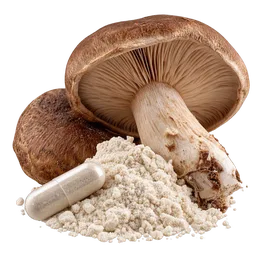
Humans don't make L-ergothioneine—yet we evolved a gated "express lane" to pull it from food and stash it in our most vulnerable tissues. Why build a door for a nutrient we never manufacture? 1
The transporter with no obvious cargo
In 2005, pharmacologists finally cracked a small mystery. A membrane protein, long mislabeled OCTN1, behaved oddly—it barely moved its supposed cargo. Then came the reveal: this transporter's true passenger was L-ergothioneine, a rare amino-acid-like compound we must eat. The team renamed it ETT, the ergothioneine transporter. It's highly efficient, sodium-powered, and placed like a red-carpet entrance in the gut, kidney, bone marrow, and immune cells—sites where the body seems determined to import and hold this molecule. In animals, once inside, it lingers for weeks. 1
A thread from ergot to porcini
Ergothioneine's story began in 1909, when Charles Tanret isolated it from ergot fungus. Today we know it's made by certain fungi and bacteria and rises through the food web—mushrooms at the top, with oats, beans, and some organs carrying smaller amounts. Several culinary mushrooms—porcini, shiitake, oyster, and king trumpet—can pack the highest levels. 2 3 4 If you sauté mushrooms, you don't fry away their secret. Ergothioneine is unusually stable to heat and pH, and in people it shows up quickly in red blood cells and sticks around—some researchers even track it as a biomarker of mushroom intake. 5
Why would we build a VIP door?
The body usually reserves special transporters for essentials. That's why biochemist Bruce Ames suggested a new category: "longevity vitamins"—dietary compounds we need not for short-term survival, but for long-term maintenance. Ergothioneine made his shortlist. 6 What makes it special isn't brute antioxidant strength; it's poise. Ergothioneine behaves like a patient bodyguard: it resists self-oxidation, can be recycled, and accumulates where damage tends to flare—red blood cells ferrying oxygen, bone marrow forging them, and tissues exposed to sun, smoke, or inflammation. 1 5
What the human clues suggest
Think of the evidence as a map with bright clusters and dim stretches.
A 21-year Swedish cohort tied higher plasma ergothioneine to lower risks of coronary disease and death. Each standard-deviation increase linked to reduced cardiovascular and all-cause mortality. Associations don't prove causation, but the signal was hard to ignore. 7
U.S. nutrition data showed mushroom eaters had lower odds of depression, possibly reflecting ergothioneine's role as a dietary anti-inflammatory. Again, association—not prescription. 8
In pregnancy, women whose early-pregnancy ergothioneine levels sat above a high threshold were far less likely to develop preeclampsia, hinting that achieving truly high circulating levels might matter. Intervention trials are now warranted. 9
Then come the first randomized trials. In 2025, a 16-week, double-blind study in older adults with memory complaints tested 10 or 25 mg/day. Objective cognitive gains were modest, but two signals stood out: dose-dependent improvements in getting to sleep and in subjective prospective memory at 25 mg/day. Blood levels rose three- to sixteen-fold, confirming excellent uptake. 10 A pharmacokinetic-guided trial estimated that about 8 mg/day for 16 weeks could also improve subjective sleep. 11 Beyond the brain, a 12-week study using a mushroom strain rich in ergothioneine (≈25 mg/day EGT) improved skin moisture versus placebo. 12 These are not miracle-cure results; they're puzzle pieces. Together with the transporter story, they suggest the body values ergothioneine enough to stock it—especially over weeks—while clinical effects emerge first in softer endpoints like sleep initiation and skin hydration.
Voices from the field
"ERGO is a little-known but potent antioxidant.. found naturally in our food that shows promise to help save us from many of the chronic inflammatory diseases that plague us today." — Robert Beelman, Penn State. 16
"Unlike some compounds that have been tested, it also seems to go into the brain." — Barry Halliwell, National University of Singapore. 17
The soil surprise
Here's a twist: plants don't make ergothioneine; they borrow it from soil fungi. When fields are aggressively tilled, those fungal networks fray—and the ergothioneine content of grains can drop by roughly a third. That's an ecological footnote with a human echo: populations consuming more ergothioneine (for example, in parts of Europe) often show lower rates of certain age-related diseases, though many diet and lifestyle differences tangle that picture. 18 19
How it likely works (no jargon required)
Think of reactive by-products of metabolism as sparks. Most of the time, our internal sprinklers (like glutathione) handle them. Ergothioneine is the fire blanket tucked where sparks are common. It doesn't rust or smoke while waiting; when used, it can be re-readied. 1 5
The dedicated transporter is like a bouncer checking IDs; without ETT, ergothioneine barely enters cells. With ETT, it concentrates in red cells and selected tissues—an elegant hint of biological priority. 1 20
In the brain, transporters even show up at sites tied to dopamine and mitochondria, offering a plausible route for neuroprotection that researchers are now probing. 21
What you can do right now
Eat the sources: Make mushrooms a regular guest (shiitake, oyster, king trumpet, porcini when you can), plus whole-grain and legume staples. Cooking won't erase ergothioneine. 3 4 6
If you supplement: Early trials used 8–25 mg/day for 8–16 weeks. Regulatory bodies have reviewed intakes up to 30 mg/day as safe for the general population, with wide safety margins. Choose products that disclose "L-ergothioneine," show third-party testing, and note FDA GRAS or EFSA Novel Food status. 10 11 13 14 15
Patience matters: Expect measurable blood-level changes within weeks; subjective sleep or skin changes often appear by weeks 8–12 in studies. 10 11 12
What we still don't know
Is ergothioneine truly a vitamin, or just vitamin-like for long-term maintenance? The transporter argues "important," while trials so far say "promising but not proven" for hard clinical outcomes. Larger, longer studies (for cognition, cardiovascular events, pregnancy outcomes) are in motion. Until then, mushrooms plus prudent dosing offer a grounded, low-risk way to explore its benefits. 6 9 10
Key takeaways
What to walk away with
- 01
- 02
- 03
- 04
- 05
Effect timeline
When to expect what
- Immediate
- No
- Peak
- 8–12 weeks
- Duration needed
- 8–16 weeks minimum; longer for cognition outcomes
- Wears off
- Gradually over 2–4 weeks after stopping (inferred from retention data).
Research trajectory
What the studies actually show
-
A dedicated human transporter (ETT/SLC22A4) avidly concentrates ergothioneine into cells; without it, uptake is minimal. 1
In 2005, researchers re-identified OCTN1's true cargo as ergothioneine and mapped expression to gut, kidney, bone marrow, and immune lineages.
Implies evolutionary priority and targeted distribution.
-
Mushrooms deliver the highest dietary ergothioneine; cooking preserves it; blood levels rise after intake and persist. 5
Food chemistry surveys, human post-prandial tracking, and stability studies converge on mushrooms as prime sources.
Supports dietary strategies and compliance tracking.
-
Higher plasma ergothioneine tracks with lower CVD and overall mortality in prospective cohorts. 7
Untargeted metabolomics in a long-running Swedish study spotlighted ergothioneine as the strongest dietary marker tied to healthier aging.
Strengthens the case for ergothioneine as a maintenance nutrient.
-
Early RCTs show improvements in subjective sleep and skin hydration; cognitive outcomes are mixed over 16 weeks. 10
Dose-ranging supplementation (8–25 mg/day) increased blood levels and nudged sleep initiation; mushroom-derived ergothioneine improved skin moisture.
Places ergothioneine in the 'promising, not proven' category for functional benefits.
-
Soil tillage can reduce ergothioneine in crops by ~30%, linking agricultural practice to human micronutrient exposure. 18
Penn State agronomy experiments compared no-till vs. conventional tillage across oats, corn, and soy.
Healthy soils may quietly feed healthy aging via fungal nutrients.
Human trials
What real trials found
-
21-year cohort: higher ergothioneine associated with lower coronary disease and mortality. 7
- Outcome
- Each SD increase in plasma ergothioneine linked with reduced CVD and all-cause mortality risk.
- Why it matters
- Population-level clue connecting ergothioneine status with healthy aging.
- Source
- Swedish prospective cohort (n≈3,000).
-
Older adults with memory complaints took 10 or 25 mg/day for 16 weeks. 10
- Outcome
- Modest objective cognitive effects; improved sleep initiation and subjective prospective memory at 25 mg; dose-dependent rise in blood levels.
- Why it matters
- First dose-ranging human RCT on cognition/sleep.
- Source
- Randomized, double-blind, placebo-controlled trial (MDPI Nutraceuticals, 2025).
-
EGT-rich Pleurotus (≈25 mg/day EGT) for 12 weeks in healthy women. 12
- Outcome
- Improved skin moisture vs placebo at week 8/12.
- Why it matters
- Demonstrates a tangible, non-cognitive benefit in humans.
- Source
- Randomized, double-blind trial.
-
Early-pregnancy plasma ergothioneine and preeclampsia risk in first-time mothers. 9
- Outcome
- Only 1% with very high ergothioneine developed preeclampsia vs 24% below threshold; warrants intervention trials.
- Why it matters
- Unexpected application in obstetrics; hypothesis-generating.
- Source
- Analysis of 432 women in the SCOPE cohort.
Expert insights
Voices in the field
ERGO is a little-known but potent antioxidant... found naturally in our food that shows promise to help save us from many chronic inflammatory diseases. 16
Unlike some compounds that have been tested, it also seems to go into the brain. 17
Practical guidance
Putting it to use
Who may benefit
Healthy-aging seekers with low mushroom intake; adults 55+ curious about subjective memory and sleep initiation; skin-health enthusiasts; populations with limited dietary fungal exposure; researchers and clinicians exploring cardiometabolic and pregnancy risk markers.
Dosing
Human trials used 8–25 mg/day for 8–16 weeks; regulatory reviews support supplemental intakes up to ~30 mg/day for the general population. Start at 5–10 mg/day; consider 25 mg/day for targeted sleep/subjective memory endpoints used in trials.
Timing
Consistency beats clock time; ergothioneine accumulates over weeks. If exploring sleep initiation, take in the first half of the day for tolerance, then adjust based on personal response reported in trials.
Quality
Look for L-ergothioneine with third-party testing and clear dose per serving. GRAS/Novel Food notices signal quality oversight. 'Nature-identical' fermentation sources avoid allergens present in mushroom concentrates.
Cautions
Human studies did not raise safety concerns at tested doses; a 2017 EFSA opinion extended safety to pregnancy, lactation, infants and toddlers under specified intakes. One RCT showed no rise in TMAO. As always, coordinate with your clinician if you manage chronic conditions or medications.
A closing thought
Sometimes evolution leaves us breadcrumbs. A door placed in our cells for a nutrient we don't make suggests a long relationship with fungi and soil. Whether we call ergothioneine a vitamin or not, the story nudges us toward a simple ethic: eat closer to ecosystems that quietly sustain us—and let careful trials, not hype, reveal the rest.
Frequently asked
Common questions
Is L-ergothioneine a vitamin?
How much ergothioneine do mushrooms provide—and does cooking destroy it?
What dose should I consider if I supplement?
How soon might I feel anything?
Is it safe with medications or during pregnancy?
Related
More on this supplement
Pulled from across the site — rankings, comparisons, combinations, and reviews where this supplement shows up.
Sources
- 1. Discovery of the ergothioneine transporter (ETT/SLC22A4) (2005)
- 2. Ergothioneine, where are we now? (2022)
- 3. Mushrooms: a rich source of the antioxidants ergothioneine and glutathione (2017)
- 4. Occurrence, dietary sources, quantification and bioactivities of natural antioxidant ergothioneine – A longevity vitamin? (2024)
- 5. Mushrooms & Health Summit Proceedings (ergothioneine bioavailability, RBC uptake, stability) (2014)
- 6. Prolonging healthy aging: Longevity vitamins and proteins (2018)
- 7. Ergothioneine is associated with reduced mortality and decreased risk of cardiovascular disease (2019)
- 8. Mushroom intake and depression: a population-based study using NHANES 2005–2016 (2021)
- 9. Relationship between plasma ergothioneine and risk of pre-eclampsia (2023)
- 10. Ergothioneine supplementation and cognitive function, memory, and sleep in older adults: randomized, placebo-controlled trial (2025)
- 11. PBPK-guided dosing: 8 mg/day ergothioneine improves subjective sleep over 16 weeks (2024)
- 12. Ergothioneine-rich Pleurotus sp.: RCT on skin moisturizing and facial conditions (2025)
- 13. FDA GRAS Notice GRN 734: Ergothioneine (no-questions letter) (2018)
- 14. EFSA: Safety of synthetic L-ergothioneine as a novel food (2016)
- 15. EFSA supplemental opinion: safety for infants, toddlers, pregnant and breastfeeding women (2017)
- 16. Is a little-known amino acid in mushrooms key to healthy aging? (2021)
- 17. Mush-room for further longevity antioxidant research (interview) (2020)
- 18. Soil tillage reduces availability of 'longevity vitamin' ergothioneine in crops (2022)
- 19. Is ergothioneine a 'longevity vitamin' limited in the American diet? (2020)
- 20. The ergothioneine transporter (ETT): substrates and locations, an inventory (2022)
- 21. Ergothioneine in the brain (2022)
1,095 words · 21 sources · L-Ergothioneine